
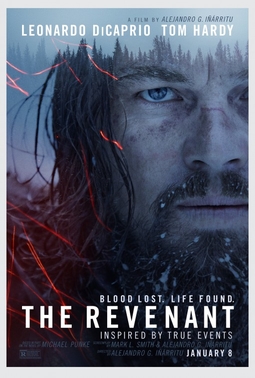
Behind the film
- Year
- 2015
- Director
- Alejandro González Iñárritu
- Writers
- Mark L. Smith, Alejandro González Iñárritu
- Runtime
- 2h 36m
- Genres
- Western, Survival, Thriller, Drama
- Production
- Regency Enterprises, New Regency Productions, Anonymous Content
- Country
- United States
- Cast
- Leonardo DiCaprio, Tom Hardy, Domhnall Gleeson, Will Poulter, Forrest Goodluck
About the film
Contains story spoilers.
The Revenant follows Hugh Glass, a frontiersman guiding a trapping party through the Great Plains in 1823. An Arikara war party attacks the group while seeking the chief’s abducted daughter, Powaqa; many trappers are killed, and the survivors escape by boat. Glass and his Pawnee son Hawk are part of the company led by Captain Andrew Henry. The film begins with the threat of violence from several directions rather than presenting the wilderness as empty. Its setting is shaped by competing armed groups and a fur expedition moving through contested land, and Glass’s family history is entwined with that conflict.
After the group leaves the river and hides its pelts, Glass is mauled by a bear while scouting. His injuries leave him unable to travel, and Henry offers money to anyone who will stay and bury him after he dies. Hawk and the young Jim Bridger volunteer, and John Fitzgerald agrees to remain too. Fitzgerald argues that the party needs to keep moving and sees the payment as an opportunity, but his plan changes after the others leave. He tries to smother Glass; Hawk intervenes, and Fitzgerald kills him while Glass can only watch. The film makes this moment the personal center of Glass’s pursuit. The bear attack nearly kills him, but the murder of his son gives his survival a direction.
Fitzgerald persuades Bridger to leave by claiming the Arikara are approaching, then abandons Glass half-buried in a makeshift grave. Bridger does not know Fitzgerald has killed Hawk. Glass drags himself out and begins moving through the cold landscape, crossing rivers and forests with wounds that make even basic movement painful. He finds a Pawnee man named Hikuc, who helps him recover and gives him food. The two men share a brief passage of care before Hikuc is killed by French Canadian hunters. Glass then encounters the hunters’ camp, frees Powaqa, and takes a horse. Those scenes widen the story beyond revenge: Glass’s route crosses other people’s efforts to survive, and he sometimes acts in their defense.
The journey becomes a series of physical improvisations. Glass hides from armed men, uses the terrain to evade pursuit, and survives a fall over a cliff by sheltering inside a horse carcass during a blizzard. The film does not turn these feats into proof that he is invincible; each one leaves him injured, exhausted or colder. Fitzgerald and Bridger reach the fort ahead of him, where Fitzgerald falsely tells Henry that Glass died and Hawk vanished. Bridger is complicit in the false account of Glass’s death but still does not know that Fitzgerald murdered Hawk. A French survivor reaches the fort carrying Bridger’s recognisable canteen, which Glass left at the hunters’ camp. Henry launches a search, initially hoping to find Hawk. Fitzgerald understands that Glass may be alive, steals the outpost’s money and flees. The searchers find Glass, who explains the murder and defends Bridger as a man Fitzgerald deceived.
Glass and Henry leave the fort together to pursue Fitzgerald. After they split up, Fitzgerald ambushes and kills Henry, then scalps him. Glass uses Henry’s body as a decoy on horseback, taking a concealed position from which he can wound Fitzgerald. Their pursuit ends in a brutal fight beside a river. Seeing the Arikara downstream, Glass remembers Hikuc’s belief that vengeance belongs beyond his own hands and pushes the injured Fitzgerald toward them. Chief Elk Dog kills Fitzgerald, while the group, now reunited with Powaqa, passes Glass without killing him. Glass is left alone with a vision of his wife and the weight of what has happened. Survival has brought him to the end of the pursuit, but it has not restored his family.
The film draws on the historical Hugh Glass story and Michael Punke’s novel, but its plot includes substantial fictional invention, most notably Glass’s son Hawk and the revenge-driven relationship with Fitzgerald. Its approach to landscape is central to the storytelling: long views of rivers, snow and forest repeatedly make the characters seem small beside the distance they must cross. The camera stays close to Glass’s damaged body in the same sequences, so the environment is both a vast panorama and a series of immediate obstacles. That mix gives the journey its force without presenting the screenplay as a reliable biography of the real Glass.
The historical background needs a careful boundary. The real Hugh Glass survived a bear attack and traveled a long distance after being left behind, but the film’s Hawk and its central revenge plot are screenplay inventions. That distinction matters because the movie’s emotional engine depends on a father watching his son die, not on a documented historical relationship. The story also frames Indigenous characters through its dramatic conflict, so the Arikara’s search for Powaqa and Hawk’s Pawnee heritage are part of the film’s fictional arrangement of people and motives. Its wintry survival journey can be discussed as a film story without treating its scenes as an exact record of frontier history.
Small objects make the long journey legible without providing a comfortable route through it. Bridger’s canteen is both a trace of the young man’s concern and the clue that eventually reveals Glass’s survival. Hiding the pelts preserves part of the expedition’s commercial purpose even as the party breaks apart; Fitzgerald’s resentment about that loss helps explain why money continues to matter during an emergency. Glass’s wounds require immediate improvisation, from sealing damaged flesh to finding shelter for a fever. Hikuc’s brief companionship offers food and care outside the trapping company’s bargains. The horse carcass provides a grim shelter after another escape costs Glass the animal carrying him. In these episodes, the landscape never pauses for his grief. Each useful thing has to be carried, recovered, concealed or surrendered, and even returning to the fort only changes the form of the danger.