
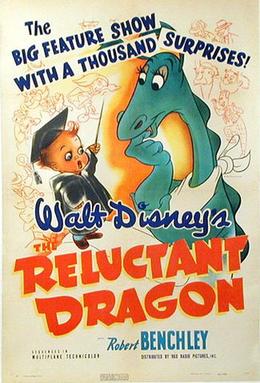
Behind the film
- Year
- 1941
- Director
- Alfred L. Werker, Ub Iwerks, Jack Kinney, Jack Cutting, Hamilton Luske
- Writers
- Erdman Penner, Dick Huemer, William Cottrell, T. Hee, Harry Clork, Al Perkins
- Genres
- Anthology
- Production
- The Walt Disney Company
- Country
- United States
- Cast
- Robert Benchley, Frances Gifford, Nana Bryant, Clarence Nash, Florence Gill, Henry Hall, Frank Faylen, Walt Disney
About the film
Contains story spoilers.
The Reluctant Dragon is built around Robert Benchley’s visit to the Disney studio, where he wants to sell the idea of a cartoon based on Kenneth Grahame’s story. He evades his assigned guide and wanders through departments and demonstrations, and the feature repeatedly pauses its live-action tour to show animated material. One interlude imagines Baby Weems, another follows a horse-riding lesson, and the final extended segment presents a mild dragon who prefers poetry to combat. The dragon befriends a boy, then agrees to stage a mock battle with the knight Sir Giles, allowing the creature to be accepted by the villagers. This hybrid structure is the film’s premise: a studio tour wrapped around several shorts, not a standalone dragon adventure. This introduction also establishes Benchley as a comic observer rather than an authoritative lecturer, so information arrives through reactions as well as explanation.
That frame gives the film an unusual double audience. Benchley plays a visitor who needs the process explained, so his wandering visit can introduce production work without pretending its details are invisible. Each department becomes a small stage on which craft is turned into spectacle: drawings move, voices acquire character, and jokes become sequences. The film’s educational impulse is also comic, because Benchley’s expectations keep colliding with the scale and specialization of the studio. He is not simply a narrator; his bewilderment supplies a human measure for an industrial art form whose finished images otherwise seem effortless. The tour’s episodic form anticipates later behind-the-scenes features, but its period details and playful staging make it specific to this studio moment.
The anthology shape is often mistaken for looseness, but the live-action passages provide a route through otherwise separate pieces. The tour functions like connective tissue, moving from one kind of animation to another and reminding viewers that each short emerges from a workplace. Baby Weems turns fanciful storytelling into a rapid sequence of visual gags; the horse-riding lesson makes instruction itself the joke; the title segment slows down to build character and atmosphere. These differences let the feature demonstrate range. Its shifts in tone are part of the argument: animation can explain, exaggerate, parody or sustain a fairy-tale world. Because each short has its own pace, the surrounding live action helps audiences reset rather than expecting one continuous dramatic arc.
The dragon story is notably gentle about the conflict it appears to promise. Its central creature prefers poetry to combat, and Sir Giles proves more compatible with him than the expected roles of monster and slayer suggest. Their staged encounter changes the meaning of a heroic spectacle: the community can witness an apparent victory while the participants preserve a friendship. This resolution also reflects the larger feature's interest in constructed effects. A battle can be a performance just as a drawing can seem alive through coordinated work. The tale asks whether the expected story needs to describe anyone's real nature before people will accept it.
The film’s live-action and animated halves also make a playful claim about authorship. Benchley’s tour presents creation as collaborative work rather than a solitary flash of inspiration. Story development, drawing, sound and performance all appear as separate contributions that must align. The shorts then let the audience test those explanations against finished examples. This arrangement makes the picture a historical studio document as well as entertainment, though it remains a produced showcase shaped to present the operation attractively. Its glimpses of labor are revealing, but they should not be mistaken for a complete or neutral account of every worker’s experience. The production’s self-presentation should be read with care: a studio showing its process also chooses which parts of labor to reveal.
Pacing depends on contrast: the conversational tour resets attention, then an animated episode expands the visual possibilities. The transition from black-and-white footage to colour occurs during the studio tour, before the title cartoon, making the process itself part of the visual transformation. The format encourages viewers to notice how a film changes when it crosses from a real studio corridor into a designed world. Benchley’s understated delivery keeps the frame from becoming solemn, while the animated sections can move into broader exaggeration. Together, these modes create a feature whose charm rests on access and interruption: the audience is repeatedly invited behind the curtain, then returned to the show. Colour becomes a quiet promise of imaginative expansion after the comparatively plain studio visit has taught the viewer how images are assembled.
The Reluctant Dragon matters as an early example of a feature that makes production itself part of the entertainment. Its title invites expectations of a single fable, but its identity is wider: documentary-style studio visit, comedy performance and short-film collection in one package. That hybridity can feel episodic, yet it also gives the work its lasting curiosity. The film asks audiences to value both the imagined creature and the people who make him legible. Keeping the parts distinct helps explain its form: Benchley’s journey supplies the spine, while the embedded shorts demonstrate how many storytelling shapes an animation studio can support. That combination explains why the work resists a single genre label and rewards attention to the transitions as much as its title tale.