
Behind the film
- Year
- 1952
- Director
- John Ford
- Writers
- Frank S. Nugent
- Runtime
- 2h 9m
- Genres
- Romantic comedy, Drama, Boxing
- Production
- Argosy Pictures
- Country
- United States
- Cast
- John Wayne, Maureen O'Hara, Victor McLaglen, Barry Fitzgerald, Ward Bond, Mildred Natwick, Francis Ford, Arthur Shields
About the film
Contains story spoilers.
The Quiet Man imagines returning home as something more difficult than recognising a landscape. Sean arrives with a connection to the place, but that connection does not make him fluent in the expectations governing it. A person can belong through memory and still be treated as a newcomer when practical decisions begin. The film builds its romance around that gap. Buying a home and choosing a partner appear to promise a fresh beginning, yet the community gives both actions meanings he cannot decide by himself. The countryside offers an inviting setting while the social world within it makes privacy much harder to obtain.
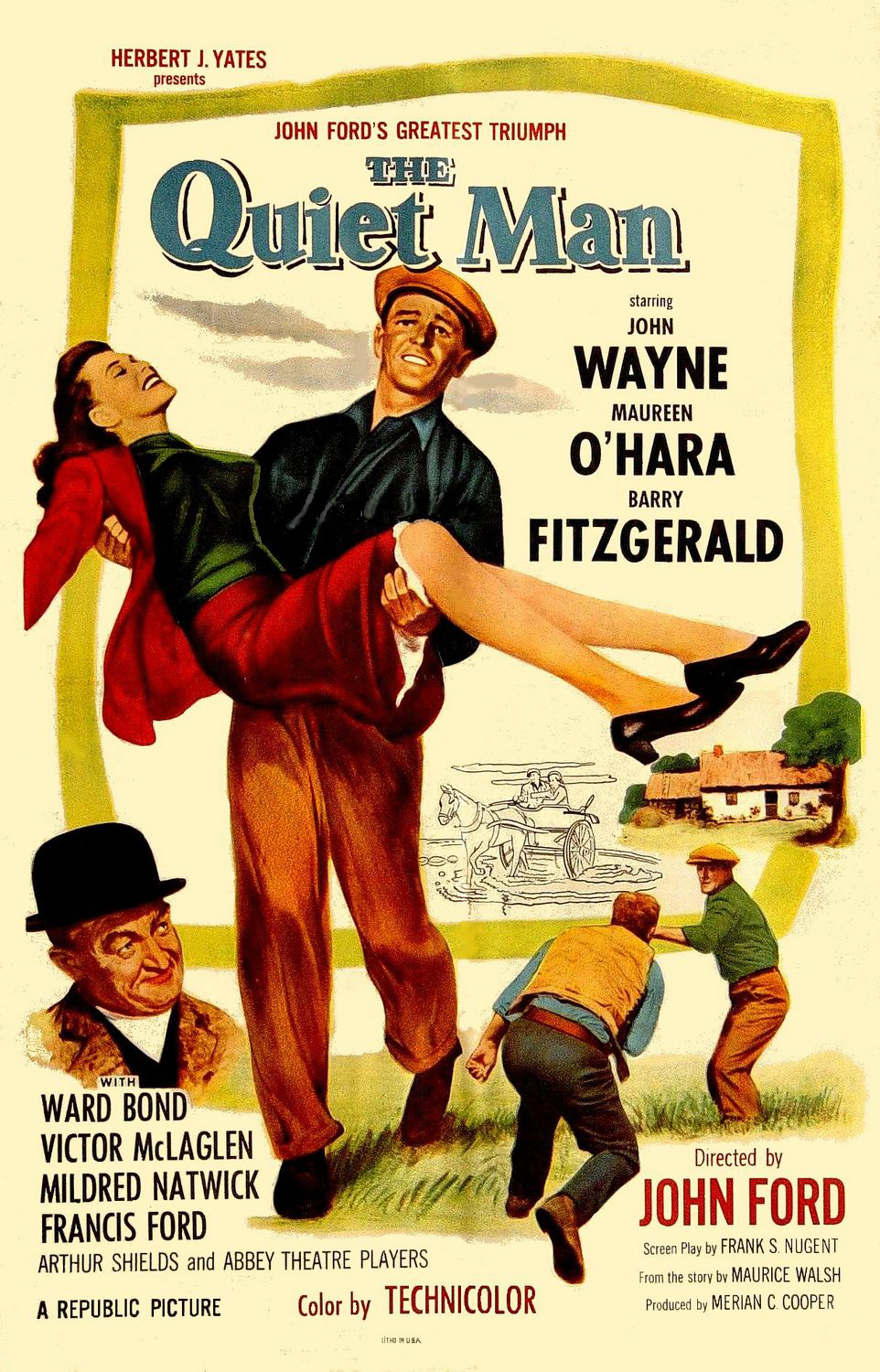
John Ford directs the 1952 film, with a screenplay by Frank S. Nugent based on Maurice Walsh's story. John Wayne plays Sean Thornton, Maureen O'Hara plays Mary Kate Danaher and Victor McLaglen plays her brother Will. Barry Fitzgerald plays Michaeleen Flynn and Ward Bond plays Father Lonergan. The village's matchmaking and mediation make the supporting figures important to how the romance proceeds. This is a world where a private intention rapidly becomes something neighbours discuss, interpret and help to arrange. The couple's relationship therefore develops inside a larger network of expectations, with assistance and interference often arriving through the same familiar people.
Sean buys his family property and marries Mary Kate despite Will's hostility. Will withholds her dowry, which Sean initially dismisses as unimportant. His reluctance to fight conceals guilt after a fatal boxing bout. Mary Kate's departure forces a confrontation: Sean demands the money, and the couple burn it when Will pays. Sean and Will fight, then reconcile. The ending returns the couple to their home and opens another courtship for Will. The dispute's resolution makes clear that receiving the money mattered differently from keeping it, though the physical coercion used along the way remains part of the film's troubling treatment of marriage.
The dowry divides the couple because they are responding to different problems. Sean thinks rejecting the money can express indifference to material gain, while Mary Kate understands the refusal as leaving her dependent on a brother who has already asserted control. The same gesture can therefore feel generous to its maker and dismissive to its recipient. That gives the conflict more substance than simple stubbornness on either side. Listening would require understanding what the property represents within the other person's life, rather than treating one's own lack of interest as proof that nobody should need to care about it. The film's central disagreement grows through that failure of translation.
Sean's boxing past makes avoidance an action with a history that others cannot see. The village interprets his reluctance through its own expectations of male courage, while he connects fighting to something irreversible. This does not mean every later decision he makes is justified by private pain. It means the public interpretation begins from incomplete knowledge. The story places a man's wish for peace inside a community prepared to understand peace differently, creating pressure to prove himself through the very behaviour he hoped to leave behind. The quietness of the title becomes complicated by that competing demand for a visible demonstration of strength.
Mary Kate's position should not disappear beneath the broad comedy of the confrontation. The film subjects her to physical handling and treats it as part of restoring the marriage, an approach that can be examined without presenting coercion as sound relationship advice. Her insistence concerns a real distinction between joining another household and being transferred without an independent claim to anything of her own. The resolution of the money dispute gives that insistence meaning, even while the surrounding staging limits the freedom through which she is allowed to pursue it. Those tensions belong together; acknowledging the dignity at stake does not require overlooking how the story makes men enforce the settlement.
The extended fight converts private anger into a communal event. Neighbours become an audience, giving the struggle a social scale much larger than the immediate quarrel. That changes the role of spectacle in the film. A conflict that has injured the marriage becomes something the village can watch and eventually absorb into its own account of restored relations. The comic treatment encourages release, but it also shows how public approval shapes what counts as a satisfactory ending. A dispute can appear resolved when the community accepts a performance of resolution, even though the questions beneath it concern whose needs were heard and whose behaviour was allowed to determine the terms.
The return to the cottage preserves the attraction of beginning again without making the journey there innocent. The Quiet Man combines a welcoming landscape with a social world that can be affectionate, intrusive and forceful, often within the same encounter. Its romance becomes clearer when the dowry is understood as a claim to standing rather than a straightforward appetite for money. Sean's escape from one past brings him into another set of demands, and Mary Kate needs her new life to acknowledge something he initially believes he can disregard. Their home finally becomes shared through an argument about belonging, with the film's warmth and its coercive assumptions remaining available to consider together.