
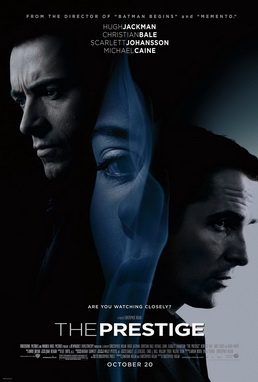
Behind the film
- Year
- 2006
- Director
- Christopher Nolan
- Writers
- Jonathan Nolan, Christopher Nolan
- Runtime
- 2h 10m
- Genres
- Mystery, Thriller, Fantasy, Drama
- Production
- Warner Bros. Entertainment, Touchstone Pictures, Newmarket Films
- Country
- United Kingdom, United States
- Cast
- Christian Bale, Hugh Jackman, Michael Caine, Scarlett Johansson, Rebecca Hall, Piper Perabo, David Bowie, Andy Serkis
About the film
Contains story spoilers.
Christopher Nolan’s The Prestige follows two London stage magicians whose rivalry begins as a professional contest and becomes a private war. Robert Angier is polished and charismatic; Alfred Borden is technically inventive and less concerned with smooth presentation. They start as colleagues under the experienced illusionist Milton, with John Cutter managing the mechanics of the act. During a water-tank escape, Angier’s wife Julia drowns after Borden ties a knot whose type he cannot identify. The accident divides the men and gives their later competition a wound that neither performance nor apology can close. The film is based on Christopher Priest’s novel, but its structure and ending belong to this screen version.
The story is delivered through journals, recollections and courtroom evidence, so the audience encounters the rivalry as a puzzle already shaped by the people inside it. Borden creates The Transported Man, apparently moving instantly from one side of the stage to another. Angier becomes fixated on discovering the secret and recruits a double, Gerald Root, to perform a version of the trick. The act works, but Angier resents having to hide beneath the stage while his double receives the applause. Borden, meanwhile, builds a life with Sarah and raises their daughter Jess, yet even his family cannot reliably tell which version of him is present. The method consumes the people who depend on him.
Angier’s obsession leads him to Borden’s diary, whose encoded clues point toward Nikola Tesla in Colorado. Tesla builds a machine intended to transport objects, but the experiments leave duplicate hats scattered outside his laboratory. The scientific marvel raises a more disturbing possibility: the machine may create a copy rather than move its subject. Angier returns to London and presents The Real Transported Man, vanishing from a machine onstage and reappearing at the back of the theatre. Audiences see a perfect miracle. Behind the curtain, the mechanics include a water tank and a body in danger, while Angier’s own understanding of what happens remains deliberately unstable.
Borden’s relationship with Sarah deteriorates as the pressures of the double life grow. Some days he is affectionate, other days distant; Sarah recognises the inconsistency but cannot know its cause. Olivia Wenscombe, Angier’s assistant, becomes involved with Borden and helps him learn what Angier is doing. Each act of spying creates more retaliation. Angier’s pursuit began after Julia’s death; Borden’s secrecy and affair with Olivia leave Sarah distressed, and she dies by suicide after becoming convinced that he no longer loves her. This loss makes the cost of his double life painfully concrete. The feud also draws Cutter into a painful position. He understands stage machinery and has repeatedly warned Angier about the cost of chasing a perfect illusion, but he remains entangled in the men’s professional and legal battles.
The film’s central reveal identifies Borden’s method as a pair of identical twins sharing one public identity. They alternate between the roles of Alfred and the assistant Fallon, dividing a single life between them. One loves Sarah, the other Olivia; when Angier sabotages a bullet-catching act and one brother loses fingers, his twin cuts off the same fingers to preserve the disguise. The secret makes the trick possible, but it also means neither brother can wholly possess a family or an independent self. One twin is arrested after entering Angier’s theatre and trying to save the man he sees drowning in a tank. The court convicts him of Angier’s murder and sentences him to hang. The reveal explains earlier contradictions, though it does not make their sacrifice seem admirable or cost-free.
In prison, solicitor Owens, acting for Lord Caldlow, offers to care for Jess in exchange for the secret of The Transported Man. Later, Caldlow visits with Jess, revealing himself as Angier. Borden passes him a note with the secret, but Angier tears it up unread. As one Borden twin is hanged, the other reaches the theatre and shoots Angier. In the basement he finds a line of water tanks. The machine creates a second Angier at a distance, while one Angier ends in a tank during each performance; the film does not establish which one he regards as himself. His uncertainty about identity is part of the horror, not doubt that the machine duplicates.
The surviving twin is reunited with Jess, while Cutter helps bring the story to its final image of the trick’s “prestige,” the return of what appeared to vanish. A stage illusion has three parts: showing the object, making it disappear, and bringing it back. Nolan applies that structure to the film itself, repeatedly offering explanations that later scenes reshape. The ending’s explicit plot is severe: Angier’s performances leave a body in a tank, and one Borden brother has been hanged for the death of his rival. The film shows duplication, while Angier’s uncertainty about which self he is remains his own fear.
The period setting turns craft into visible labour. Stage apparatus, trapdoors, disguises and water tanks make the secrets materially present, while the theatre’s audience sees only the polished surface. Wally Pfister’s photography and David Julyan’s score support a world of dim backstage corridors, crowded streets and carefully lit stages. The feud outlasts the original cause because both men begin to treat admiration as a form of defeat. Angier wants the audience’s wonder without accepting the humiliation of being hidden from it; Borden wants to protect the secret even as it destroys his family. Their different methods mirror their characters: one divides himself and lives two partial lives, while the other allows a machine to make death part of his nightly act. The story gives no clean victor. Jess returns to the surviving Borden, but one twin is lost and the other man’s theatre contains a record of repeated killings. The final reveal completes the magic trick and leaves its cost in plain view.