
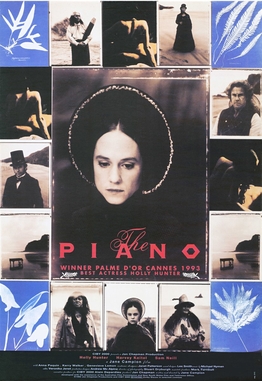
Behind the film
- Year
- 1993
- Director
- Jane Campion
- Writers
- Jane Campion
- Runtime
- 2h 00m
- Genres
- Drama, Romance
- Production
- Jan Chapman Productions, Ciby 2000, Australian Film Commission
- Country
- France, Australia, New Zealand
- Cast
- Holly Hunter, Harvey Keitel, Sam Neill, Anna Paquin, Kerry Walker, Genevieve Lemon, Tungia Baker, Bruce Allpress
About the film
Contains story spoilers.
Ada McGrath arrives in colonial New Zealand with her daughter Flora and a piano, which the ship’s crew leaves on the beach. Her new husband, Alisdair Stewart, refuses to retrieve it, so Ada asks their neighbour George Baines for help. George exchanges land with Alisdair and bargains with Ada for piano lessons, gradually asking for greater intimacy in return for the instrument’s keys. Ada eventually chooses George, but Alisdair discovers her message to him and cuts off one of her fingers. He later releases Ada and Flora to leave with George. During the journey to the ship, Ada asks that the piano be thrown overboard and deliberately lets its rope catch her foot, then chooses to free herself underwater. In the epilogue, she lives with George and Flora, teaches piano and uses a metal replacement finger.
Jane Campion makes communication the film’s organizing problem. Ada does not speak, but the movie never treats her as a silent blank waiting for other people to interpret her. Her playing, signs, gaze and movements carry different kinds of meaning, while Flora’s role as interpreter gives the child unusual power within adult negotiations. Holly Hunter’s performance depends on precise physical choices: when Ada is guarded, when music lets her become animated, and when her attention shifts between the instrument and the people around her. The audience is asked to read her directly instead of relying only on dialogue translated by someone else.
The piano is both a musical instrument and a practical source of leverage. It is the means by which Ada expresses herself, yet it can also be transferred, withheld or divided into keys by the men around her. That material arrangement makes the negotiation with Baines uncomfortable by design: Ada wants access to the piano, but the terms are set within a colonial household where her choices are already constrained. The film’s erotic tension grows from that imbalance rather than floating free of it. Music gives Ada agency, while the bargain reveals how easily another person can try to price that agency.
The landscape around the settlement is not presented as empty scenery. Beach, forest, muddy ground and the wooden interiors of the settlers’ homes shape how far people can move and how exposed they feel. Campion and cinematographer Stuart Dryburgh repeatedly frame Ada against weather and terrain, making the environment seem to press on the social order the characters have brought with them. George’s ease within Māori life contrasts with Stewart’s more possessive attachment to property and command. The film focuses on its Scottish characters’ conflict, but its setting continually signals that their private drama unfolds on land already inhabited and culturally complex.
Sam Neill plays Stewart as a man who wants to understand his wife by controlling the conditions around her. His restraint does not make his behavior harmless; it makes his authority look respectable until his actions expose its violence. Harvey Keitel’s Baines begins from a different position, but the film does not let desire make him automatically generous. He first uses the piano as part of a bargain and has to confront the difference between obtaining Ada’s presence and receiving her willing affection. That distinction is essential to how the relationship changes, and the performances leave room for discomfort along with attraction.
Flora is more than a narrative bridge between adults. Anna Paquin gives her a child’s practical intelligence and emotional attachments, including a bond with Stewart that complicates her loyalty to her mother. Her interpretation can clarify Ada’s signs but also alters what other people hear, which makes the child an active participant in the family’s communication. Campion’s use of close framing gives the girl’s reactions weight without turning her into a symbol of innocence. The adult world depends on her help, then judges her when she chooses according to the affection she has developed.
Michael Nyman’s score takes the piano’s melodies beyond the moments when Ada is physically playing. The music can express an inner life that dialogue would flatten, but it also changes with the audience’s knowledge of what the instrument means to her. The sound and image work together: hands, keys, wood, water and weather form a physical vocabulary alongside the spoken language of the settlers. This attention to touch prevents the score from functioning as decorative sadness. It remains tied to Ada’s skill and to an object whose ownership has repeatedly been used to define her choices.
Survival here does not mean that desire has made the preceding violence acceptable. Ada’s future can contain affection without cancelling what was done to her, and the film allows that difficult combination to remain visible. Its attention to hands makes bodily damage inseparable from the work of expression, but expression is never reduced to a single physical capacity. The person who communicates is larger than the instrument or gesture through which others have learned to recognise her. That gives the story a question to carry beyond the household: whether a relationship can make room for another person’s will, rather than turning the ability to understand her into a claim of possession.