
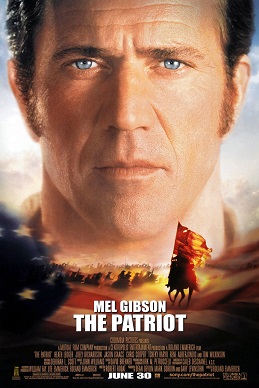
Behind the film
- Year
- 2000
- Director
- Roland Emmerich
- Writers
- Robert Rodat
- Genres
- War, Historical, Action, Drama
- Production
- Centropolis Entertainment, Mutual Film Corporation, Columbia Pictures
- Country
- Germany, United States
- Cast
- Mel Gibson, Heath Ledger, Joely Richardson, Jason Isaacs, Chris Cooper, Tchéky Karyo, René Auberjonois, Tom Wilkinson
About the film
Contains story spoilers.
In 1776, widower Benjamin Martin abstains from a South Carolina vote on joining the Continental Army, while his eldest son Gabriel enlists. Four years later, a wounded Gabriel returns to the family farm with dispatches; British Colonel William Tavington arrests him and kills Benjamin's younger son Thomas when he tries to intervene. Benjamin and two younger boys ambush the convoy and free Gabriel, then Benjamin joins a militia led by his former commander. His raids bring retaliation against local families, so the Martins flee to a Gullah settlement. Tavington later burns a church where Gabriel's new wife Anne and other residents are trapped; Gabriel dies attacking the British camp. Benjamin considers leaving, but returns to lead his men into the campaign's final battle. He kills Tavington, the American side wins, and Benjamin comes home to find the militia rebuilding his farm.
The film is a historical fiction built around a fictionalized family and invented military figures, not a record of the Revolution. Its central conflict begins with Benjamin's reluctance: he has seen what war can demand from a person and is unwilling to send other people into a fight he will not join himself. Gabriel's enlistment forces the question into the household before the British arrive. The assembly scene makes this difference visible through a choice made in public but carried home afterward. Their disagreement gives the large campaign a close human scale, because political allegiance is first experienced as a father trying to protect his children and a son insisting on choosing his own cause.
The narrative binds domestic space to military action. The Martin farm is not a refuge sealed off from politics; it becomes a place where wounded soldiers are treated, dispatches arrive, and the British decision to arrest Gabriel transforms private hospitality into danger. Benjamin's children make every movement beyond the farm carry consequences. The younger boys witness the ambush that frees Gabriel, while the family's later flight places Charlotte's household and a Gullah community within the same expanding conflict. The film's focus remains on Benjamin and his family, but the presence of other communities shows that the struggle is not limited to the decisions made by white officers and soldiers. The house and fields keep domestic labor in view, even as military uniforms and weapons begin to dominate the frame.
Mel Gibson plays Benjamin as a man whose capacity for violence is already established before the story's military campaign begins. His first rescue of Gabriel is effective but frightening to the boys beside him; the sequence does not present combat skill as a clean inheritance. Benjamin has to live with the effect his example has on his children. Heath Ledger gives Gabriel a different kind of conviction, more open and forward-moving. Their relationship changes from argument about whether to fight into a harder partnership in which both men understand that the cause they serve can take people from them. The film uses that contrast to keep patriotism from being only a banner or speech.
Tavington supplies the story with a personal antagonist, while Colonel Harry Burwell and Major Jean Villeneuve connect Benjamin to the larger Continental effort. The contrast can simplify a complicated war into a legible conflict between brutality and resistance, which is one reason the film should be approached as melodrama shaped by history. Jason Isaacs plays Tavington with rigid purpose, making the character's military authority feel inseparable from menace. Chris Cooper's Burwell and Tchéky Karyo's Villeneuve offer Benjamin relationships based on prior service, command and mutual distrust that gradually becomes cooperation. These ties make the militia's formation feel like a negotiated alliance rather than an instant heroic unit.
The action is organized around tactics as much as scale. Benjamin's militia uses ambushes, decoys and knowledge of local routes to disrupt a better-equipped force; battle geography therefore expresses the difference between conventional command and irregular resistance. Caleb Deschanel's cinematography gives the landscapes room to become part of the plan, while the editing shifts from broad formations to close, disorienting hand-to-hand combat. The camera often follows one person's immediate position instead of offering a clean overview, so confusion is part of the scene's physical experience. The film's large set pieces are designed to keep its family story in view: the danger is measured by who may not come home, not only by which side controls a field.
John Williams's score helps give the drama an emotional scale larger than one household. Music can connect a private feeling with the sweep of a national story, but that connection also asks the audience to notice how such stories are made. A heroic narrative chooses where to place its sympathy and whose losses to bring close. The film's emphasis on Benjamin makes that choice particularly visible, binding a cause to the person through whom it is experienced. Its historical setting therefore invites two kinds of attention: following the emotional drama and recognising the limits of the perspective organising it. The result is a large-scale adventure about obligation and grief, whose meaning belongs to its fictional construction rather than to a complete account of the war.