
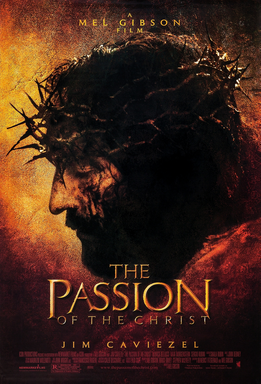
Behind the film
- Year
- 2004
- Director
- Mel Gibson
- Writers
- Benedict Fitzgerald, Mel Gibson
- Genres
- Drama, Biographical, Historical, Sword-and-sandal
- Production
- Icon Productions
- Country
- United States
- Cast
- Jim Caviezel, Maia Morgenstern, Monica Bellucci, Hristo Shopov, Rosalinda Celentano, Sergio Rubini, Francesco De Vito, Mattia Sbragia
About the film
Contains story spoilers.
The Passion of the Christ begins in the darkness of Gethsemane, where Jesus prays while the disciples nearby struggle to remain awake. The scene places the coming ordeal within an explicitly spiritual conflict, including the presence of Satan, rather than introducing it as an ordinary criminal investigation. Judas arrives with the people who will arrest Jesus, turning an intimate betrayal into the first step of a public process. Jim Caviezel’s performance moves through fear, endurance and resolve, with the film concentrating on the physical and emotional pressure of the hours that follow. Its narrow time frame gives the story an urgent direction even for viewers who already know where it is heading.
The arrest separates Jesus from those closest to him and puts him before the religious authorities. In the film’s presentation, accusations and demands for condemnation drive the questioning while dissenting voices fail to stop it. Peter follows at a distance but denies his connection to Jesus when challenged, discovering that personal loyalty has become harder to maintain under threat. Judas also confronts the consequences of what he has done, but his attempt to reverse the betrayal does not recover control of events. Their parallel distress gives the ordeal more than one perspective: the central figure undergoes violence, while followers who had imagined themselves faithful encounter their own inability to prevent or face it.
Jesus is brought before Pontius Pilate, whose authority introduces the political dimension of the sentence. Pilate questions him and hesitates, while his wife Claudia expresses concern. A transfer to Herod does not settle the case, and Jesus returns to a governor concerned about unrest as well as judgment. The crowd’s demand for Barabbas’s release instead of his creates another stage in the pressure toward execution. These scenes portray decisions made by particular people within the film’s religious dramatization. Jesus, Mary and his disciples are themselves Jewish, and the conflict shown around them should not be treated as a factual verdict on an entire people or a simple explanation of ancient history.
The scourging occupies a prolonged and intensely violent portion of the film, making the body the main site through which the religious meaning is expressed. Roman soldiers perform the punishment while spectators and companions respond from the edges of the scene. Mary and Mary Magdalene try to attend to what they can after the violence, gestures that offer care without reversing the sentence. The filmmaking gives suffering a duration that is difficult to separate from the experience of watching, rather than allowing it to function only as a brief passage between trial and execution. Its severity is central to the film’s devotional approach, even though the emotional response it invites will differ greatly among viewers.
The journey toward Golgotha changes the ordeal from a fixed scene of punishment into a movement through the city. Jesus carries the cross, falls and continues, while people along the route offer hostility, indifference or help. Simon of Cyrene is compelled to assist him, becoming physically involved in a burden he did not initially choose. Mary’s attempts to reach her son give the journey a personal scale beside its public spectacle. Maia Morgenstern’s restrained performance allows a glance or a movement toward him to carry weight without turning every reaction into a speech. Compassion appears through limited acts, emphasizing what can still be offered when no one present is able to end the violence.
Memories interrupt the forward movement, including episodes of teaching, domestic life and the Last Supper. These passages connect the suffering figure to relationships and actions that existed before the arrest, allowing Mary’s perception of her adult son to meet recollections of him as a child. The flashbacks also place the present events beside teachings about love, forgiveness and sacrifice, giving the film a theological frame that extends beyond the visible actions of the authorities. They are not a complete biography of Jesus. Their purpose is to make particular moments resonate across the compressed ordeal, so that the person seen struggling along the road remains connected to a life of companionship and instruction.
At Golgotha, Jesus is crucified between two other condemned men while Mary, John and Mary Magdalene remain among the witnesses. The film emphasizes his concern for others and his forgiveness of those involved, placing the cruelty around him in contrast with the response he offers. His death is accompanied by an earthquake and symbolic images of spiritual consequence. The body is taken down, and Mary holds him in a composition that gathers the long public ordeal into a moment of maternal grief. A brief final scene in the tomb then shows resurrection, changing the narrative’s last movement from mourning to the Christian claim that death has not been the conclusion.
Gibson directs a screenplay written with Benedict Fitzgerald, using dialogue in Aramaic, Hebrew and Latin alongside subtitles. Caleb Deschanel’s cinematography distinguishes the garden’s darkness, the enclosed spaces of judgment and the exposed path to execution, while the recurring memories provide relief and connection rather than a separate adventure. Supernatural figures and symbolic images keep the religious perspective visible throughout. The film is therefore best understood as a specific devotional adaptation, drawing on Christian traditions to concentrate on suffering, witness and redemption. Its world is organized around a familiar sacred story, but its particular force comes from the narrowness of the chosen interval and the attention given to those who can accompany Jesus without preventing what happens.