
Behind the film
- Year
- 2001
- Director
- Alejandro Amenábar
- Writers
- Alejandro Amenábar
- Runtime
- 1h 44m
- Genres
- Horror, Drama, Mystery
- Production
- StudioCanal, Miramax, Canal+
- Country
- United States, Spain, France
- Cast
- Nicole Kidman, Fionnula Flanagan, Christopher Eccleston, Elaine Cassidy, Eric Sykes, Alakina Mann, James Bentley, Renée Asherson
About the film
Contains story spoilers.
The Others makes a household feel frightening before its inhabitants can agree on what is frightening them. Doors, curtains and rules organise the children's daily lives, so any disturbance seems to threaten a carefully maintained system of protection. The house is more than a backdrop containing a supernatural problem. It is the structure through which Grace understands her responsibilities and her authority, and that makes uncertainty particularly difficult for her to tolerate. If something is happening that she cannot explain or command, the security of the family and the story she tells herself about being its guardian are both placed under pressure.
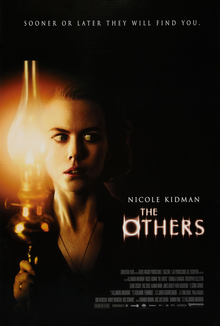
Alejandro Amenábar wrote and directed the 2001 film, with Nicole Kidman playing Grace. Fionnula Flanagan, Eric Sykes and Elaine Cassidy play the incoming servants; Alakina Mann and James Bentley are the children, Anne and Nicholas. The setting is Jersey in 1945, in a household left waiting after the war. That position matters because the family's isolation is also a suspended state of expectation. Grace maintains a world that appears to require constant vigilance, while the absence of her husband leaves her without the reassurance of an ordinary domestic future. The servants enter this fragile arrangement with a composure she finds increasingly difficult to interpret.
Grace believes her children must avoid light, and the house operates around that restriction. Anne reports a boy called Victor and other intruders. Their unseen presence becomes a struggle over whose account of the house is true. Grace's husband briefly returns, then leaves again. Eventually a séance reveals the reversal: Victor's family are living people, while Grace and her children are ghosts. Grace had killed the children and herself. The servants, who also died long ago, understand their condition. Once Grace remembers, the apparent invasion becomes an encounter between two families occupying the same home from different sides of death.
Grace's insistence on an orderly explanation creates much of the film's tension. She can acknowledge that something alarming has occurred while resisting the account Anne gives of it, because accepting that account would mean admitting limits to her own knowledge. Her authority becomes a way of containing questions as well as keeping danger outside. The difficulty is not simply that an adult refuses to believe a child. Both are describing experiences from within a situation whose basic terms they do not yet understand, and Grace's certainty makes it harder for the family to investigate those terms together.
The restrictions on light turn an ordinary feature of a house into something that must be managed through repeated attention. Opening and closing become consequential actions, while the possibility of a mistake keeps the rooms from feeling secure. Darkness conceals information, but it also appears to be what protects the children. That makes the familiar horror impulse to illuminate a threatening space complicated: the very thing that might reveal what is happening seems capable of harming the people Grace is trying to keep safe. The film builds suspense from that contradiction rather than needing the house to be continuously filled with visible apparitions.
The servants' calm is unsettling because it suggests knowledge outside Grace's system. They do not react with the urgency she expects, making their behaviour look like indifference or disobedience. Once the truth is known, their position changes. They have an understanding that the family lacks, but understanding does not give them the power to make Grace accept it on command. Their presence therefore supplies a second form of authority, one founded on recognising the household's condition rather than controlling its routines. The difference between those approaches becomes clearer as Grace's efforts to restore the old order become less able to explain events.
The revelation reorganises the word intruder. From Grace's perspective, strangers have entered her house; from the living family's perspective, the house contains a disturbing presence they cannot remove. Neither account requires its occupants to have knowingly set out to torment the other. The frightening overlap comes from each family treating its own experience as the complete description of the space. The séance allows the film to disclose that overlap while also exposing the history Grace has suppressed. Its supernatural explanation belongs to the story's fictional world, and the final recognition does not make the violence behind that history less devastating.
By the ending, sunlight no longer has the meaning Grace assigned it, and the family remains in the house after the living occupants leave. The resolution offers a new understanding of their surroundings rather than a return to life before the catastrophe. Grace must acknowledge what happened instead of protecting an account in which she has only been protecting her children. Amenábar's ghost story thus finishes with a painful alteration in knowledge. The rooms have not become a different place, but the family can no longer inhabit them through the same assumptions, leaving memory and responsibility at the centre of the haunting.