
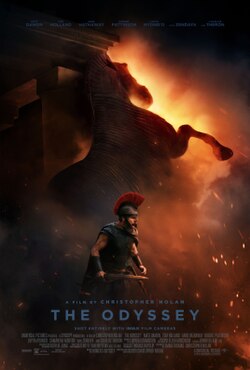
Behind the film
- Year
- 2026
- Director
- Christopher Nolan
- Writers
- Christopher Nolan
- Genres
- Fantasy, Adventure, Action, Historical
- Production
- Syncopy Inc., Universal Pictures
- Country
- United States, United Kingdom
- Cast
- Matt Damon, Anne Hathaway, Tom Holland, Robert Pattinson, Zendaya, Charlize Theron, Samantha Morton, Lupita Nyong'o
About the film
Contains story spoilers.
Christopher Nolan’s The Odyssey sets the wandering king’s ordeal beside the life his absence has created. In Ithaca, Penelope has spent years facing suitors who consume the household’s stores while demanding that she choose a new husband. Their son Telemachus has grown up without his father and is increasingly willing to challenge them, even though they control the hall and its weapons. The film intercuts this strained home with Odysseus’s route back from Troy, giving the journey an emotional counterweight: each delay is measured against a family trying to keep its life intact.
Memories return to the Trojan Horse and its violent trick, then treats that victory as the source of Odysseus’s burden rather than a clean triumph. Nolan’s Odysseus is an ingenious military leader, but his cunning has consequences for the men who follow him and for the people whose city falls. The story returns to this history through memories, encounters and Athena’s appearances. Athena does not merely hand him solutions; her presence draws attention to the people injured by his choices. The film makes the road home a reckoning with the war as much as a sequence of geographical obstacles.
At sea, the crew is driven by food, fear and the need to keep moving. They enter the Cyclops’s cave and find themselves trapped with a creature who can overpower them in close quarters. Odysseus relies on deception and a dangerous escape rather than strength alone. Later, the men face the Laestrygonians and lose ships, then hear the Sirens’ song: Odysseus is bound to the mast so he can hear them without steering toward them, while the crew protects itself from the sound. These episodes have distinct physical stakes, and each survival leaves the group smaller and the leader more responsible for what he has asked them to do.
Calypso's island gives the delay a different form from an attack at sea. Lotus flowers dull Odysseus' memory, threatening the connection to the family and home he is trying to reach. His past has to become something he can recover and tell, not just a sequence of events assumed to remain clear in his mind. Circe's encounter brings a more frightening transformation of his men, while the visit among the dead reconnects the journey with people already lost. These episodes put survival beside the preservation of identity. Remaining physically alive would not fulfill the voyage if he could no longer remember whom he wanted to return to or why the return mattered.
The king's disguised return requires him to enter his own world as someone it is allowed to mistreat. Eumaeus assists him, and the recognition from his old dog, Argo, gives the homecoming a moment outside the struggle over political power. The animal has no claim to a throne and gains nothing by recognizing a master. Penelope and Telemachus face more complicated decisions, shaped by years in which the absent man has existed through expectation and other people's stories. Returning in person cannot simply replace those experiences. Matt Damon's Odysseus must become a husband and father to people whose lives have continued without his guidance, not only prove that their king remains alive.
Penelope's bow contest turns a household object into a test of identity. Odysseus succeeds where the suitors fail, then fights alongside Telemachus against the men occupying the hall. The recognition and the violence are inseparable, so reclaiming the room does not provide an uncomplicated reunion. Anne Hathaway's Penelope has had to maintain a position while surrounded by people pressing their claims upon her. Tom Holland's Telemachus has grown into decisions of his own. The family cannot resume a life suspended at the moment the father left. Their meeting brings three changed people together, with the prospect of rebuilding a relationship rather than recovering a perfectly preserved one.
Athena's connection to a young woman killed at Troy makes Odysseus' reckoning with the war personal. The goddess's appearance carries an accusation that a victorious soldier cannot dismiss merely because he survived. His decision to leave Ithaca allows Telemachus to take the throne, and Penelope goes with him. That ending changes the usual reward attached to the hero's arrival: reunion does not require reclaiming permanent command. The final return to the Trojan Horse places the achievement that made him famous beside the damage he now recognizes. For this Odysseus, the ability to outwit an enemy has proved very different from the ability to live peacefully with what victory demanded.
The film’s nonlinear construction links Ithaca’s occupied hall with the voyage rather than treating the two as unrelated plotlines. Large-scale images of ships, storms and ancient architecture sit beside tense domestic scenes where a look or pause carries political meaning. Nolan’s IMAX presentation makes the sea and battlefield physically imposing, but the central conflict remains intimate: a family has lived with absence while a returning warrior has to face the difference between being celebrated and being forgiven. This is a specific adaptation of Homer’s poem, with its own emphasis on guilt and chosen exile; its events and ending belong to the film, not to a generalized summary of the ancient text.