
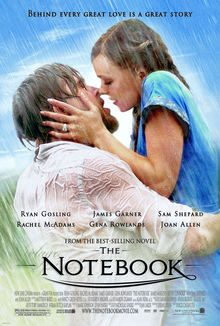
Behind the film
- Year
- 2004
- Director
- Nick Cassavetes
- Writers
- Jeremy Leven, Jan Sardi
- Runtime
- 2h 03m (theatrical version)
- Genres
- Romance, Drama, Coming-of-age
- Production
- New Line Cinema
- Country
- United States
- Cast
- Ryan Gosling, Rachel McAdams, James Garner, Gena Rowlands, James Marsden, Joan Allen, Sam Shepard
About the film
Contains story spoilers.
The Notebook opens with a small ritual that the film slowly teaches us to read: an elderly man known as Duke sits beside a woman in a care home and reads a story from a notebook. She listens, but does not recognize the characters as people in her own life. The pages take us to Seabrook Island, South Carolina, in 1940, where lumber-mill worker Noah Calhoun meets Allie Hamilton, a seventeen-year-old visiting from a wealthy family. Their first attraction is impulsive and awkward. Allie initially finds Noah too rough and persistent, while his conviction that he can win her over makes their social difference seem, to him, like an obstacle rather than a warning.
Their summer affair quickly becomes intense, but the film gives it a material setting rather than treating romance as abstract destiny. Noah takes Allie to an abandoned plantation house, Windsor, and describes how he would restore it. The broken estate becomes a picture of the future he imagines: a place shaped through patience and labor, not inherited status. When Allie’s parents summon the police and her mother Anne forbids the relationship, Noah overhears and tells Allie he sees no future for them. The remark wounds both of them. Allie regrets leaving, but her family departs the next morning before she can find Noah at the mill, and a chance to explain is lost.
Noah writes to Allie every day for a year, but Anne intercepts the letters. Each believes the other has chosen silence. World War II widens the distance: Noah and his friend Fin enlist, and Fin is killed in the Battle of the Bulge. Allie becomes a nurse and meets Lon Hammond, a wounded officer whose money and family standing reassure her parents. They become engaged, and the story lets this relationship feel more than a convenient obstacle: Lon offers kindness and a stable shared life. Noah, meanwhile, returns home to find his father has sold their house so Noah can buy Windsor. After his father dies, Noah repairs the estate but cannot bring himself to sell it.
The reunion begins with an image rather than a confession. Allie sees a newspaper photograph of Noah standing before the restored Windsor and faints. The house she once imagined is now real, and she travels to see him before marrying Lon. Seven years have passed. Noah is startled when she arrives; the two try to talk as adults, but the shared summer surfaces immediately. He takes her out in a small boat through water filled with birds, and the quiet outing gives way to a rain-soaked confrontation. Allie asks why he never wrote. Noah tells her he did: Anne kept the letters from her. Their kiss does not erase the years, but it reveals that the separation was based on a false understanding.
When Allie’s mother arrives to warn her that Lon has come looking, she also explains why she hid the letters. Anne once loved a working-class man herself and chose the security of her present life; she cannot pretend that choice settled every question. She gives Allie Noah’s letters and leaves her to decide. Allie is caught between a dependable engagement and a relationship whose promise she knows, but whose future is uncertain. Noah insists that she choose openly, even if the decision hurts him. Allie returns to Lon and speaks with him honestly before choosing Noah. The film frames the decision not as a simple triumph over money, but as an acceptance of the particular life she wants.
The care-home story now changes meaning: Duke is Noah, and the woman he reads to is Allie, living with advanced dementia. The notebook is her own journal, written so that Noah can read their history back to her during moments when she is able to recognize him. Sometimes the method works. Allie remembers their love, asks after their children and dances with Noah; then the recognition fades and fear returns. The film’s cuts between young and old versions of the couple make memory a formal structure, not merely a theme. The audience knows the story while Allie repeatedly loses access to it, so familiar scenes acquire a second emotional life in the present.
After Noah suffers a heart attack and Allie is moved to a dementia ward, he visits her at night. She recognizes him again and says she does not want to forget. The next morning, staff find them dead together in her bed. The ending makes their reunion tender but also inseparable from the cost of Allie’s illness; it does not turn the disease into a puzzle solved by devotion. Nick Cassavetes balances the old couple’s care-home setting against the sunlit summer and restored-house romance, with Ryan Gosling and Rachel McAdams carrying the younger story and James Garner and Gena Rowlands making its later echo legible. The notebook itself binds both timelines, a private record that can briefly return a shared identity.