
Behind the film
- Year
- 1986
- Director
- Jean-Jacques Annaud
- Writers
- Andrew Birkin, Gérard Brach, Howard Franklin, Alain Godard
- Genres
- Crime, Thriller, Mystery, Horror
- Production
- Constantin Film, France 3, RAI
- Country
- France, Italy, Germany
- Cast
- Sean Connery, Christian Slater, F. Murray Abraham, Helmut Qualtinger, Feodor Chaliapin Jr., Michael Lonsdale, Ron Perlman, Valentina Vargas
About the film
Contains story spoilers.
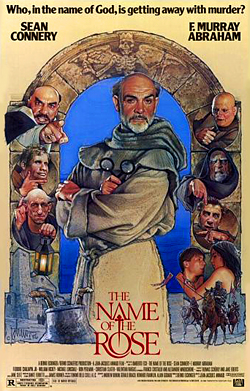
The Name of the Rose makes an abbey into a complete social world before making it a puzzle. It has rules about who may enter particular rooms, who may read particular books and who has the authority to explain what happens within its walls. William of Baskerville arrives as a guest rather than as the owner of those rules. Sean Connery's friar brings curiosity, observation and a readiness to test an explanation against physical detail. Beside him, Christian Slater's Adso is still learning what it means to see and understand. Their investigation takes place in a community where knowledge is treasured, restricted and feared, so a discovery can threaten a hierarchy as well as identify a murderer.
William and Adso investigate deaths at a northern Italian abbey before a theological gathering. Blackened fingers and tongues lead towards a hidden book and a forbidden library. Inquisitor Bernardo Gui arrives and forces confessions from people he accuses of heresy, disregarding William's objections. In the library, William identifies Jorge as the guardian of a book on comedy whose pages he has poisoned to prevent its ideas spreading. Jorge starts a fire that destroys the collection. Two condemned men die, while local peasants rescue a girl accused alongside them and kill Gui as he flees. William saves a few books. Adso leaves with him rather than remaining with the girl, whose name he never learned.
The mystery's physical setting makes the control of information visible. Books are not merely background decoration for learned men. Their placement, accessibility and movement can determine who has an opportunity to learn something, and who can prevent that opportunity. A labyrinthine library gives intellectual restriction an architectural form: possessing a collection does not mean allowing its contents to circulate freely. William's desire to understand therefore requires acts of trespass as well as reasoning. The danger belongs partly to what he might discover and partly to the fact that he is insisting on discovering it for himself. The abbey's authority is easier to maintain when its explanations and its locked spaces remain beyond the reach of an outsider's questions.
Gui represents a method opposed to William's. F. Murray Abraham's inquisitor can arrive with an account of guilt already available and make people fit it. Confession under threat gives the proceeding an appearance of certainty without making the account true. William, by contrast, risks remaining uncertain because a plausible explanation still needs to survive contact with evidence. Their disagreement has immediate consequences for people with little power to resist either man's interpretation. The tribunal is not an abstract debate between intellectual styles. It determines who will be punished, and the pressure to announce an answer becomes dangerous precisely because unanswered deaths have made the community afraid. Authority can offer relief from doubt while increasing the danger to those it chooses to blame.
Adso's encounter with the unnamed girl opens a part of the abbey's world that scholarship alone cannot describe. She is connected to the poverty outside its walls and to exchanges shaped by unequal access to food. For the novice, desire arrives within that material inequality rather than as a clean romantic alternative to his religious education. His understanding remains incomplete, and the older voice looking back gives the relationship a lasting presence without filling every gap. Not knowing her name matters because it limits what he can claim to know about the person he remembers. The film puts that absence beside an investigation obsessed with identifying and interpreting signs. Some of the most significant parts of a life can remain beyond the categories its narrator learned to use.
Jorge's defence of the hidden book gives the final conflict a particular focus. Laughter threatens a form of authority that depends on remaining solemn and unquestionable. A discussion of comedy is therefore treated as dangerous not because it is physically powerful, but because it might change how people regard power. The poisoning turns the act of reading into a lethal encounter with the person who wants to control it. The fire then destroys far more than the disputed volume. Knowledge collected and protected over time can disappear during one attempt to preserve a preferred order. William's armful of salvaged books measures the gap between valuing a collection and being able to save it once the institution holding it has become destructive.
Jean-Jacques Annaud directed the 1986 adaptation of Umberto Eco's novel, with credited writing by Andrew Birkin, Gérard Brach, Howard Franklin and Alain Godard. The film follows its own version of the story, whose outcomes differ from the novel, and its medieval fiction is not a documentary record of the real Bernardo Gui. Its darkness, narrow passages and crowded interiors keep investigation close to the practical conditions of living in that place. The ending sends teacher and novice back onto the road with an incomplete rescue of both knowledge and people. William has uncovered the mechanism behind the deaths without preserving the world that contained it. Adso has learned from him while carrying a personal memory that cannot be resolved into the same kind of answer.