
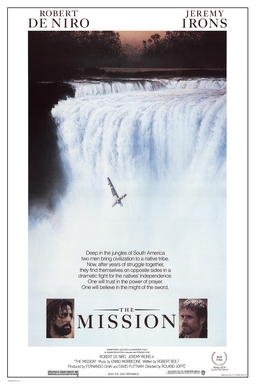
Behind the film
- Year
- 1986
- Director
- Roland Joffé
- Writers
- Robert Bolt
- Genres
- Drama, Historical
- Production
- Warner Bros. Entertainment, Warner Bros. Pictures
- Country
- United Kingdom, France
- Cast
- Robert De Niro, Jeremy Irons, Ray McAnally, Aidan Quinn, Cherie Lunghi, Liam Neeson, Ronald Pickup, Bercelio Moya
About the film
Contains story spoilers.
Father Gabriel enters the South American jungle to establish a mission among the Guarani, while mercenary Rodrigo Mendoza hunts Indigenous people to sell as slaves. After Mendoza kills his brother, he undertakes a punishing act of penance and is eventually welcomed by the community, joining the Jesuits. A treaty then transfers the mission lands from Spain to Portugal, and Cardinal Altamirano must decide whether to defend the settlement or obey the European powers. Gabriel chooses nonviolence; Mendoza takes up arms. When colonial forces attack, both men are killed, but a group of children escapes by canoe with a violin and other belongings. Altamirano is left to reckon with his decision as the children continue beyond the destroyed settlement.
Roland Joffé frames the story as a collision between ideals that are all compromised by power. Gabriel believes that presence, faith and peaceful witness can protect the Guarani; Mendoza believes that armed resistance is the only language the invading forces will respect. The film grants both positions emotional seriousness without making either a comfortable solution. Gabriel’s patience can look like courage and helplessness at once, while Mendoza’s violence is tied to guilt but cannot undo the violence that made his former livelihood possible. Their disagreement gives the film a human scale for a conflict conducted through imperial documents and soldiers.
Mendoza’s change is difficult because remorse does not give him authority over the people he harmed. A desire to become different can be sincere while remaining centred on the person who wants relief from guilt. Robert De Niro’s performance gives that difficulty a bodily weight, making attention and restraint seem like capacities the character has to learn. Forgiveness cannot simply be announced from the side seeking it. The film’s moral pressure comes from recognising that a changed life depends on relationships whose terms he cannot determine alone, and that acceptance is not a certificate declaring the consequences of an earlier life complete.
Jeremy Irons gives Gabriel an inward steadiness that differs from Mendoza’s forceful, restless energy. The priest’s faith is expressed through practice—learning a place, returning to it and maintaining relationships—rather than through speeches alone. That restraint helps the film avoid turning him into an uncomplicated symbol of goodness. His approach is still embedded in a mission system that brings European religion into Indigenous territory, even as he tries to shield the people there from colonial exploitation. The story’s moral tension depends on seeing both his devotion and the limits of the institution he serves.
The Guarani community should not be reduced to a backdrop for the two European men’s spiritual choices. The film gives the people a visible life through collective music, work, movement and the decisions they make about who may enter their community. Its framing repeatedly sets individual figures against a shared landscape, reminding viewers that the land is not an empty arena for a European argument. At the same time, the film’s focus remains largely with Gabriel, Mendoza and Altamirano. That limitation is part of the perspective the film offers, and it calls for attention to how Indigenous people appear as agents within, and beyond, the missionaries’ story.
Ennio Morricone’s score helps connect the film’s contrasting worlds without pretending they are identical. The oboe’s clear line feels exposed against the dense environment, while choral writing gives communal scenes a scale larger than any one character. Music becomes a form of communication in the film’s visual language: it can invite contact, carry grief, or create a solemn order that political power cannot supply. The recurring themes also make the emotional movement legible without requiring the characters to explain every shift in belief. Silence and natural sound around the score keep the landscape present as more than accompaniment.
The cinematography turns waterfalls, cliffs, forest and river into both spectacle and constraint. Wide views locate the characters within a vast environment, while close compositions return attention to faces and gestures. The film’s movement between these scales prevents its historical setting from becoming a static pageant. Water can appear beautiful and dangerous in the same sequence; the landscape offers a route into the community but also exposes how little control any individual possesses. The images give the story a physical memory, making its moral questions feel attached to land, travel and the vulnerability of bodies.
Altamirano represents the power to transform other people’s lives through an apparently administrative decision. Distance can make an agreement look manageable until its terms become conditions imposed on a community. His position does not allow regret to stand outside responsibility, because the authority that makes a choice possible also connects him to its consequences. The film’s historical world is dramatised rather than a complete record of Guarani experience or colonial policy. Its perspective remains concentrated on European men, even while the lives at stake exceed their arguments. That limitation helps make the question of responsibility wider than whether any one protagonist can maintain a personally consistent conscience.