
Behind the film
- Year
- 1975
- Director
- Andrei Tarkovsky
- Writers
- Andrei Tarkovsky, Alexander Misharin
- Genres
- Experimental, Drama, Biographical
- Production
- Mosfilm
- Country
- Soviet Union
- Cast
- Margarita Terekhova, Ignat Daniltsev, Oleg Yankovsky, Innokenti Smoktunovsky, Alla Demidova, Anatoly Solonitsyn, Nikolai Grinko, Filipp Yankovsky
About the film
Contains story spoilers.
Mirror does not introduce a life by lining up the events that explain it. It approaches that life through what keeps returning: people, places, fragments of fear and images whose significance cannot be settled by putting a date beside them. The result asks for a different kind of attention from a story built around a problem and its eventual solution. It is possible to understand an emotion before being certain where a scene belongs in time. That uncertainty is part of the film's approach to memory, where what persists may be less orderly than the account someone would offer when asked to describe their past.
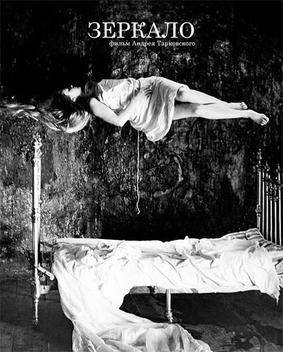
Andrei Tarkovsky directed the 1975 film and wrote it with Alexander Misharin. Margarita Terekhova plays both the narrator's mother and his former wife, a casting choice that makes resemblance part of the film's construction. Childhood, wartime experience and adult life share the narrative with dreams, poetry and archival images. These are not interchangeable kinds of evidence. A staged recollection can tell us about a character's attachment without proving that every remembered detail happened precisely as shown. The film's personal associations should therefore be approached as an artistic arrangement rather than decoded as a fully authenticated biography of its director.
The central perspective belongs to Alexei, whose adult face is largely withheld. Memories of his mother and absent father mingle with troubled relations with Natalia and their son Ignat. A burning barn, anxious work at a printshop and wartime experiences become part of that recollection. The closing images bring the young mother and her older self into an impossible shared view across time. The film does not conclude by supplying a master timeline that resolves every transition. Its ending continues the relationship between moments, allowing ages that cannot coexist literally to remain close in feeling.
The doubled roles offer one way to follow that relationship without reducing the film to a puzzle. A memory of a parent may influence how someone sees a later partner, even when the two relationships are plainly different. Casting makes that association visible, but it does not require the women to have identical inner lives. Indeed, the gap between a man's associations and another person's separate existence can become one of the film's questions. Remembering somebody intensely does not necessarily mean understanding them fairly. Memory may preserve affection and also repeat a habit of seeing through one's own needs. The repeated face makes familiarity immediate while leaving the differences between those relationships available for the viewer to question.
The withheld adult face shifts attention away from a conventional central performance. A narrator can dominate a story without constantly occupying its visible centre. The people he recalls become the images through which his presence is inferred. That arrangement invites a useful question about autobiographical storytelling: how much of what we call a self is actually an account of other people? The film makes room for a mother, a partner and a child to become more than background information about the man remembering them. At the same time, their appearances remain shaped by the perspective that has brought them together.
History interrupts any temptation to treat recollection as a completely private room. Wartime images place individual experience beside upheaval that exceeds what one family could know or control. The film's movement between those scales does not make a childhood moment and a public event equal in size. It makes them capable of existing together in someone's awareness. A person may remember a small domestic fear from a period whose official history is dominated by enormous losses. The private memory is not a rival claim that history should be reduced to the household; it is one of the ways history entered a life.
Dreams complicate the distinction further because they can preserve emotional connections while abandoning ordinary physical possibility. Trying to translate every unusual image into a single fixed meaning would impose the kind of order the film repeatedly avoids. A more useful approach is to notice what a passage makes available: vulnerability, separation, a desired return or the persistence of somebody's presence. Those are interpretive possibilities rather than answers guaranteed by a code. The film allows associations to accumulate across its movements, so a later image can alter how an earlier one feels without explaining it away.
Mirror's final effect belongs to that ongoing alteration. A life recalled near its end does not become complete simply because there are no more events to add. Relations can remain unresolved, and a remembered moment may still contain possibilities that subsequent years closed off. The film holds those conditions together instead of choosing a single reconciled account. It offers an experience of time in which a person's past is active, uneven and shared with people who cannot be reduced to what that person remembers. Its continuity comes from those attachments, even when its scenes refuse the reassuring continuity of a calendar.