
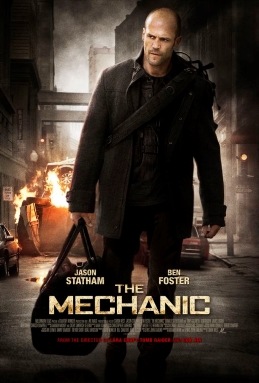
Behind the film
- Year
- 2011
- Director
- Simon West
- Writers
- Lewis John Carlino, Richard Wenk
- Runtime
- 1h 32m
- Genres
- Action, Thriller
- Production
- Millennium Media
- Country
- United States
- Cast
- Ben Foster, Jason Statham, Tony Goldwyn, Donald Sutherland, Mini Andén, Christa Campbell, John McConnell, Katarzyna Wolejnio
About the film
Contains story spoilers.
Arthur Bishop has built his life around leaving no trace. In Simon West’s 2011 film, “mechanic” is the trade’s name for a contract assassin who engineers deaths to look accidental or otherwise misdirect suspicion. Bishop is a meticulous planner who keeps to himself, spends time with records and a half-restored sports car, and approaches a job as a problem to solve. The opening assignment shows the method: he waits for a clean opportunity to kill a drug lord, then manipulates the aftermath so the guards believe their employer is still alive. The work is controlled, but it has also left Bishop isolated.
Harry McKenna is the exception. He is Bishop’s former teacher, close friend and senior figure in the same company, and their meetings carry the ease of a long relationship. Then Bishop’s employer, Dean, claims that Harry has betrayed the organisation and gives Bishop the assignment to kill him. Bishop hesitates but accepts. He stages the death to resemble a carjacking gone wrong, delivering a professional job that also destroys the one relationship that matters to him. Harry’s final exchange with Bishop makes the loss personal, and Bishop is left with the guilt of having acted on a story that was not true.
At Harry’s funeral, Bishop meets Steve, the dead man’s estranged son. Steve is angry, reckless and already interested in the assassin’s life; he wants Bishop to teach him. Bishop takes him on partly from guilt and partly because he can give Harry’s son the training he never received from his father. Their temperaments collide. Bishop plans each step and hides his presence, while Steve rushes in, improvises and can turn a quiet hit into a violent fight. His first lessons include surveillance, preparation and how to build a convincing accident, but the film also shows how little the young man understands about the consequences of the work.
Steve’s first contract is against Burke, another professional assassin. Bishop supplies a plan, but Steve ignores the intended quiet approach and goes to Burke’s house, where killing the much larger man becomes a prolonged fight. Later, Bishop and Steve target cult leader Andrew Vaughn. An intended medical-looking death gives way to strangulation and a shootout when the original method becomes impractical. The assignments keep turning instruction into improvisation. Bishop can explain how to control a situation, but his pupil’s choices—and unexpected circumstances around a target—disrupt the neat design. The relationship has an uncomfortable double edge: Bishop is shaping the son of the man he killed, while Steve is being taught by the person who has concealed the truth about his father.
The company’s account of Harry’s betrayal begins to unravel as Bishop and Steve uncover how Dean has directed them. They turn against the organisation that hired them and set out to reach its leader. The danger is now shared, but so is the information Steve lacks: he knows that Harry was killed by someone in the company, not yet that Bishop pulled the trigger. The film builds their final stretch around that imbalance. Their partnership works tactically, while each man reads the other through a different idea of loyalty—Bishop’s regret and Steve’s grief do not cancel the fact that one trained the other while concealing the truth.
Steve eventually finds evidence that Bishop killed his father. At a fuel stop, the two men recognise that the secret is no longer safe, though their conversation leaves room for a last choice. Bishop apologises without forcing Steve to accept it. Steve shoots the truck’s fuel tank and walks away believing he has killed his mentor; he then returns to Bishop’s home and takes the restored sports car. A note left for him warns that reading it means he is already dead. The car explodes with Steve inside, while security footage later shows Bishop rolling clear of the truck before its blast. The film ends on Bishop surviving through the same foresight that has defined his work, even after his bond with Steve is destroyed.
The remake keeps the original film’s apprenticeship framework but shifts its emphasis toward the father-and-son bond between Harry and Steve, and between a surrogate teacher and his pupil. Director Simon West said he and screenwriter Richard Wenk kept the 1972 story’s structure while rebuilding the dialogue and modernising the hit sequences. That intention is visible in the contrast between Statham’s controlled movements and Foster’s restless, sometimes uncontrolled energy. Their scenes alternate between instruction and friction, so the action assignments also track whether Steve is learning discipline or simply finding a more efficient outlet for his anger.
The film sets this relationship inside a brisk, violent action style. Bishop’s elaborate setups depend on observation, disguises and timing; Steve’s methods are more physical and leave a trail. The contrast gives the assassin trade a practical vocabulary—watch a target, prepare a cover story, control what witnesses notice—while also showing how quickly that precision collapses when the pupil acts on impulse. Donald Sutherland’s brief role gives Harry the weight of an old bond that the film cannot pause long to explain. Once he is gone, Bishop and Steve carry the relationship forward as a mixture of mentorship, withheld truth and revenge, until the final explosions replace any chance of reconciliation.