
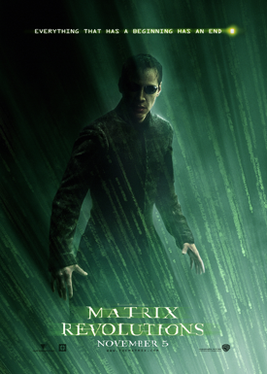
Behind the film
- Year
- 2003
- Director
- Lana Wachowski, Lilly Wachowski
- Writers
- Lana Wachowski, Lilly Wachowski
- Runtime
- 2h 9m
- Genres
- Science fiction action, Cyberpunk, Wuxia, Science fiction
- Production
- Warner Bros. Entertainment, Village Roadshow Pictures, Silver Pictures
- Country
- United States, Australia
- Cast
- Keanu Reeves, Laurence Fishburne, Carrie-Anne Moss, Hugo Weaving, Jada Pinkett Smith, Monica Bellucci, Lambert Wilson, Harold Perrineau
About the film
Contains story spoilers.
Neo’s body is aboard the Mjolnir while his consciousness is trapped in Mobil Avenue, a station between the Matrix and machine world. He meets Sati and her program family, but the Trainman prevents Neo from joining them on the train and leaves him stranded. In the Matrix, Trinity, Morpheus and Seraph confront the Merovingian and secure Neo’s release. This interval makes the two worlds feel less like a simple real-versus-virtual split: programs have families and motives of their own, and travel between systems becomes part of the conflict.
Neo visits the Oracle, who warns that Smith has become a threat to both the Matrix and the human world. Smith later absorbs the Oracle and gains her ability to see possible futures. Neo returns to his body as human crews regroup around Zion’s defense. The city is bracing for a Sentinel assault, while Neo concludes that he must go to the Machine City rather than remain with the fleet. Niobe offers him the Logos, and Trinity chooses to accompany him. Their missions are linked: Zion must survive long enough for Neo to reach the machines.
Bane, whose mind has been taken over by Smith, is hiding aboard the Logos. He takes Trinity hostage, and Neo realizes the person before him is no longer fully Bane. In the struggle, Bane blinds Neo with a power cable. Neo discovers he can still perceive machine code in the physical world and uses that ability to defeat him. Trinity pilots the ship onward. The discovery changes what Neo can do outside the Matrix, but it does not make him invulnerable; the journey remains dangerous and depends on the people aboard the ship.
At Zion, the Sentinels overwhelm the shipyard. Niobe and Morpheus race back on the Mjolnir, forcing the vessel through the partially opened gate before unleashing its electromagnetic pulse. The blast disables the attacking machines, but also knocks out Zion’s remaining defenses. The survivors understand that they have bought time, not safety. Their position shifts the film from a street-level fight to the burden of keeping a city alive while its defense systems lie dark and the next machine assault approaches.
The Logos reaches the Machine City and is attacked. Neo uses his new power to destroy some pursuing machines but collapses from the strain. Trinity flies above them, briefly sees the open sky before descending toward the city and crashing; she is fatally impaled and dies after telling Neo she loves him. Neo enters the Machine City alone and meets its leader, the Deus Ex Machina. He explains that Smith threatens the machines too, and offers to stop him in exchange for peace. The machines agree and pause their attack on Zion, creating a short window for Neo’s confrontation.
The machines plug Neo into the Matrix, where Smith has assimilated nearly everyone. The Smith-Oracle faces Neo and predicts victory, but during their prolonged fight Smith repeats the Oracle’s phrase about beginnings and endings. Neo allows Smith to assimilate him. In the machine city, energy passes through Neo and destroys Smith’s copies throughout the Matrix, restoring the people and programs he absorbed. The Sentinels withdraw from Zion. This is a sacrifice that ends the immediate war, not a simple combat victory; Neo’s survival remains uncertain as the city learns what has happened.
After the Matrix reboots, the Architect tells the Oracle that people who want to leave will be freed, though he criticizes the risks she took. Seraph asks whether she knew Neo would save them; she admits she did not, but believed. The ending leaves a new political arrangement rather than a complete account of what peace will mean. The Wachowskis contrast Zion’s metal corridors and the machines’ immense city with the rain-soaked digital streets of Neo’s final fight. Don Davis’s choral score gives the climax a scale beyond the physical blows exchanged between Neo and Smith.
Sati gives the machine world a stake beyond maintaining the system that has imprisoned humanity. Her parents are trying to protect a child whose existence is not justified by an assigned function, and their devotion is something Neo can understand even when their origin is unfamiliar. The Oracle’s care for her reinforces the distinction between machines as an opposing force and programs capable of individual attachment. Smith moves in the opposite direction, replacing differences with copies of himself. His apparent success empties the world of anyone who can disagree with him, leaving domination without a meaningful relationship to what has been dominated. The final fight takes place against that unnaturally uniform population, so Neo’s isolation has a visual counterpart in Smith’s endless repetition. The resolution also belongs to people far from that confrontation. Zion’s defenders have to continue working without certainty that Neo’s plan will succeed, and Niobe commits her ship while others prepare to withstand the assault. Their survival depends on an outcome they cannot directly control. Sati’s sunrise after the reset offers a gentler form of creation than either side’s weapons, suggesting that the newly negotiated peace might permit something beyond another round of defensive preparation.