
Behind the film
- Year
- 2021
- Director
- Lana Wachowski
- Writers
- Lana Wachowski, David Mitchell, Aleksandar Hemon
- Runtime
- 2h 28m
- Genres
- Cyberpunk, Science fiction, Action, Superhero
- Production
- Warner Bros. Entertainment, Village Roadshow Pictures
- Country
- United States
- Cast
- Keanu Reeves, Carrie-Anne Moss, Jessica Henwick, Yahya Abdul-Mateen II, Jonathan Groff, Neil Patrick Harris, Jada Pinkett Smith, Priyanka Chopra Jonas
About the film
Contains story spoilers.
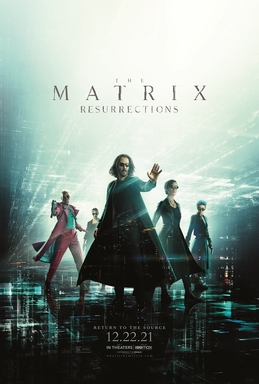
Bugs frees a new Morpheus program and helps awaken Thomas Anderson, who has been made to regard his life as Neo as a video game. Trinity lives nearby as Tiffany. Neo reaches Io, where Niobe explains that sixty years have passed and some machines now cooperate with humans. His therapist, the Analyst, reveals that he resurrected Neo and Trinity and uses their suppressed connection to power a new Matrix through emotional manipulation. Sati helps plan Trinity's extraction. Neo offers to return if she refuses liberation; Trinity recognises herself and chooses freedom. Smith disrupts the Analyst's attack. After a pursuit, Neo and Trinity leap from a rooftop, and Trinity flies them to safety. Together, they confront the Analyst and promise to reshape the Matrix.
The film begins from a particularly unsettling kind of containment: a person's own story can be available everywhere while its meaning remains inaccessible to him. That makes memory a battleground as much as the simulated environment. A familiar image does not guarantee a true understanding, especially when someone else provides the approved explanation for why it keeps returning. Keanu Reeves's Thomas is therefore placed in a situation different from simply forgetting an adventure. He is surrounded by a version of it that can be consumed, discussed and repackaged without leading him back to himself. The premise allows the sequel to ask what happens when an experience becomes a product, and whether recognition can survive the explanations used to make that product harmless.
That question gives Resurrections its deliberately self-aware relationship with the earlier films. The Matrix is both the world of the story and a recognisable piece of entertainment within it. The overlap makes familiar material feel unstable rather than automatically reassuring. References can offer a route towards understanding, but they can also become another layer of distraction. Lana Wachowski's film uses that ambiguity to examine the difference between repeating something and recovering what mattered about it. An audience expecting familiar gestures encounters a story interested in the expectation itself. Its continuation is therefore not only an additional mission within an established universe. It also becomes a conversation about how a universe is remembered, sold and made to resemble the thing people think they already know.
Neo and Trinity's relationship supplies a more intimate answer to that problem. Their connection matters because neither person can be adequately understood as an image in someone else's account. Carrie-Anne Moss's character requires her own recognition and agency; a rescue cannot substitute for the choice of the person being rescued. That gives the romance a different function from a reward attached to heroic success. It becomes a way of challenging a system that relies on deciding what both people are permitted to know and feel. The emotional stakes are consequently inseparable from the film's ideas about control. Freedom requires room for a relationship to exist on its participants' terms, rather than on terms imposed by whoever claims to understand them best.
The Analyst represents a form of domination built around that claim to understanding. Neil Patrick Harris's character makes control appear conversational and reassuring, allowing authority to operate through an explanation rather than an obvious command. The danger is not simply that he knows how people think. It is that he treats that knowledge as permission to arrange their lives in his own interest. That distinction helps the film move beyond a basic contrast between real and false surroundings. A convincing interpretation can be restrictive even when it seems to account for someone's discomfort. The question becomes who benefits from the explanation and what possibilities it excludes. The story places emotional dependency inside the machinery of the Matrix without suggesting that intimacy itself must be the enemy.
Bugs gives the return a perspective outside the central couple. Jessica Henwick's character connects curiosity with action, providing a way into familiar mythology without merely standing back to admire it. Her importance lies partly in the possibility that someone shaped by an earlier story can do more than repeat its conclusions. The new Morpheus similarly complicates the relationship between resemblance and identity. A name and a set of recognisable traits can carry meaning without making their bearer identical to the original person. That allows the film to revisit its own vocabulary while asking what can change within it. The younger figures are useful because they create movement between memory and possibility, making the past something to respond to rather than a script everyone must obey.
Io broadens the consequences of the earlier struggle. Its existence suggests that history can produce developments which a returning hero did not personally oversee and may not immediately understand. That is a valuable complication for a story centred on a legendary figure. Neo's importance does not mean that everyone else's life remained suspended in his absence. Niobe's perspective makes responsibility look different from the exhilaration of another escape: an established community has something to preserve, and caution can arise from care rather than cowardice. The film thereby gives survival a social scale. Personal liberation and collective security are related, but a difficult choice can emerge when they pull in different directions. The hero must encounter a world that has continued to acquire its own priorities.
Resurrections is still an action film, yet its most distinctive conflict concerns the ownership of meaning. Bodies can move through spectacular danger while identities remain confined by stories told about them. That tension gives the familiar visual language another purpose. A return to recognisable places and figures can either affirm an old arrangement or expose the need to change it. The film favours the possibility that a second chance should be more than another performance of the same role. Its romance, its new allies and its changed human world all press against the idea that familiarity is a complete answer. Understanding its direction means taking the emotional argument seriously alongside the spectacle: remembering who you were matters, but so does choosing what that knowledge allows you to become.