
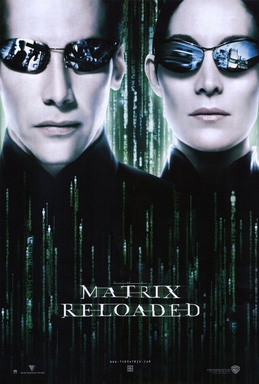
Behind the film
- Year
- 2003
- Director
- Lana Wachowski, Lilly Wachowski
- Writers
- Lana Wachowski, Lilly Wachowski
- Genres
- Action, Thriller, Science fiction, Martial arts
- Production
- Warner Bros. Entertainment, Village Roadshow Pictures, Silver Pictures
- Country
- United States
- Cast
- Keanu Reeves, Laurence Fishburne, Carrie-Anne Moss, Hugo Weaving, Gloria Foster, Jada Pinkett Smith, Lambert Wilson, Monica Bellucci
About the film
Contains story spoilers.
The Matrix Reloaded opens after Neo has learned to act outside the simulation’s usual limits, but that achievement has not ended the war. Machines are tunnelling toward Zion, the underground city where humans who escaped the Matrix live. Its defenders have little time to prepare, and their leaders disagree about how to use it. Commander Lock wants ships and crews available for military defence, while Morpheus believes that Neo’s role in the prophecy offers another route to survival. Neo and Trinity are now together, giving his recurring vision of her death a fear that reaches beyond the city’s larger emergency. His power has increased while his certainty about what to do with it has not.
Zion makes the human world more tangible than a briefing aboard the Nebuchadnezzar could. Homes, communal gatherings, machinery, and personal histories surround the resistance crews, showing the lives that depend on their decisions. Morpheus’ public confidence gives people a language for hope, but it also puts him at odds with those responsible for immediate practical defence. Neo is treated as a possible saviour by people who bring him needs he cannot simply solve. His conversation about the machines that sustain the city complicates the easy division between humans and technology: even a place built to resist machine control depends on mechanical systems to remain habitable.
Inside the Matrix, Neo reaches the Oracle through her guardian Seraph and learns that she too is a program. That discovery changes the grounds on which he has trusted her, although it does not make her advice immediately useless. She directs him toward the Keymaker, whose ability to open concealed passages can take him to the Source. Smith then returns, no longer functioning as the agent Neo previously fought. He can copy himself over other inhabitants, turning a confrontation into an expanding crowd of the same opponent. His encounter with Bane allows him to reach beyond the simulation through a human body, giving the rebellion an intrusion it has not yet recognized.
The Keymaker is being held by the Merovingian, a program who treats access and information as possessions to trade. Neo, Morpheus, and Trinity meet him in a restaurant, where his insistence on cause and consequence makes a negotiation sound like a lecture. His wife Persephone provides another way forward, acting out of anger at his infidelity rather than loyalty to the resistance. Their intervention releases the Keymaker but brings the Merovingian’s followers after them. Neo holds off attackers while his companions flee, and the pursuit moves onto a freeway where agents, the ghostlike Twins, civilian vehicles, and the escaping group share a dangerously confined route.
Reaching the Source becomes a coordinated operation rather than a door Neo can simply force open. Several ship crews must act together to interrupt the power systems protecting it, while the Keymaker guides Neo and Morpheus through the simulation’s concealed connections. Neo asks Trinity to remain outside because of his vision, but the loss of another crew forces her to complete their part of the operation. Smith’s copies attack the approach, and the Keymaker dies after opening the final passage. Neo reaches the Architect, the program responsible for the Matrix’s design, at the same moment that the plan has exposed Trinity to the danger he hoped to prevent.
The Architect gives the prophecy a different explanation. The One is part of a recurring system for managing the instability produced by human choice, and previous versions have ended with Zion destroyed and repopulated. Neo is offered a path that continues that cycle, or a return to Trinity with catastrophic consequences presented as the alternative. He chooses her, catches her after she is shot and falls, and restores her heartbeat. Back outside the Matrix, Sentinels destroy the Nebuchadnezzar. Neo unexpectedly stops pursuing machines without being connected to the simulation, then collapses. The survivors are recovered by another ship, where the unconscious Bane lies near him and the wider human counterattack has already failed.
The action repeatedly tests whether overwhelming ability is enough. Neo’s fight with Smith’s copies becomes a problem of endless repetition, while the freeway chase requires Morpheus and Trinity to protect another person through movement they cannot fully control. Doors offer a particularly fitting image for the film’s questions: a route can appear to be an escape while remaining part of a system designed by someone else. The Architect’s room turns that problem into a conversation surrounded by screens, replacing the reassuring language of destiny with a calculation Neo is expected to complete. His refusal is personal and immediate, but its effect on everyone beyond Trinity remains unresolved.
The two worlds also have different physical textures. Zion’s worn surfaces, crowded gatherings, and exposed infrastructure put human survival close to bodies and labour. Within the Matrix, immaculate interiors and carefully arranged clothes can belong to programs competing over access to the system. The Merovingian’s polished authority differs from the Oracle’s familiar manner, making appearances an unreliable guide to allegiance. The Wachowskis extend the first film’s premise by letting the resistance discover how deeply its own expectations may have been anticipated. Reloaded ends with those expectations shaken, leaving the approaching battle, Smith’s new reach, and Neo’s unexplained connection to the machines open rather than supplying the later film’s answers.