
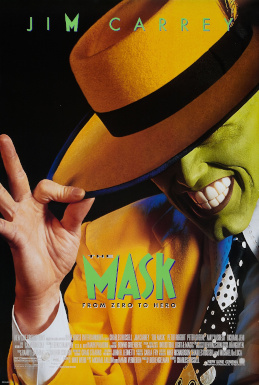
Behind the film
- Year
- 1994
- Director
- Chuck Russell
- Writers
- Mike Werb
- Runtime
- 1h 41m
- Genres
- Fantasy, Superhero, Comedy, Speculative fiction
- Production
- New Line Cinema, Dark Horse Entertainment
- Country
- United States
- Cast
- Jim Carrey, Cameron Diaz, Peter Greene, Peter Riegert, Amy Yasbeck, Richard Jeni, Orestes Matacena, Ben Stein
About the film
Contains story spoilers.
Stanley Ipkiss spends his days being pushed around in Edge City. At the bank, customers and colleagues take advantage of his willingness to please; at home, his landlady has little patience for him. His friend Charlie offers a route into the city’s nightlife, although getting through the door of the Coco Bongo is another matter. Then singer Tina Carlyle visits Stanley’s workplace. He sees a glamorous woman who treats him kindly, without realizing that her camera is recording the bank for a robbery. Tina’s boyfriend, gangster Dorian Tyrell, wants enough money and influence to replace the nightclub’s owner, Niko. Stanley’s ordinary frustrations and Dorian’s criminal ambitions are about to collide through a very strange object.
After a miserable evening, Stanley stops at a bridge and spots what appears to be someone in the water. His attempt to help turns up a wooden mask instead. Putting it on at home produces a green face, impossible movements, and a personality that treats the room like a cartoon set. Inhibitions disappear along with ordinary physical limits. Stanley can change shape, manufacture props, and turn a confrontation into a performance. The morning brings his familiar face back, leaving him to work out whether the night really happened. His dog Milo is a more dependable companion than most of the people around him, even when the newly animated household becomes difficult to manage.
Money becomes the first practical use of the transformation. Stanley robs his own bank to fund a visit to Tina’s club, getting there ahead of Dorian’s planned thieves and disrupting their operation. Inside the Coco Bongo, the awkward customer becomes an extravagant dancer in a bright suit. Tina responds to his confidence, while Dorian sees someone who has taken his money and challenged his authority. Police lieutenant Kellaway starts linking the disturbances to Stanley. A piece of clothing left behind changes back into material from his ordinary pajamas, giving the detective a clue that the night-time figure and the nervous bank employee belong to the same story.
Stanley consults psychiatrist Arthur Neuman, whose discussion of social disguises gives him a way to understand the object. Its association with Loki suggests a trickster rather than a conventional hero, and its effects draw on the wearer’s suppressed desires. That distinction becomes dangerous when reporter Peggy Brandt betrays Stanley to Dorian for money. Dorian puts the mask on and becomes a far more menacing figure, using its power to pursue the control he already wanted. Stanley is handed over to the police. When Tina visits him, she makes clear that she values the kindness he showed her without the transformation. The appeal of the mask now has to compete with the possibility of being accepted as himself.
Dorian takes Tina to a charity event at the Coco Bongo, kills Niko, and threatens the people inside with a bomb. Milo retrieves the keys that help Stanley escape his cell, and Stanley returns to the club before he has any magical advantage. Tina tricks Dorian into removing the mask, allowing Milo to wear it briefly before Stanley recovers it. The final fight brings cartoon physics to the rescue: the bomb is swallowed, and Dorian is swept away through the fountain. The mayor’s intervention clears Stanley, while Kellaway’s suspicions fail to settle the story. Back at the bridge, Tina throws the mask away. Stanley’s relationship can begin without keeping the object, although Milo remains interested in retrieving it.
Jim Carrey’s performance supplies the connection between the digital effects and the person beneath them. As Stanley, he folds himself into apologetic smiles and hesitant movements; transformed, he becomes a succession of poses, voices, and exaggerated reactions. An attraction can send his eyes and tongue beyond any plausible anatomy, while an escape can turn into a musical number with the police joining the choreography. The effects follow the emotional impulse rather than requiring a consistent set of combat abilities. It makes sense that Stanley’s enthusiasm would become spectacle, just as Dorian’s desire to dominate produces a heavier, more threatening incarnation of the same magic. Stanley’s collection of cartoons gives those fantasies a recognizable source, connecting the elastic screen effects to the entertainment he already retreats into at home.
The Coco Bongo gives that spectacle a particular home. Its band, dance floor, and sharply dressed crowd connect Stanley’s fantasies to old nightclub glamour, while the surrounding gangster plot provides people determined to take everything seriously. Their seriousness gives his improvisation something to disrupt. Tina moves between both worlds: she understands the danger posed by Dorian and can participate in Stanley’s theatrical exuberance, but her decisions also help free them from it. The romance therefore depends on more than an impressive entrance. Stanley must act while vulnerable, and Tina must help change the terms of the confrontation, before the film lets them leave the nightclub and face an ordinary day together.