
Behind the film
- Year
- 1998
- Director
- Martin Campbell
- Writers
- John Eskow, Ted Elliott, Terry Rossio
- Runtime
- 2h 17m
- Genres
- Action, Heist, Superhero, Adventure
- Production
- TriStar Pictures, Amblin Entertainment
- Country
- United States
- Cast
- Antonio Banderas, Anthony Hopkins, Catherine Zeta-Jones, Stuart Wilson, Matt Letscher, L. Q. Jones, Tony Amendola, Maury Chaykin
About the film
Contains story spoilers.
The Mask of Zorro makes the famous identity something that can survive the man who first carried it, but only if the successor understands what the identity is for. A mask can conceal a face without supplying a purpose. Alejandro begins with a personal enemy and a powerful desire to answer his loss, while Diego possesses experience shaped by years of fighting for others. Their meeting gives the adventure a relationship between different stages of life, connecting youthful impatience with experience acquired through loss. The older man's knowledge needs a future, and the younger man's energy needs a direction that can make it more than an extension of anger.
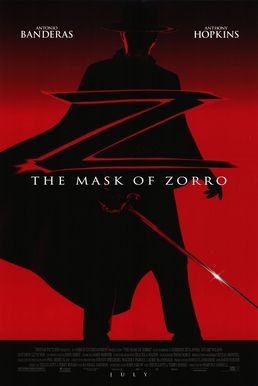
Martin Campbell directs the 1998 swashbuckler, with Antonio Banderas as Alejandro Murrieta, Anthony Hopkins as Don Diego de la Vega and Catherine Zeta-Jones as Elena. Stuart Wilson plays Rafael Montero. John Eskow, Ted Elliott and Terry Rossio wrote the screenplay. The film's nineteenth-century California is an adventure setting built around corrupt power, concealed identities and dramatic reversals, rather than documentary history. Its political conflict gives the swordplay a public purpose, while the relationships give the same action private stakes. A confrontation can therefore concern the fate of exploited workers and the recovery of a family at the same time.
Montero discovers Diego is Zorro, imprisons him and takes his infant daughter after Diego's wife is killed. Years later, Diego escapes and trains Alejandro, whose brother has died following an encounter with Captain Love. Montero returns with Elena, raised to believe he is her father, and plans to acquire California using wealth extracted through forced labour. Alejandro infiltrates his circle while Elena learns about her real parents. At the mine, the two Zorros confront their enemies and help free the workers. Diego is fatally wounded, but blesses Alejandro and Elena before his death. Alejandro continues the identity and starts a family with her.
Training changes Alejandro's relationship to the skill he wants to acquire. At first, becoming more capable appears to mean becoming better equipped to pursue his own grievance. Diego insists that Zorro's role includes obligations to people who cannot protect themselves. That lesson is not entirely comfortable for either man, because Diego's own desire to recover Elena can also draw him towards a private objective. Their partnership has to negotiate the difference between teaching a principle and consistently living by it, making succession an exchange in which both have something to recognise about their motives.
Elena's position gives concealed identity another meaning. Alejandro hides who he is as a strategy; Elena has had important knowledge of who she is withheld from her. Her relationship with Montero rests on an account of her origins that protects his actions from scrutiny. Discovering the truth therefore changes more than the name she attaches to a father. It alters the meaning of the home and affection through which she has understood her life. The film gives her recognition consequences within the action, allowing knowledge to change what she chooses to do rather than leaving her simply waiting to be reclaimed.
The romance between Elena and Alejandro develops through performances in which neither person's full position is initially available to the other. His movement between polished social appearances and the masked figure creates opportunities for attraction as well as misunderstanding. The adventure can use that contrast for humour and flirtation while retaining the larger problem of trust. A person who can convincingly occupy different roles must eventually offer something more stable than a successful performance. Their relationship becomes part of the succession story because Alejandro's future requires an identity he can inhabit with others, not merely a disguise through which he can act alone.
The mine reveals the substance beneath Montero's ambitions. His plan treats the territory as something that can be obtained through an arrangement among powerful men, while the wealth enabling that arrangement depends on people who have been denied freedom. That connection gives the final rescue an importance beyond defeating the villains. Saving the workers directly answers the lesson Diego has been trying to pass on, making the mantle of Zorro visible through service rather than reputation. The action brings the heroic identity down to a practical demand: people are in danger, and their survival must matter alongside the heroes' personal reckonings.
Diego's death makes the succession final while preserving its emotional cost. Recovering his daughter does not give him the long future with her that Montero's actions took away. Alejandro can carry the identity forward, but he cannot undo that loss. The later family scene allows continuity to sit beside bereavement, giving the ending a future without erasing what made it necessary. Campbell's film turns the inherited mask into a promise that a hero's work can outlast him, provided the next wearer understands the people behind the legend and the responsibilities that make the legend worth continuing.