
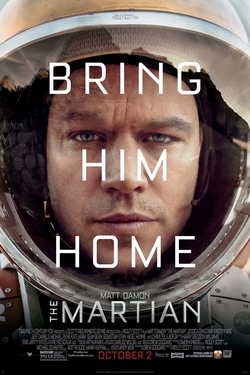
Behind the film
- Year
- 2015
- Director
- Ridley Scott
- Writers
- Drew Goddard, Andy Weir
- Runtime
- 2h 21m
- Genres
- Science fiction, Survival, Adventure, Drama
- Production
- Scott Free Productions, TSG Entertainment, 20th Century Studios
- Country
- United States, United Kingdom
- Cast
- Matt Damon, Jessica Chastain, Kristen Wiig, Jeff Daniels, Michael Peña, Kate Mara, Sean Bean, Sebastian Stan
About the film
Contains story spoilers.
The Ares 3 crew are carrying out a surface mission on Mars when an approaching storm makes the habitat and launch plan unsafe. During the evacuation, an antenna section hits Mark Watney and throws him out of sight. Commander Melissa Lewis has to leave with the rest of the team before the ascent vehicle is compromised, and the crew take Watney’s silence and missing signal as evidence that he is dead. The film then reveals that he has survived and returned to the habitat. He is badly injured, alone on another planet and faced with a mission designed for a full crew, not one person left behind.
Watney is a botanist as well as an astronaut, and he treats survival as a sequence of problems that can be measured. The habitat has limited food, water and oxygen, and the next planned human mission is years away. He inventories the supplies, works out how long they can last and tries to stretch them by growing potatoes in Martian soil using the crew’s stored waste as fertilizer. The solution is not magic: it depends on available material, careful routines and a controlled environment. A breach or failed harvest could wipe out the margin he has created, so even a small repair can become a major story turn.
The movie follows Watney’s practical work alongside the effort back on Earth. At NASA, satellite images reveal that he is moving around the habitat, forcing the agency to acknowledge that he is alive. Communications become the next problem: he needs a way to send information to Earth, and Earth needs a way to send instructions back. He travels to an old Mars mission site and recovers the Pathfinder probe, using it to re-establish contact. The exchange is slow and limited, but it changes his situation from solitary improvisation into a conversation with people who can help plan the next steps.
At NASA, director Teddy Sanders and mission director Vincent Kapoor have to weigh a rescue attempt against the risks to another crew. Mitch Henderson, who manages the astronauts, learns that headquarters has kept important information from Lewis and her team. Meanwhile, JPL director Bruce Ng and his staff work on a supply plan to send food to Mars, and a young astrodynamicist, Rich Purnell, proposes a different route using the Hermes spacecraft already returning to Earth. These parallel threads show that the rescue depends on people with different kinds of authority: engineering, flight operations and public decision-making all affect what Watney can attempt.
A disaster in the habitat destroys Watney’s potato crop and the environment he depends on. The setback is not just a shortage of calories; it removes the plan that was meant to carry him through the waiting period. He responds by packing for a long rover journey to Schiaparelli crater, where the Ares 4 ascent vehicle is scheduled to be waiting. The trip turns the film into a road story across a mostly empty landscape. Watney modifies the rover for the distance, watches its power and life-support needs, and uses the terrain as a series of obstacles rather than scenery alone.
The rescue becomes a rebellion when Henderson secretly sends Purnell's rejected course to the Hermes crew. Lewis puts the decision to a unanimous vote: turn back for Watney despite NASA's refusal, or continue home. Lewis, Martinez, Vogel, Beck and Johanssen decide to continue, even though the return will extend their mission and expose them to danger. NASA and the crew coordinate a complicated intercept, while Watney reaches the ascent vehicle and alters it so it can meet Hermes. Each side has to make the other’s plan physically possible: he can control the vehicle on Mars, but only his crew can reach him in space. Their work is collaborative even when the characters are separated by millions of kilometres.
The rendezvous does not go exactly to plan. Watney launches from Mars, but the Hermes and the ascent vehicle approach at an unsafe speed. The crew adjust course, and Lewis goes out to retrieve him. Watney cuts his glove and uses the escaping air to steer himself toward her, a desperate improvisation that echoes the practical, slightly comic tone he has used to keep fear manageable. Lewis catches him, and the crew bring him aboard. The rescue is not won by one heroic trick; it is the last link in a chain of work by Watney, the people at NASA and the astronauts who chose to turn back.
The film jumps ahead to Watney teaching astronaut candidates, describing survival as a process of solving one problem and then moving to the next. That closing note fits the structure the movie has used throughout: a damaged system, an inventory of what remains, an experiment, a setback and another attempt. The humor keeps the story from becoming grim, but it does not make the isolation disappear. Watney’s jokes are one way of dealing with it, while the parallel Earth scenes show how many other people are quietly invested in whether his next calculation works.