
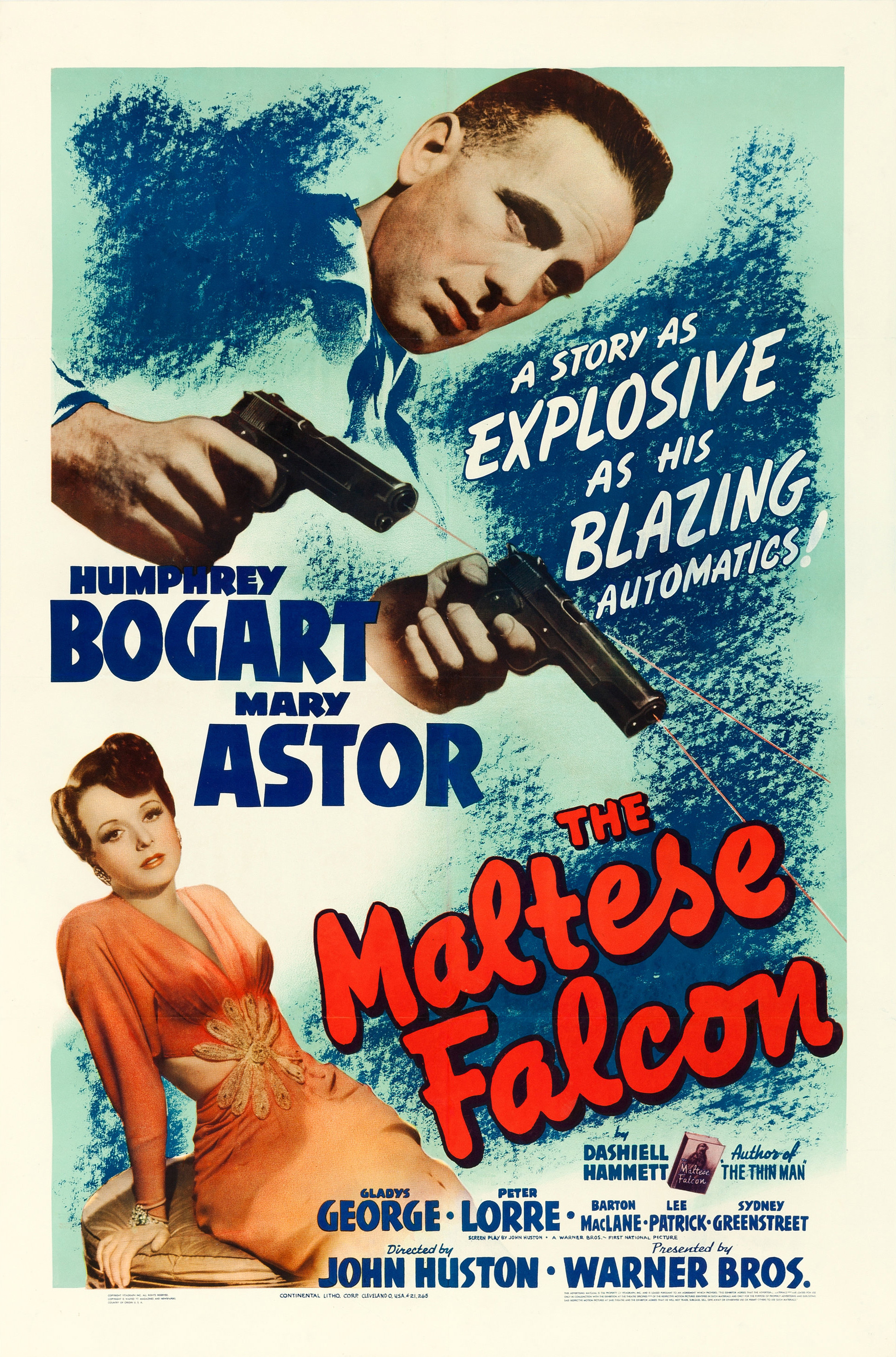
Behind the film
- Year
- 1941
- Director
- John Huston
- Writers
- John Huston
- Genres
- Crime, Mystery, Film noir, Treasure hunt
- Production
- Warner Bros. Entertainment, Warner Bros. Pictures
- Country
- United States
- Cast
- Humphrey Bogart, Mary Astor, Peter Lorre, Sydney Greenstreet, Gladys George, Lee Patrick, Elisha Cook Jr., Barton MacLane
About the film
Contains story spoilers.
A woman calling herself Ruth Wonderly hires Sam Spade and Miles Archer with a story about a missing sister. Archer is murdered, another man dies, and their client admits she is really Brigid O'Shaughnessy. Spade encounters Joel Cairo and Kasper Gutman, rival seekers of a supposedly priceless falcon statue, while police suspect his involvement in the killings. A dying ship's captain brings the bird to his office. Spade negotiates with Gutman's circle, demanding a culprit he can hand over to police; their anticipated treasure turns out to be a fake. He identifies Brigid as Archer's killer, despite his attraction to her, and turns her in. The mystery ends with an ordinary-looking object carrying an extraordinary record of deception, hope and violence.
Spade's profession makes skepticism part of his daily work, but skepticism is not the same thing as knowing the answer. A detective can recognize an implausible account without immediately possessing a better one. That distinction gives the conversations their pressure. Listening becomes a way of measuring what another person needs him to believe, and bargaining becomes a way of buying time. The film's puzzle is therefore social as much as evidential. Each participant tries to manage the amount of information in circulation, offering enough to secure help while withholding enough to retain an advantage. Spade has to work inside that economy rather than standing above it. His apparent confidence is useful precisely because the people facing him cannot easily see how much remains uncertain.
Brigid brings the emotional cost of that uncertainty into focus. Her vulnerability can invite protection while also directing attention away from her own decisions. The difficulty is that a convincing appeal need not be wholly fabricated to be manipulative. Someone can be afraid and still be lying about why. Spade's attraction makes that ambiguity harder to handle because desire encourages him to accept the explanation that would allow intimacy to continue. The film gives the conflict force by refusing to make professional suspicion cancel feeling. Caring about a person does not guarantee that their account is reliable. The eventual judgment matters because it requires him to act against a wish he has not simply stopped having.
Gutman's courtesy offers another kind of disguise. The language of civilized negotiation can make a dangerous demand sound like an interesting business proposition. His composure invites the detective to join a conversation between reasonable men, even when that conversation depends on treating other people as expendable. Cairo brings a more brittle version of the same bargaining world: formality and threat can sit very close together. Their different manners create variety without supplying a clear ethical distinction. A polished surface may conceal violence, and a nervous surface may conceal purpose. The ensemble makes the room itself unstable, because the meaning of an alliance can change without anyone leaving their chair. Holding a conversation becomes a tactical act.
The falcon is effective because much of its importance exists in what people believe about it. Its promised value organizes behavior before anyone can establish that the object in front of them deserves the promise. The desire to possess it becomes its own momentum, strong enough to survive repeated warnings and injuries. This is a treasure story whose deepest suspense concerns the cost of wanting. An object can become a justification for betrayal while remaining strangely remote from the practical damage done in its name. The film does not need a large archaeological world to make that appetite legible. What matters is the way the imagined prize changes the terms on which its seekers deal with one another.
Much of the action happens through pressure rather than pursuit. Offices, apartments and hotel rooms become places where a person can seem surrounded even while everyone is speaking politely. A doorway changes who controls access; a seated conversation can place someone at a disadvantage without looking like a fight. The black-and-white image supports a world of partial knowledge, in which faces and gestures have to carry meanings that no narrator resolves for the audience. Bogart's restrained authority gives Spade a readable surface while keeping the motive underneath available for doubt. Huston's staging allows the actors' competing energies to become part of the investigation. Watching who waits, interrupts or remains comfortable can matter as much as following the declared facts.
Spade's relationship to Archer makes duty particularly complicated. An obligation does not necessarily disappear because affection is limited or because the people involved have behaved badly. That is a harder code than simple loyalty to someone you love. It asks whether a professional relationship establishes responsibilities that survive personal dislike and temptation. The detective's moral standing remains imperfect, but imperfection does not make every decision equivalent. There can still be a line he refuses to cross. The film's strength as a character problem lies in locating that line within a compromised person, rather than furnishing an unimpeachable hero who always wanted to do the correct thing. Judgment becomes an action taken under pressure, with a real emotional price attached.
The failed promise of the bird leaves two kinds of consequences behind. The seekers' fantasy can continue elsewhere, because disappointment does not necessarily end obsession. The harms committed while pursuing it remain concrete, however small or worthless the object itself proves to be. That imbalance gives the ending its weight. A mystery can explain what happened without repairing it, and exposing a lie does not restore every life organized around the lie. Spade's choice closes his immediate case while leaving the larger hunger recognizable. The world has not become transparent or safe. What has become clearer is that wanting something intensely cannot establish its value, or excuse the way a person behaves while trying to obtain it.