
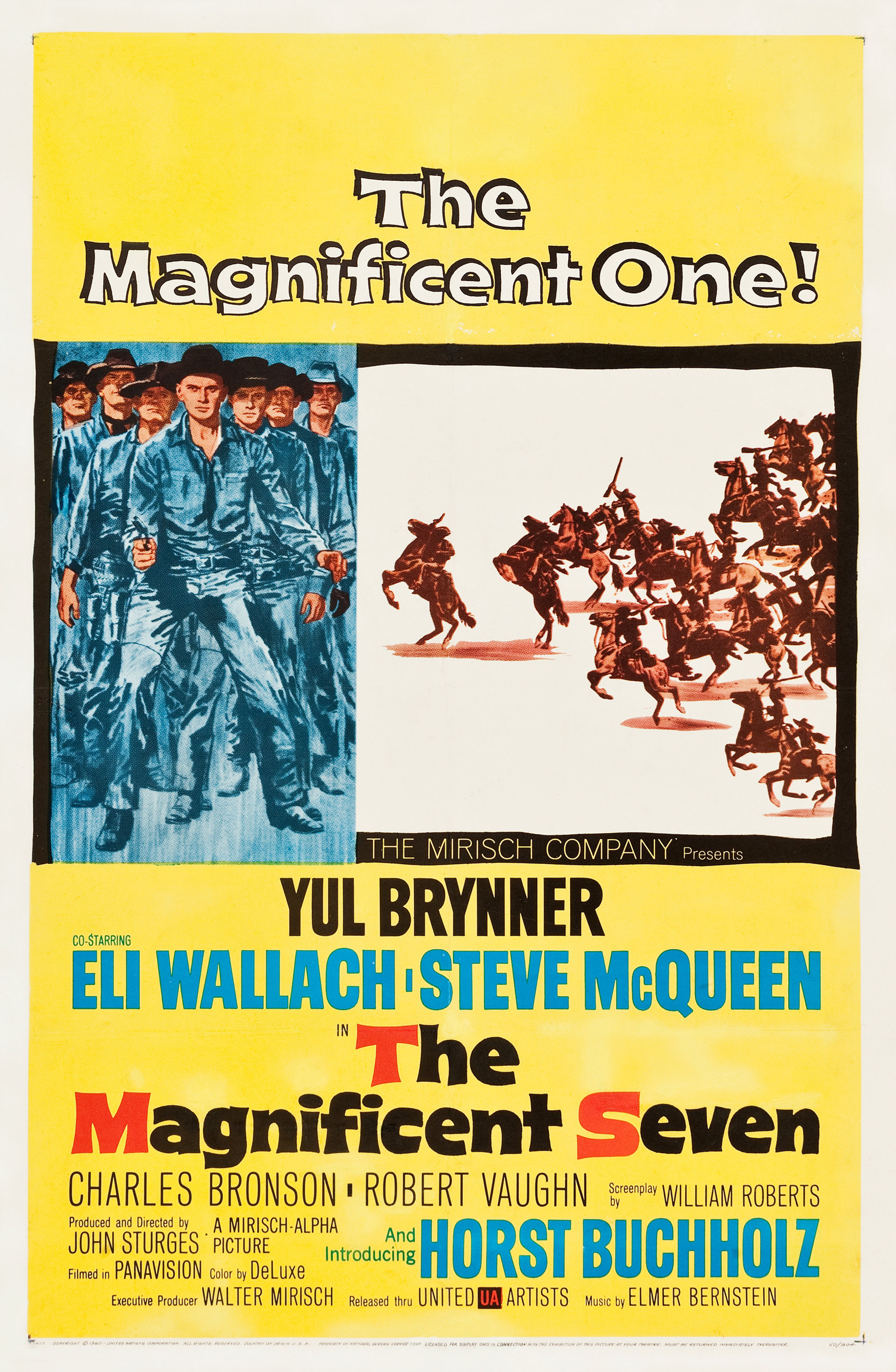
Behind the film
- Year
- 1960
- Director
- John Sturges
- Writers
- William Roberts
- Genres
- Western, Drama, Action
- Production
- United Artists, The Mirisch Company
- Country
- United States
- Cast
- Yul Brynner, Steve McQueen, Eli Wallach, Charles Bronson, James Coburn, Robert Vaughn, Brad Dexter, Horst Buchholz
About the film
Contains story spoilers.
Calvera and his bandits return to the Mexican village of Ixcatlan at harvest time, taking food and goods as they have before. When one farmer protests, Calvera shoots him, and the other villagers are left with too little to survive. An elder advises them to buy guns and learn to defend themselves. A delegation heads to the border and encounters Chris Adams and Vin Tanner, gunmen who agree to drive a dead Indigenous man’s coffin through a hostile town when the undertaker refuses to risk the trip. The villagers watch the two men outdraw an angry crowd and ask Chris to buy weapons. He proposes something different: hire gunmen to stand with them while they learn to fight.
The village can afford only a small fee for six weeks’ work, so Chris recruits men for reasons other than a rich reward. Vin joins, along with O’Reilly, a veteran; Britt, a composed expert with knife and gun; Lee, a well-dressed man whose confidence has collapsed; and Harry Luck, who assumes there must be hidden treasure. Chico, a young Mexican who admires the gunmen, is initially rejected after failing Chris’s test. He follows the group anyway and eventually earns a place. The seven ride to Ixcatlan and meet a population too frightened to welcome them. The men begin by protecting a village that does not yet trust them, and Chico’s anger at its caution reveals how much he still romanticizes the life he wants.
The preparation is as important as the eventual gunfight. The seven discover Calvera’s scouts and use the weapons taken from them to teach the farmers how to shoot. When the villagers hide their women, fearing the hired men as much as the bandits, Chris tells them that Calvera poses the greater danger and sends Chico to bring the women back. Food is scarce; once the gunmen learn how little the farmers have, they give their own portions away. These actions shift the arrangement from a job to a relationship, though the men continue to tell themselves they are professionals. The village also begins turning its physical layout into defense, building barriers and traps that let its residents contribute rather than watch passively.
Calvera’s first attack meets a force more prepared than before. He offers the seven a share of the village’s goods if they stand aside, but Chris refuses. The bandits are driven back, and the villagers celebrate until shots interrupt the evening. The seven search for the attackers and confront the costs that make their hired detachment difficult to maintain. Vin envies Sotero’s family life; Lee admits he has enemies and fears that they may find him; O’Reilly grows close to the village boys who look up to him. Harry continues to expect treasure, while Chico is drawn to Petra, a young woman who offers a life beyond the gun belt. The men’s private reasons for joining begin to matter more than their professional poses.
Chico infiltrates Calvera’s camp and learns that the bandits are preparing to return because they are hungry. The villagers argue about whether resistance is worth risking their families. Meanwhile, the seven’s attempt to steal the bandits’ horses fails, and Calvera captures them after the traitor Sotero reveals their plan. Calvera lets the men go, privately offering their guns back and asking why they care about a poor village. He cannot imagine a motive beyond money. The group leaves Ixcatlan with weapons, but the betrayal has changed its meaning: the seven must decide whether to walk away once the contract and the villagers’ trust have both collapsed.
Harry departs, tired of fighting without the treasure he imagined. The others return to Ixcatlan and are drawn into the final battle. Vin is wounded; Harry changes his mind, rides back and is shot. Chris carries him into a store and comforts him with a story about the riches he hoped to find. Lee finally overcomes his fear and shoots several attackers before he is killed. The farmers and women join the defense, and the bandits are driven from the village. Britt and O’Reilly also die, the latter beside the boys who had adopted him as a hero. Chris, Vin and Chico survive, but the elder makes clear that the farmers, not the hired guns, have won the fight.
The closing ride gives Chico a choice that the others cannot make for him. Chris and Vin leave as professional gunmen, while Chico returns to Petra and puts down his holster. Chris accepts the elder’s judgment: the gunmen will keep losing because their work carries them from one crisis to the next, while the villagers have a home to rebuild. The ending holds victory and grief together without pretending that the seven have permanently changed the structure of violence. Their success is measured by what the farmers can now do for themselves, not by the legends the gunmen may tell about their own skill.
John Sturges builds the ensemble through contrasting temperaments and clear physical staging. Yul Brynner’s Chris makes decisions with economy, Steve McQueen’s Vin watches and reacts, Charles Bronson’s O’Reilly is shaped by his bond with the village children, and James Coburn’s Britt treats marksmanship as a discipline rather than a boast. Panavision landscapes give the bandits’ repeated approach a visible scale, while Elmer Bernstein’s theme turns the riders’ arrival into a ceremony. The story adapts Seven Samurai’s alliance between hired fighters and a threatened village into a Western setting, preserving the uncomfortable contrast between skill at violence and a settled life worth defending. Sturges keeps the adaptation focused on the exchange between gunmen and farmers, and on the cost each side pays for that alliance.