
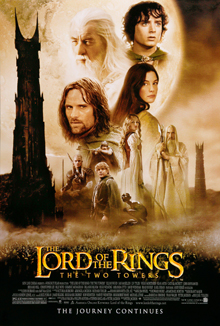
Behind the film
- Year
- 2002
- Director
- Peter Jackson
- Writers
- Fran Walsh, Philippa Boyens, Stephen Sinclair, Peter Jackson
- Runtime
- 2h 59m
- Genres
- Fantasy, Adventure, Action
- Production
- New Line Cinema, WingNut Films
- Country
- New Zealand, United States
- Cast
- Ian McKellen, Sean Astin, Viggo Mortensen, Andy Serkis, Liv Tyler, Cate Blanchett, John Rhys-Davies, Orlando Bloom
About the film
Contains story spoilers.
The Two Towers opens with the Fellowship broken apart after the attack at Amon Hen. Frodo and Sam have gone on toward Mordor, while Merry and Pippin have been captured by Orcs. Aragorn, Legolas and Gimli set out after them, following the trail across Rohan. The film adapts the middle movement of Peter Jackson’s Lord of the Rings trilogy, so its characters are already carrying choices and losses from The Fellowship of the Ring. Its title points toward two centres of danger, Saruman’s tower at Orthanc and Sauron’s stronghold in Mordor, but the immediate problem is how to keep the scattered companions from being swallowed by the war gathering around them.
Frodo and Sam are not alone for long. They catch Gollum, the former bearer of the Ring, and force him to guide them toward the Black Gate. He speaks of himself as both Gollum and Sméagol, and the film stages that split as an argument over whether he can resist the Ring’s pull. Sam distrusts him for good reason, while Frodo sees a possibility in the damaged creature because Gollum understands the burden he carries. Their relationship is uneasy and intimate: Gollum knows paths that the hobbits cannot find, but he also has a history with the Ring that makes every promise uncertain. The journey through the Dead Marshes turns that danger into images of submerged bodies and lights that tempt the living toward the water.
The pursuit party reaches Rohan, where King Théoden is under the influence of Saruman’s counsellor Gríma Wormtongue. Éomer has been sent away, and the king’s confidence is almost gone. Gandalf returns in white after his fall fighting the Balrog, and helps break Saruman’s hold over Théoden. The change gives Rohan a chance to act, but not time to prepare comfortably: Saruman’s army is already moving through the region. Aragorn, Legolas and Gimli become part of the effort to bring people to safety at Helm’s Deep. Théoden is not a simple coward suddenly transformed into a fearless commander; he has to choose between protecting his people in the fortress and believing that resistance still has meaning.
Merry and Pippin’s escape takes them into Fangorn Forest, where they meet Treebeard, an Ent who is cautious and slow to act. The hobbits try to persuade him that Saruman is destroying the trees, but he initially sees the conflict as something belonging to the other peoples of Middle-earth. Once he sees the clear-cut land around Isengard, his patience changes into anger. The Ents’ march is a second kind of battle beside Helm’s Deep: it begins with a decision about whether a people will involve itself at all. Their action against Isengard shows that the damage of war reaches beyond forts and armies, into the living places that have no voice in a council.
Helm’s Deep is the film’s great convergence point. Refugees crowd into the fortress while Théoden, Aragorn and their defenders prepare for an assault by Saruman’s much larger force. The storm, the dark ramparts and the tight spaces make the siege feel physically exhausting, and the battle is extended into a central sequence rather than a brief obstacle. The attackers breach the wall with an explosive charge, pushing the defenders back toward the keep. Aragorn urges Théoden to ride out instead of waiting for the gate to fall. When defeat seems close, Gandalf returns at dawn with Éomer and the Rohirrim, striking the Orc army from behind. The reprieve is earned through endurance and timing, not an effortless victory.
The way the film arranges its separate journeys gives the story a wider pulse than a single quest could. Frodo’s route is quiet and exposed; Rohan’s story moves from political paralysis into organised defence; the Ents offer a much older perspective on the conflict. Gandalf’s account of surviving the Balrog is presented through Frodo’s dream and a voice-over passage, linking the new story to the previous film without turning it into a simple flashback. The intercutting lets one group’s choices echo against another’s: Frodo must decide whether to trust Gollum, Théoden must decide whether to resist, and Treebeard must decide whether the destruction has gone too far to ignore.
The adaptation makes its own choices around Tolkien’s novel. Helm’s Deep becomes the dramatic centre of this film, and the Aragorn-Arwen material appears through memories and visions rather than following the book’s presentation. Gollum is also a mixture of performance and digital character work, with Andy Serkis’s movement and voice giving the creature a readable inner conflict. The costumes, armour, creatures, props and environments give Rohan and Fangorn distinct physical identities. Those details keep the fantasy from becoming a generic battlefield: the timber halls of Edoras, the exposed stone of the fortress and the ancient forest all have different textures and histories.
At the end, Helm’s Deep has survived and Isengard has been flooded by the Ents, but neither victory resolves the larger war. Gandalf warns that the next assault will be directed toward Gondor, while Frodo, Sam and Gollum continue toward Mordor with danger still ahead. The theatrical cut ends with this forward-looking convergence; extended editions add material and run substantially longer, so a runtime depends on which version is being discussed. The film’s close is not a tidy stopping point. It leaves the characters in different kinds of motion, with the Ring still active, the armies still gathering and the survival of Rohan only one part of the struggle.