
Behind the film
- Year
- 2003
- Director
- Peter Jackson
- Writers
- Fran Walsh, Philippa Boyens, Peter Jackson
- Runtime
- 3h 20m
- Genres
- Fantasy, Adventure
- Production
- New Line Cinema, WingNut Films
- Country
- New Zealand, United States
- Cast
- Elijah Wood, Ian McKellen, Andy Serkis, Viggo Mortensen, Liv Tyler, Sean Astin, Cate Blanchett, Christopher Lee
About the film
Contains story spoilers.
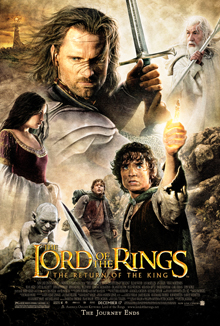
The Return of the King brings Peter Jackson’s film trilogy to its final conflict. The One Ring still has to be destroyed in the fires of Mount Doom, and Frodo is now deep into a journey that has worn down his strength and narrowed his world. Sam stays beside him, while Gollum guides them through the approaches to Mordor and quietly looks for a chance to reclaim the Ring. Far from them, Gandalf and the surviving companions face the military force gathering under Sauron. The film follows the theatrical trilogy’s story and its own adaptation choices; it is based on Tolkien’s book but does not reproduce every event in the same place or order.
The film opens with Gollum’s earlier life as Sméagol, showing how his desire for the Ring turns into the murder of Déagol and, over time, into the creature Frodo and Sam know. This is not just background information: it gives the audience a view of what the Ring has already done to a person who once carried it. In the present, Frodo’s trust in Gollum and Sam’s suspicion pull in opposite directions. Gollum is useful because he knows routes through Mordor, but every step closer to the Ring strengthens his possessiveness. Sam cannot make Frodo abandon him without also asking Frodo to abandon a guide he increasingly depends on.
The hobbits’ journey runs alongside the defence of Gondor. Pippin has seen Sauron’s power through the palantír and travels with Gandalf to Minas Tirith, where Steward Denethor is grieving Boromir and treats Faramir with cold disappointment. Denethor’s authority is weakened by despair and by his belief that resistance is pointless. Gandalf tries to organise the city’s defence while the enemy approaches, but courage alone cannot make the numbers fair. The film uses the white stone city, its terraces and walls to make Gondor feel like an old political inheritance under immediate threat. The question is whether its people can defend a kingdom whose own ruler has stopped believing it can be saved.
Aragorn’s path is about accepting responsibility that he has spent much of the trilogy avoiding. He joins Legolas and Gimli on the road to the Dead, where the Army of the Dead can be called upon because of an oath its members failed to keep. In the film, their arrival at the Battle of the Pelennor Fields gives the defenders decisive support. Aragorn’s return to Minas Tirith is therefore both military and symbolic: he is not simply a skilled fighter arriving with reinforcements, but the heir who must choose whether to stand publicly as a king. The story ties that choice to Gondor’s survival, while allowing Théoden, Éowyn and the Riders of Rohan to meet the danger on their own terms.
The battle sequence gathers several threads at once. Théoden leads the Rohirrim into the field, Éowyn fights alongside Merry after being told to remain behind, and the forces of Mordor bring enormous creatures and siege weapons against the city. The scale can be read in layers: individual decisions remain visible within the mass of soldiers and machines. The battle is not won without loss, and Théoden dies after being struck down, with Éowyn beside him. The film shifts some details from the novel, including the moment of Théoden’s death and who receives his final words. Its attention stays on the characters’ experience of the clash rather than on a detached map of military movements.
While the armies fight, Frodo and Sam’s route becomes more private and difficult. Gollum tricks Frodo into suspecting Sam, and the two hobbits separate for a time. Sam returns when he realises the danger Frodo is in, but Frodo is already close to the limits of what he can carry. At the pass above Mordor, Shelob attacks them. Sam drives the creature away and believes Frodo is dead, but the Orcs carry Frodo into their tower. Sam follows and frees him. These events make his loyalty practical as well as emotional: he is the one who can act when Frodo cannot, and he keeps the task alive without being able to remove the Ring’s influence from Frodo’s mind.
The film’s design shifts between the worn intimacy of the hobbits and the huge scale of Minas Tirith and Mordor. Physical armour, weapons, costumes, props and prosthetics give the armies and peoples distinct visual identities. The Ring’s influence is conveyed through changes in sound and pace as well as through character reactions, while Gollum’s performance blends Andy Serkis’s acting with computer-generated work. The battle’s visual effects expand the forces on screen, but the close emotional line stays with people who are frightened, exhausted or responsible for someone else. Howard Shore’s score draws together motifs developed across the earlier films, giving the final conflict the feeling of an ending built over time.
Frodo reaches the Crack of Doom but cannot willingly throw the Ring into the fire. Gollum attacks him, takes the Ring and falls into the lava with it, ending the object’s hold on the world. The film then continues through a series of returns: Aragorn is crowned, the hobbits go home, and Frodo eventually leaves Middle-earth with the Elves because the wounds of his journey cannot be healed there. That extended farewell is a defining part of the theatrical ending, and the extended edition adds further scenes, including Saruman’s death before the final return to the Shire. The longer edition deepens several relationships and conflicts, but the central outcome remains the same: victory cannot return Frodo to the person he was before the journey. The film closes on survival, but also on what the survivors cannot simply put behind them.