
Behind the film
- Year
- 2013
- Director
- Gore Verbinski
- Writers
- Justin Haythe, Terry Rossio, Ted Elliott
- Runtime
- 149 minutes
- Genres
- Action, Buddy, Comedy, Western
- Production
- Walt Disney Pictures, Infinitum Nihil, Jerry Bruckheimer Films
- Country
- United States
- Cast
- Armie Hammer, Johnny Depp, William Fichtner, Tom Wilkinson, Ruth Wilson, Helena Bonham Carter, James Badge Dale, Barry Pepper
About the film
Contains story spoilers.
The Lone Ranger turns a hero's origin into a dispute about what justice can mean when respectable authority protects the people responsible for harm. John Reid arrives with confidence in a system of law, while Tonto brings a history that makes that confidence difficult to share. The adventure depends on their differences, but those differences are not limited to comic personality clashes. They involve incompatible expectations about how wrongdoing can be recognised and answered. Their partnership becomes necessary because neither one's starting position is enough to navigate the situation alone, and because the story repeatedly tests the institutions John initially expects to trust.
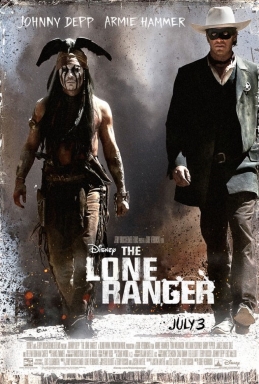
Gore Verbinski directs the 2013 Western adventure, with Armie Hammer as John and Johnny Depp as Tonto. Justin Haythe, Ted Elliott and Terry Rossio wrote the screenplay. Tom Wilkinson plays Cole, William Fichtner plays Cavendish and Ruth Wilson plays Rebecca. The film presents a fictional origin within a familiar franchise, not a historical account of Comanche people or railroad development. Its narrative is framed through an older Tonto telling a boy about the past. That arrangement makes the act of storytelling part of the film: a public legend is approached through one person's account rather than delivered as an uncontested record.
In 1869, John joins his brother Dan's pursuit of Cavendish. An ambush kills the Rangers, but John survives and joins Tonto under a concealed identity. Their investigation exposes railroad magnate Cole's connection to Cavendish and the exploitation of silver. Tonto's childhood history ties his grief to the same men. John eventually abandons his expectation that the compromised authorities will deliver justice. He resumes the mask and helps Tonto disrupt Cole's scheme, rescuing Rebecca and her son during the train confrontation. Afterwards he declines an official post and rides away with Tonto. The framing story leaves the boy considering what he has heard.
The mask gives identity a practical role in the disagreement about authority. A recognised name can place someone inside a system while preventing them from acting outside its assumptions. Concealment reverses that relationship, allowing John to reconsider which kind of legitimacy matters to him. The cost is that action can no longer be justified simply by pointing to an official role. The story's origin concerns becoming responsible for a choice rather than being entitled to make it through appointment. That makes the familiar heroic image the result of a conflict: it carries a changing understanding of the difference between lawful appearance and meaningful protection.
Tonto's grief brings a longer timescale into John's immediate crisis. A recent loss can feel like the centre of the world until it encounters suffering that preceded it and helped shape the conditions in which it occurred. Their relationship asks John to recognise a history his own account initially excludes. It also makes Tonto's certainty complicated, because grief can organise experience through explanations that another person does not share. The film's supernatural language belongs within that contested storytelling. Understanding its function does not require treating it as evidence about a real culture; it is part of how this fictional character expresses guilt, danger and the need for an answer.
The railroad connects wealth to the ability to define a public story. Something presented as progress can conceal whose land, safety or future has been treated as expendable. That contrast gives the infrastructure more significance than providing tracks on which an action scene can occur. It links movement and extraction, allowing the pursuit of profit to wear an appearance of communal advancement. The film's conflict asks who gets to describe the arrangement and whose experience that description leaves out. An institution's reputation can become another tool of control when the people benefiting from it also determine how its consequences are explained to everybody else.
Comedy operates alongside those darker pressures through the partnership's incompatible expectations and the adventure's extravagant circumstances. A hero can possess conviction without possessing an accurate understanding of what to do, and a companion can be helpful while remaining difficult to interpret. The resulting friction keeps cooperation active. The pair must respond to each other rather than merely discover that they agree after all. Their shared purpose develops through the difficulty of working together, giving the large action sequences a relationship to carry as well as an objective to resolve. The scale can become increasingly improbable while the disagreement about responsibility remains intelligible beneath it.
The framing device finally returns the legend to a listener who has to decide what to do with it. Stories can offer an image of courage without providing a neutral account of every event they contain. The film allows that difference to remain visible, making inspiration and uncertainty coexist. John's future also stays outside the uncomplicated security of an official position, since his experience has altered what such a position would mean. This version of the Lone Ranger is a Western origin story about a partnership formed through mistrust of easy explanations, ending with the mask as a chosen responsibility rather than a simple confirmation that its wearer was always right.