
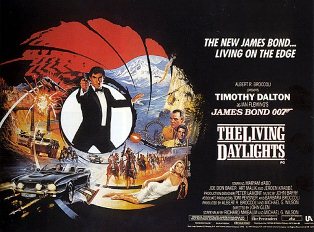
Behind the film
- Year
- 1987
- Director
- John Glen
- Writers
- Richard Maibaum, Michael G. Wilson
- Runtime
- 2h 10m
- Genres
- Thriller, Action, Spy
- Production
- Eon Productions
- Country
- United Kingdom
- Cast
- Timothy Dalton, Maryam d'Abo, Jeroen Krabbé, Joe Don Baker, Art Malik, John Rhys-Davies, Desmond Llewelyn, Caroline Bliss
About the film
Contains story spoilers.
The film opens with a training exercise for British agents on Gibraltar, where an intruder turns a routine test into a real attack and kills agent 004. Bond pursues the saboteur down the Rock and escapes by parachute as the attacker's vehicle goes over the edge. The pre-title sequence establishes a harder, more watchful Bond in Timothy Dalton's first appearance as 007: he follows a changing threat rather than pausing for a victory quip. The mission that follows begins in Bratislava, where KGB general Georgi Koskov plans to defect during an orchestra concert. Bond is stationed across the street as counter-sniper, watching for anyone who might stop the escape. The movie's early action joins a personal loss to an assignment that appears to concern a single high-ranking defector.
When Koskov slips from the concert hall, Bond notices the sniper is Kara Milovy, a cellist in the orchestra. His orders are to eliminate her, but he shoots the rifle rather than Kara, allowing Koskov to escape through a pipeline service shuttle to Austria. Bond later returns to Bratislava to learn who she is and discovers she is Koskov's lover. He pretends he is taking her to reunite with the general, and Kara accepts because she believes the defection was genuine. A cello case hides a rifle loaded with blanks, exposing that the first operation was staged. Bond still chooses to get Kara out of the city, and their escape through a police chase and across a frozen lake turns the deception into an uneasy partnership. Their trust develops while each has only partial knowledge of the other's intentions.
In Vienna, Saunders, Bond's local contact, traces Kara's expensive cello to American arms dealer Brad Whitaker. The connection implicates Koskov in a weapons deal and gives Bond reason to question the defector's account of a KGB campaign against Western agents. Necros, Koskov's operative, kills Saunders and leaves behind the same slogan used after earlier murders. Bond confronts Pushkin, the new KGB chief, who explains that Koskov has been avoiding arrest for misusing Soviet funds. Rather than kill Pushkin, Bond helps fake his assassination at a trade convention. The false news lets Koskov and Whitaker proceed, while Bond can follow their real plan without triggering a wider confrontation. The sequence changes the mission from obedience to investigation.
Kara has been told by Koskov that Bond is a KGB agent. She drugs him and helps Koskov take him to a Soviet air base in Afghanistan, where both are imprisoned. In a neighboring cell they meet Kamran Shah, an Afghan resistance leader condemned by the Soviets. The three escape, and Bond and Kara learn that Koskov is buying opium from Shah's fighters with Soviet diamonds. He intends to sell the drug and use the proceeds to complete the arms deal with Whitaker, who is supplying Western weapons. This scheme gives the spy plot a different shape from the opening: Koskov's danger comes less from ideology than from turning intelligence and military resources into personal profit. Kara's place in the operation shifts as she learns she has been used by the general she loved.
Bond and Kara work with Shah's men against the air base. Bond plants an explosive on the cargo plane carrying opium, but the plan breaks down when he is discovered and has to take off before the others can board. Kara drives a jeep into the cargo hold; Necros jumps aboard from another vehicle and fights Bond on the aircraft's open ramp. Bond knocks Necros from the plane, sending him from the hanging cargo net, and initially deactivates the bomb. Seeing Shah and his men pursued, he reactivates it and drops it onto a bridge, stopping the Soviet forces. The plane crashes, destroying the opium, while Bond and Kara survive. Back in Tangier, Bond and Felix Leiter confront Whitaker; Pushkin arrests Koskov and sends him back to Moscow. The ruined shipment and the confrontation in Tangier finally expose the financial operation concealed behind Koskov’s claim to political danger.
The closing Vienna concert returns Kara to the cello and lets her meet Bond after the operation is over, giving her a public performance that contrasts with her earlier, manipulated role as a supposed sniper. The film moves through concert halls, border checkpoints, an amusement park, a desert air base and the cargo plane, so each setting changes the kind of danger the characters face. John Glen's direction balances espionage with physical set pieces, including the car's retractable skis and the final fight above the plane's open ramp. The score and title song share the soundscape with quieter scenes, while Dalton's reserved performance keeps the romance subordinate to the question of whom Bond can trust. Kara's final concert gives the story a graceful return to the place where its first deception began.
Music also helps connect the film's separate disguises and sudden shifts in danger. Necros carries a Walkman that plays the Pretenders song associated with his attacks, turning an ordinary personal device into a warning that can arrive before Bond understands who is nearby. That recurring cue differs from the main title song and the closing song, so the soundtrack has several jobs: it marks the film's early escape, gives the assassin a recognizable signature, and then returns to the more reflective mood of Bond and Kara's journey. The device fits a story where appearances repeatedly mislead, because the threatening signal is heard before its source is fully understood.