
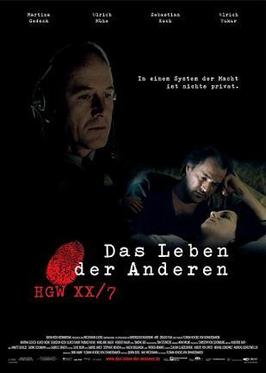
Behind the film
- Year
- 2006
- Director
- Florian Henckel von Donnersmarck
- Writers
- Florian Henckel von Donnersmarck
- Runtime
- 2h 17m
- Genres
- Drama, Thriller, Political thriller
- Production
- Wiedemann & Berg Television, Bayerischer Rundfunk, Arte
- Country
- Germany
- Cast
- Ulrich Mühe, Sebastian Koch, Martina Gedeck, Ulrich Tukur, Thomas Thieme, Herbert Knaup, Bastian Trost, Werner Daehn
About the film
Contains story spoilers.
East Berlin in 1984 is a place where a conversation can have an invisible audience. The Lives of Others follows the machinery that supplies that audience: surveillance officers, informants, reports and officials who can transform suspicion into punishment. Florian Henckel von Donnersmarck’s 2006 drama centres on Gerd Wiesler, a Stasi officer played by Ulrich Mühe, who initially appears entirely comfortable within this system. His precision is professional pride, and he can explain interrogation methods without acknowledging their cruelty. Watching him listen to other people becomes the film’s way of asking whether a person trained to reduce lives to evidence can begin to recognise those lives as something more.
The assignment concerns Georg Dreyman, a successful playwright, and Christa-Maria Sieland, the actress who shares his home. Dreyman has enough official acceptance to work, but that position does not remove him from danger. Culture is supervised, careers depend on approval, and personal relationships provide openings for pressure. A minister’s interest in Christa-Maria gives the investigation an uglier purpose than protecting the state. Wiesler’s superior Grubitz understands the career value of keeping powerful men satisfied. Their exchanges reveal how ideology and ambition cooperate: the language of political vigilance can conceal private jealousy, sexual coercion and the desire to remove an inconvenient rival.
Wiesler’s listening station creates a striking contrast with the apartment below. Headphones and paperwork place him inside the couple’s lives while physically keeping him apart from them. Their affection, disagreements and artistic friendships reach a man whose own existence is spare and lonely. Sebastian Koch gives Dreyman a confidence that initially looks compatible with remaining within the rules, while Martina Gedeck makes Christa-Maria’s vulnerability inseparable from her intelligence and attachment to performing. They cannot simply choose a private life outside politics. Work, love and survival are tangled together, and information about any one of them can become leverage over the others.
The suffering of Dreyman’s friend Albert Jerska gives that pressure a personal form. Barred from directing, Jerska is separated from the work that gave his life meaning. His death helps push Dreyman beyond the compromises that previously protected his career. The music associated with him also becomes an emotional connection for Wiesler, who hears something the surveillance apparatus has no useful category for. The officer’s change unfolds through attention and altered decisions rather than a declaration that he has suddenly become good. Mühe’s restrained face allows long pauses to matter. The very discipline that makes Wiesler effective at spying begins to serve an understanding his employers did not request.
Dreyman’s secret writing for publication in the West turns the apartment into a site of genuine political risk. Friends must consider how to communicate, whom to trust and what traces the work will leave. A hidden typewriter becomes consequential because anonymity depends on more than keeping a name off an article. Wiesler starts protecting the people he is supposed to expose, manipulating what reaches his superiors. That intervention does not make the larger apparatus harmless. The threat remains in the capacity to search a home, destroy a career or exploit a weakness, and the film’s suspense comes from the narrow space between what has happened and what an official report says happened.
Christa-Maria is particularly exposed to that machinery. Pressure on her career and personal vulnerabilities makes resistance costly, and her involvement in the investigation cannot be understood as a simple measure of affection. When the hidden writing equipment becomes the object of a search, Wiesler’s removal of it changes the outcome without the couple understanding his role. Christa-Maria’s death makes the protection incomplete and painfully late. Dreyman loses someone he cannot recover, while Wiesler’s superiors recognise that their operation has been undermined. His punishment is a diminished working life, and the film does not turn dissent into an uncomplicated escape from the institution that trained him.
After reunification, surveillance records give Dreyman a different way to read his past. The files reveal the extent of the observation and suggest that the anonymous officer identified within them did something unexpected. Discovering a protector does not undo the intrusion or the losses. Dreyman locates Wiesler but does not stage a grand reunion; the eventual acknowledgment comes through a book dedicated to him. Wiesler encounters that book in an ordinary shop, and the final exchange carries its force through understatement. Recognition arrives as a private connection between writer and reader, far removed from the official systems that once classified both men.
The film’s world feels defined by rooms and thresholds: the apartment, the listening space, offices, corridors and the places where artists gather. Those divisions let people be close enough to affect one another while separated by roles they may never fully understand. Its account of moral change belongs to a fictional drama, not a claim that surveillance institutions reliably produce their own benevolent protectors. The unsettling question is how such a change could occur within a system designed to prevent it. Wiesler’s intelligence survives his transformation, but his purpose changes; Dreyman’s art gains a reader he never intended; and Christa-Maria’s absence remains a reminder that understanding and intervention do not necessarily arrive in time.