
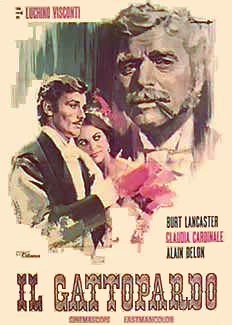
Behind the film
- Year
- 1963
- Director
- Luchino Visconti
- Writers
- Suso Cecchi d’Amico, Pasquale Festa Campanile, Enrico Medioli, Massimo Franciosa, Luchino Visconti
- Genres
- Drama
- Production
- Titanus
- Country
- France, Italy
- Cast
- Burt Lancaster, Claudia Cardinale, Alain Delon, Paolo Stoppa, Rina Morelli, Romolo Valli, Terence Hill, Pierre Clémenti
About the film
Contains story spoilers.
In 1860 Sicily, Prince Don Fabrizio witnesses the Risorgimento unsettle the class that has long shaped his life. His nephew Tancredi joins the changing political order, while the wealthy Don Calogero and his daughter Angelica represent new influence and money. Fabrizio approves Tancredi and Angelica’s engagement, then declines an invitation to enter the new government. At a grand ball, his elegant participation in society is shadowed by the knowledge that it is passing beyond him. The story ends with the Prince alone, facing his own mortality and a transformed world.
Visconti’s film treats historical change as something measured in rooms, gestures and patterns of attention. Political events are present, but the camera often stays with the people who interpret them rather than illustrating every turning point directly. The result makes class visible as behavior: who is greeted, who waits, who can move through a room without explanation. The film’s long compositions let these relationships settle into the frame, asking viewers to read power in posture and distance as carefully as in speech. The formal restraint lets political uncertainty appear through shifts in attention rather than exposition alone.
Burt Lancaster’s Don Fabrizio is neither a simple defender of tradition nor an uncomplicated progressive observer. His awareness of decline is sharp, but it is filtered through the privileges he has inherited. The character can diagnose how political labels change while social hierarchy persists, yet he remains attached to the elegance and rituals that make his position meaningful. Lancaster’s measured performance helps hold those contradictions together; a glance or pause can suggest amusement, fatigue and grief without resolving them into a single attitude. His contradictions remain visible, which keeps the Prince from functioning only as a mouthpiece for the film.
Tancredi’s adaptability gives the older Prince a living example of survival through change. Alain Delon’s youthful poise has a different energy from Lancaster’s gravity, so their relationship becomes a contrast in tempo as much as in politics. The younger man can shift allegiance and imagine a future; the older man sees the price of those shifts. Their bond keeps the generational difference affectionate, which makes the film’s analysis of opportunism more complicated than a simple condemnation. Tancredi’s charm and calculation coexist, giving their relationship an affectionate but unsentimental quality.
Angelica’s arrival links romance to economic change. Claudia Cardinale’s presence draws attention across the social spaces she enters, while the character’s family position brings wealth into a world organized around birth and lineage. The engagement does not erase distinctions; it converts them into a new arrangement. Visconti’s staging makes the exchange legible through costume, posture and the way other characters look at her. Desire and calculation occupy the same frame, so the match can feel both intimate and politically consequential. The film treats Angelica as a person moving through this arrangement, not merely as a symbol of money.
The ball sequence concentrates the film’s approach to time. Its rooms, dance patterns and social rituals extend beyond ordinary plot efficiency, allowing the audience to feel how a world sustains itself by repeating its forms. Fabrizio’s dance with Angelica briefly restores his former elegance, but the sequence does not mistake that grace for a reversal of history. The moment’s beauty depends on its limit. Visconti lets the viewer stay inside the spectacle long enough to sense its exhaustion, rather than explaining the theme through a quick line of dialogue. Duration becomes part of the sequence’s meaning, as the pageantry slowly reveals fatigue beneath its polish. The scene also gives social observation time to become personal unease. A room full of coordinated movement can preserve the appearance of continuity while one participant becomes increasingly aware of his own exhaustion. Elegance and weariness remain visible together, without a speech needing to separate them.
The title image turns political continuity into a metaphor, but the film speaks from Fabrizio’s aristocratic position. His account of new rulers replacing old ones is a character’s perception, not a comprehensive historical verdict on Italian unification. The adaptation keeps that perspective legible through the Prince’s privilege and melancholy. Treating it as a neutral guide to nineteenth-century history would flatten the very subject the film explores: how people narrate change from the position they stand to lose. Historical context matters, but the film’s class-bound voice is essential to understanding its argument.
The wide Super Technirama image gives architecture and bodies room to coexist, reinforcing a drama in which scale makes rank and distance visible. The original Italian version and the shorter American English-language release offer different experiences of its duration. Across those versions, the central relationship between spectacle and mortality remains crucial: the Prince can still inhabit a magnificent room even as his confidence in its permanence dissolves. Visconti's adaptation of Giuseppe Tomasi di Lampedusa's novel makes that contradiction both intimate and public. The final movement follows an individual awareness of change rather than reducing the passing of a social world to a triumphant announcement.