
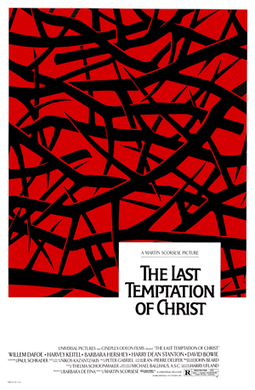
Behind the film
- Year
- 1988
- Director
- Martin Scorsese
- Writers
- Paul Schrader
- Genres
- Drama, Historical, Historical drama, Thriller
- Production
- Cineplex Odeon Films
- Country
- Canada, United States
- Cast
- Willem Dafoe, Harvey Keitel, Barbara Hershey, Harry Dean Stanton, David Bowie, Victor Argo, Paul Herman, John Lurie
About the film
Contains story spoilers.
The Last Temptation of Christ approaches a sacred figure through the difficulty of accepting a purpose that includes suffering. Its Jesus does not begin with an effortless certainty about what his life must mean. Fear and desire remain present, making the possibility of another life something the film can explore rather than dismiss before the story begins. That choice gives the drama its particular form. The question is how commitment can become meaningful while another future still appears desirable, and whether the value of an ordinary human life can make sacrifice more difficult without making the spiritual calling disappear.
Martin Scorsese directs the 1988 film from Paul Schrader's adaptation of Nikos Kazantzakis's novel. Willem Dafoe plays Jesus, Harvey Keitel plays Judas and Barbara Hershey plays Mary Magdalene. This is an imaginative religious drama, not an account claiming to reproduce the Gospels or establish historical events. Its invented possibilities are part of the adaptation's exploration of human and spiritual conflict. Understanding that boundary is essential to understanding what the story is doing. It asks the audience to consider the pressures experienced by its version of Jesus, while the familiar outline of his mission gives those pressures a destination he struggles to accept.
Jesus begins as a carpenter making crosses for Roman occupiers, tormented by uncertainty about his calling. He starts preaching, gathers followers, resists temptation in the desert and performs miracles. His mission brings him to Jerusalem; he asks Judas to arrange the betrayal leading to arrest and crucifixion. On the cross, an apparent angel offers escape into marriage and family life. In that alternative future, Paul and Judas confront him with the significance of what he has abandoned. Judas reveals the angel as Satan. Jesus rejects the imagined escape, returns to the cross and accepts the purpose he had been tempted to evade.
The opening conflict makes vocation uncomfortable before it makes it authoritative. A calling can be felt as an intrusion into somebody's life rather than a clear explanation of how to live it. The film's Jesus struggles partly because accepting responsibility does not immediately supply freedom from fear. His uncertainty is therefore more than an obstacle placed before a familiar story. It changes the way commitment can be understood within that story: a decision becomes significant because another possibility remains emotionally available. The drama draws attention to the labour of acceptance, allowing spiritual purpose to involve continuing difficulty rather than requiring human vulnerability to vanish.
Judas brings a competing expectation to that purpose. Hope for deliverance can concern the immediate conditions under which people suffer, while another understanding of salvation asks them to look beyond those conditions. Their disagreement gives friendship a demanding role. Believing somebody matters does not ensure agreement about what they should do, and loyalty may become harder when the required action contradicts the future a friend wants. The film refuses an uncomplicated division between a figure certain of his mission and an opponent who understands nothing about it. Attachment persists within the argument, making the relationship more painful and more consequential than simple hostility would allow.
The alternative life gives temptation substance by associating it with ordinary forms of belonging. Family, companionship and time spent beyond a public mission are not presented merely as meaningless distractions. Their attraction is part of what makes the choice difficult. The drama can therefore explore sacrifice without pretending that what is relinquished has no value. A purpose gains weight through the possibility of refusing it, while refusal becomes persuasive because it offers recognisable human goods. That is the particular challenge created by the final vision: it gives another future enough emotional reality for returning from it to require more than dismissing an obvious deception.
The encounter between a living person and a story already being told about him raises a further question about belief. A message can acquire a public life whose significance exceeds the experience of the person at its centre. That possibility makes testimony, conviction and responsibility difficult to align. The film uses its imagined circumstances to consider what happens when a narrative's power becomes separate from the events it describes. It does not require the audience to adopt the characters' positions as an established theology. Their disagreement belongs to the drama's inquiry into whether meaning can be sustained through an account that its subject cannot honestly recognise.
Returning to the cross closes the alternative future without suggesting the struggle was unnecessary. The acceptance matters because the story has allowed the temptation to be experienced as a life, with attachments and the passage of time, rather than merely as an abstract option. The ending brings the conflict back to its point of greatest pressure and lets a final choice answer it. Scorsese's film is organised around that difficult movement from uncertainty to commitment. Its distinctive religious imagination makes human vulnerability part of the question of sacrifice, presenting faith through the burden of choosing while the desire to escape remains understandable.