
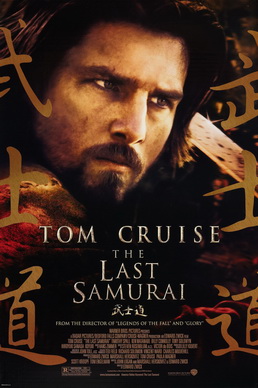
Behind the film
- Year
- 2003
- Director
- Edward Zwick
- Writers
- John Logan, Marshall Herskovitz, Edward Zwick
- Genres
- War, Drama, Action, Ninja
- Production
- Bedford Falls Productions, Cruise/Wagner Productions
- Country
- United States, Japan
- Cast
- Tom Cruise, Ken Watanabe, Timothy Spall, Tony Goldwyn, Hiroyuki Sanada, Koyuki, Billy Connolly, Shin Koyamada
About the film
Contains story spoilers.
The Last Samurai follows Nathan Algren, a former U.S. Army captain hired in the 1870s to train Japan’s new imperial conscripts. He carries deep guilt over wartime violence in the American West and relies on alcohol to blunt the memories. Colonel Bagley, his former superior, recruits him for a commercial mission organized by businessman Omura, who wants a modern army capable of suppressing the samurai resisting the new order. Algren accepts for the money, bringing along his old comrade Sergeant Gant and meeting Simon Graham, a British translator who knows the samurai and their customs.
Algren struggles to turn the poorly trained recruits into soldiers, but Omura and Bagley send them against a rebel force before they are ready. The new army collapses under the samurai attack. Gant is killed and Algren is wounded; Katsumoto, the rebel leader, spares him and takes him prisoner. General Hasegawa, a former samurai now serving the emperor, is allowed to die by ritual suicide after defeat. Algren’s capture takes him into Katsumoto’s village, where he is cared for by Taka, the widow of a samurai he killed in battle.
At first, Algren is isolated and treated with suspicion. The village’s routines, language and training gradually become familiar, and Taka helps him confront both his drinking and his guilt. Katsumoto wants to understand the American soldier who was present at the battle and who may help explain the new army’s methods. Algren, in turn, begins to see that the samurai are not simply obstacles to modernization: they are defending political influence and ways of life as the emperor’s advisers rush to replace them. Their relationship develops through observation and exchange rather than a sudden conversion.
When ninja attack the village, Algren helps defend Katsumoto and concludes that Omura is behind the attempt. Katsumoto travels to Tokyo to meet Emperor Meiji and intends to release Algren. But the emperor is inexperienced and under Omura’s influence. At a government meeting, Omura orders Katsumoto arrested for carrying a sword in public, offering trial or ritual death. Algren refuses to return to training the imperial army. He then joins Graham and Katsumoto’s men to free their leader; during the escape, Katsumoto’s son Nobutada is gravely wounded while protecting their retreat through the city and sacrifices himself so the others can get away.
The imperial army advances to crush the rebellion, and Katsumoto considers ending his life rather than leading his people into another defeat. Algren convinces him to fight and pledges to stand beside the samurai. Taka gives Algren her late husband’s armour, and Katsumoto presents him with a sword bearing an inscription that frames him as a meeting point between old and new. Their last stand is designed around the army’s confidence: the samurai draw it into a trap and inflict serious losses, but incoming reinforcements and Gatling guns overwhelm the cavalry.
Bagley is killed by Algren during the battle. A captain once trained by Algren orders the firing to stop, visibly shaken by the slaughter. Katsumoto is mortally wounded and performs seppuku with Algren’s help as the soldiers kneel. Algren survives and later interrupts trade negotiations to present Katsumoto’s sword to the emperor, urging him to remember the traditions for which the samurai fought. The emperor refuses the proposed American arms agreement and moves against Omura’s power and asks how Katsumoto died; Algren instead promises to tell him how Katsumoto lived. The film ends with Algren returning to the village and Taka.
Algren’s time in the village includes repeated defeats in sword practice rather than an immediate mastery of unfamiliar skills. Ujio regards him with hostility and forces him to learn through exhausting repetition. The training changes his habits as well as his ability to fight: watching others work and beginning again after failure offers a different rhythm from the drinking and sales performances that introduced him. His relationship with Taka remains complicated by the death of her husband, so acceptance carries a cost the village cannot simply forget. Graham provides another kind of contact, translating language and explaining customs while also recording what he observes. These relationships give Algren routes into the community without making its people interchangeable guides to his recovery.
Edward Zwick stages the village as a world of repetitive practice and communal work, in contrast to the hurried military drills and technology of the imperial camp. John Toll’s photography gives mountain and village scenes a changing seasonal texture, while the final battlefield is organized around the shift from cavalry tactics to machine-gun fire. Tom Cruise’s Algren is framed as a damaged outsider, but Ken Watanabe’s Katsumoto carries the film’s political and spiritual center. The story is historical fiction inspired by the Satsuma Rebellion, not a documentary account: its invented American protagonist and simplified conflict should be read as dramatization rather than a literal record of Japanese modernization.