
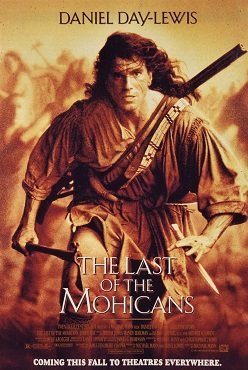
Behind the film
- Year
- 1992
- Director
- Michael Mann
- Writers
- Michael Mann, Christopher Crowe
- Genres
- Drama, Romance, War, Melodrama
- Production
- Morgan Creek Entertainment
- Country
- United States
- Cast
- Daniel Day-Lewis, Madeleine Stowe, Jodhi May, Russell Means, Eric Schweig, Wes Studi, Maurice Roëves, Steven Waddington
About the film
Contains story spoilers.
Set during the French and Indian War, the film follows Hawkeye, Chingachgook and Uncas as they help Cora and Alice Munro reach Fort William Henry. Their escort is ambushed by Magua, and the surrender is followed by an attack on the departing column. The retreat becomes a pursuit, separating the group and ending in loss, rescue and vengeance. The story’s historical setting frames a fictional family and conflict, with the colonial war pressing on each character’s choices.
Michael Mann’s adaptation turns landscape into an active source of pressure. Forest, water, rock and open ground repeatedly determine what characters can perceive and how quickly they can move. The camera tends to make bodies feel small against terrain, then shifts into close pursuit when distance collapses. This alternation gives the wilderness two meanings at once: it offers routes around military authority, yet it also hides danger. Geography becomes part of the drama’s moral texture, because survival depends on reading a place rather than controlling it. That balance between movement and pause gives the film a recognisable visual pulse across its changing locations.
The film’s sound gives movement a second rhythm. Breath, footsteps, weapons and the musical score form a forward drive that can make a travel sequence feel almost like a chase before anyone speaks. The score’s recurring melodic line links private attachment to the larger landscape, and its return gives emotional continuity to scenes that otherwise jump among characters and locations. This approach helps the film hold romance, war and family loyalty inside one tonal world without making them feel like separate genres placed side by side. Sound often connects separate spaces before the image does, carrying tension across edits and keeping attention on movement.
Hawkeye’s position as a white adoptee in a Mohican family complicates the conventional lone-frontiersman role. His bond with Chingachgook and Uncas is the foundation of his identity, but the camera does not let him become the only meaningful figure in that family. Chingachgook’s presence carries authority and experience; Uncas has his own emotional direction. The film’s title and closing language connect individual grief to a people’s continuity, while care is taken to understand that the story’s dramatic phrase is not a statement that the real Mohican people are extinct. The family bond feels earned because the film returns to shared skills, not only declarations of loyalty.
Magua’s antagonism is shaped by a grievance against British power and a personal history of violence. The film gives his pursuit a force that exceeds a simple obstacle for the romantic leads, though its point of view still channels much of the story through the British and colonial characters. Wes Studi’s performance makes stillness and controlled speech as important as physical threat. The contrast between Magua’s precise intent and the soldiers’ institutional confidence exposes how official authority can produce the very resentment it later treats as inexplicable. His authority comes from motive and presence, not from the British chain of command surrounding the fort.
Cora’s story gives the film a different kind of resistance. She does not share Hawkeye’s freedom of movement, but she repeatedly makes decisions about trust and attachment within structures that presume to arrange her future. Madeleine Stowe plays her as observant and deliberate, so the character’s independence reads through choices rather than a modern speech inserted into a period setting. The romance works best when it is understood as one strand of a larger negotiation over who is allowed to decide where they belong. Her decisions have consequences within a landscape where military orders and personal loyalty repeatedly come into conflict. The romance also makes trust a practical decision: attachment changes whom a character follows, and therefore which dangers she must face.
The film's historical spectacle provides the pressure around its fictional relationships, while its adaptation makes a particular selection from a larger literary tradition. Michael Mann and Christopher Crowe's screenplay brings James Fenimore Cooper's characters into a form organised around pursuit and attachment. A film can use a recognisable historical conflict without becoming a comprehensive account of the communities involved. Here, the emotional force depends on whose loyalties are tested when the official promise of protection fails. The closeness of the action gives those loyalties physical urgency, while the surrounding war remains larger than any one character's ability to explain or command.
Mann’s staging favors momentum and physical clarity. Group movement is easy to follow even when the landscape is visually dense, and action tends to resolve through bodies crossing paths rather than distant tactical diagrams. The romantic passages slow the film without dissolving its forward pull; glances and pauses become meaningful because motion surrounds them. This balance is why the film’s emotional register feels inseparable from its setting. Its characters are shaped by a world where loyalty is tested at speed, and the land never becomes merely decorative scenery. The finished film’s artistic center emerges from the interaction of landscape, performance and movement.