
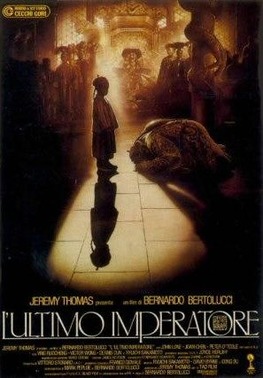
Behind the film
- Year
- 1987
- Director
- Bernardo Bertolucci
- Writers
- Mark Peploe, Bernardo Bertolucci
- Runtime
- 2h 43m
- Genres
- Drama, Biographical, Historical, Epic
- Production
- Recorded Picture Company
- Country
- People's Republic of China, France, United Kingdom, Italy, British Hong Kong
- Cast
- John Lone, Joan Chen, Peter O’Toole, Ying Ruocheng, Victor Wong, Dennis Dun, Ryuichi Sakamoto, Vivian Wu
About the film
Contains story spoilers.
The Last Emperor introduces Puyi after the life that gave him his title has already collapsed. Arriving as a prisoner in the new People’s Republic of China, he attempts suicide and is prevented from avoiding the process that awaits him. The film then returns to his childhood, making the grandeur of his early surroundings inseparable from the knowledge of where they will lead. A small boy is taken into the Forbidden City and made emperor while wanting the simple reassurance of going home. Everyone behaves as though he occupies the centre of the world, yet the first important decision about his own life has been made without his consent.
The palace gives Puyi enormous status and remarkably little freedom. Servants attend to his needs, rituals affirm his importance, and the buildings seem to stretch around him without an obvious end. Nevertheless, he cannot simply walk out through the gates. His wet nurse provides an intimacy that ceremony cannot replace, and her removal is another decision he cannot prevent. His younger brother’s arrival brings news of the republic outside, exposing the gap between the title maintained within the walls and the political reality beyond them. A child who has been taught that everything belongs to him must begin to understand that the world can change without asking him first.
Reginald Johnston’s appointment as tutor creates a route toward unfamiliar ideas and habits. Puyi encounters English education and a version of modern life that seems to offer possibilities his existing household resists. Glasses and a bicycle become more than useful objects: they mark the interference of another perspective in a setting accustomed to preserving its own routines. Peter O’Toole’s Johnston has access to the emperor without occupying the same place as the courtiers, allowing conversation to challenge assumptions that formal obedience keeps intact. Puyi’s desire to leave grows alongside his interest in reforming his surroundings. He wants to be modern without surrendering the exceptional position from which he imagines that future.
Marriage brings Wanrong and the secondary consort Wenxiu into a household already burdened by competing expectations. Reforming palace life does not repair the absence of genuine political authority, and expulsion eventually forces Puyi into the outside world he has long imagined. His life in Tianjin offers fashionable clothing, entertainment and foreign contacts, but little of the independence those surfaces suggest. Wenxiu’s departure shows that other people can make choices he cannot command into reversal. Wanrong remains, while their relationship becomes increasingly damaged. The film allows pleasure and humiliation to occupy the same period: leaving the palace opens possibilities, but it does not provide a coherent answer to who he should be without its protection.
The Japanese offer Puyi a restored imperial identity in Manchukuo. He accepts a role that appears to recover the authority lost in China, only to find that decisions are controlled by those who installed him. The new court reproduces ceremonial grandeur while making his dependence more exposed. Wanrong’s deterioration and the treatment of her child show the personal violence beneath arrangements presented as political opportunity. The film follows a man repeatedly attracted to symbols of command while others determine what command can mean. His cooperation is not made harmless by his powerlessness. When the war ends, the title cannot protect him from captivity or from questions about the regime he helped represent.
The prison sequences return throughout the film, placing recollection beside interrogation. Puyi initially remains accustomed to being served and treats other people as though his former rank still settles their obligations. Ordinary tasks challenge that expectation more effectively than another ceremonial humiliation would. The governor’s insistence on responsibility requires him to examine the difference between having been controlled and having made choices within that control. Historical biography is shaped here into a drama of memory and accountability; the film’s scenes should not be read as a complete transcript of Puyi’s real life. Its framing asks how someone can explain the past without using explanation to excuse every part of it.
After release, Puyi works as a gardener in a country that has changed again. A public procession during the Cultural Revolution brings him face to face with the punishment of the former prison governor, whose position once gave him authority over Puyi’s future. The reversal prevents the story from ending with a simple transfer from one stable order to another. A visit to the old palace brings a quieter transformation. Now a museum visitor, Puyi tells a child that he once occupied the throne and produces a childhood keepsake as proof. The institution that defined his life can contain him only as a story, and the final tour guide reduces that life to a few sentences.
Bernardo Bertolucci and cinematographer Vittorio Storaro make the changing settings part of the character study. Palace courtyards, ordered ranks and richly coloured interiors give Puyi’s childhood a scale that dwarfs the person supposedly ruling them. Later environments offer different kinds of enclosure, whether social, political or literal. John Lone’s adult performance carries the tension between entitlement and uncertainty, while Joan Chen’s Wanrong reveals how the same arrangements damage someone whose position provides even fewer routes outward. The movement across decades is expansive, but recurring objects and relationships keep it personal. The emperor’s story is ultimately about learning to inhabit a life without an institution continually telling him that he is its most important person.