
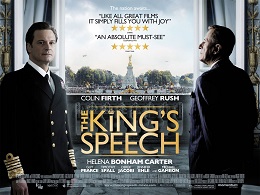
Behind the film
- Year
- 2010
- Director
- Tom Hooper
- Writers
- David Seidler
- Runtime
- 1h 58m
- Genres
- Biographical, Drama, Historical
- Production
- UK Film Council, See-Saw Films, Bedlam Productions
- Country
- United Kingdom
- Cast
- Colin Firth, Geoffrey Rush, Helena Bonham Carter, Guy Pearce, Timothy Spall, Derek Jacobi, Jennifer Ehle, Michael Gambon
About the film
Contains story spoilers.
The film begins at Wembley Stadium, where Prince Albert, Duke of York, gives a public address that is interrupted by his stammer. His previous treatments have brought little relief, and the broadcast makes his difficulty visible to a large audience. His wife Elizabeth persuades him to visit Lionel Logue, an Australian speech therapist whose methods do not resemble the formal medical treatment Bertie expects. Logue asks him to recite Hamlet while listening to music through headphones and gives him a recording of the reading. Bertie leaves frustrated, but later listens to the recording and realizes that he can speak fluently under different conditions.
Bertie returns for daily sessions as his father, King George V, explains that radio broadcasts will make public speech central to the monarchy’s connection with ordinary people. The king’s elder son, David, is neglecting some of his responsibilities, so Bertie’s ability to use the wireless matters even before anyone expects him to become king. At first, the therapy is as much a conflict of status as of technique: Logue insists on informality and personal trust, while Bertie is accustomed to rank and deference. The recordings offer evidence of progress, but they do not immediately dissolve the anger and self-consciousness that follow him into family conversations.
After George V dies, David becomes King Edward VIII, but his intention to marry Wallis Simpson creates a constitutional crisis. Bertie tries to warn him about the consequences, then quarrels with Logue when the therapist suggests that Bertie himself could make a good king. Bertie accuses him of treason and ends their sessions. Edward eventually abdicates to marry, and Bertie ascends the throne as George VI. The change is not framed as a simple rise in confidence: the man who struggled to speak at Wembley now has to address a country during a period of political upheaval, with little time to prepare for the public role he had never expected to inherit.
Lionel and Bertie resume their work before the coronation. The king's advisers question why he sought treatment without consulting them and challenge Logue's lack of formal qualifications. Logue explains that his experience came from helping returning soldiers who were suffering from shell shock; he had developed ways of helping men recover their ability to communicate, although he does not hold the medical credentials the palace expects. Bertie remains angry until Logue sits on the coronation chair to provoke him. Bertie protests that he has a voice, and realizes he has spoken without stammering while expressing anger. He returns to rehearsal with Logue and completes the ceremony.
The film’s central challenge arrives in 1939, after Britain declares war on Nazi Germany. The king must broadcast to Britain and the Empire, and Logue is summoned to Buckingham Palace to help him prepare. Churchill, Neville Chamberlain, and other officials are present nearby, but the final rehearsal and delivery are between Bertie and Lionel. Logue conducts him through the speech, helping him manage pauses and phrases. Bertie stammers at points but continues, and the radio address becomes an effort in communication rather than a demonstration of effortless fluency. His achievement is not that his speech has disappeared; it is that he can speak under pressure with support.
After the broadcast, the Royal Family steps onto the palace balcony as a crowd applauds. A closing title explains that Logue was later made a Commander of the Royal Victorian Order and remained present for George VI’s wartime speeches; he and the king stayed friends until the king’s death. The film ends on public recognition of the partnership that began in private sessions. It gives the two men a personal rhythm of argument and trust, with Logue refusing to treat Bertie as only a monarch and Bertie gradually accepting help without giving up his authority.
Logue's informal methods matter because they challenge the distance Bertie has learned to maintain. Calling the future king by his family nickname and insisting on equal footing initially seem like provocations, but they make it possible to discuss fear and embarrassment without turning every session into a court performance. The recording is an early example of that approach: Bertie leaves angry, yet can hear his own successful reading without the pressure of watching himself speak. Later, the coronation-chair argument produces another unplanned moment of fluent speech. The film treats these moments as tools Bertie can use, not cures that erase his stammer, and the broadcast applies them under a responsibility he cannot delegate.
Tom Hooper’s staging keeps Bertie’s body and voice at the center of formal spaces: the Wembley hall, the palace rooms, and the coronation setting all make speech feel like a public test. The historical drama compresses events and invents private exchanges to shape the relationship between George VI and Logue; it should not be treated as a complete record of their lives or every political decision around abdication. Within the film, however, the therapy is concrete and collaborative. Repetition, recording, breathing, and trust help Bertie meet an obligation that cannot be avoided, even when his stammer remains part of the person speaking.