
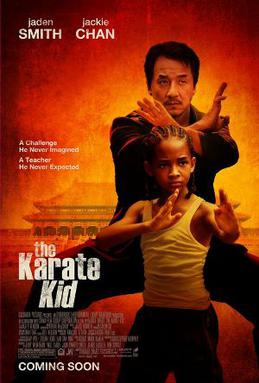
Behind the film
- Year
- 2010
- Director
- Harald Zwart
- Writers
- Christopher Murphey
- Genres
- Comedy drama, Drama, Martial arts, Children's
- Production
- Overbrook Entertainment, Columbia Pictures, China Film Group Corporation
- Country
- People's Republic of China, United States
- Cast
- Jaden Smith, Jackie Chan, Taraji P. Henson, Wenwen Han, Zhenwei Wang, Yu Rongguang, Luke Carberry, Shijia Lü
About the film
Contains story spoilers.
Dre and his mother move to Beijing, where his friendship with violinist Meiying draws the hostility of Cheng. After repeated bullying, Dre retaliates and is attacked by Cheng's group. Maintenance man Han intervenes and agrees to teach him kung fu. A failed attempt to negotiate with their instructor leads to a tournament arrangement. Han's repetitive jacket exercise builds foundations Dre initially fails to recognise. Their relationship deepens when Dre discovers Han's grief over the accident which killed his family. Dre also apologises to Meiying's father after encouraging her to neglect a commitment. At the tournament, an opponent deliberately injures Dre's leg. He continues, defeats Cheng in the final and earns the rival students' respect, with their bow to Han challenging the example set by their own teacher.
The relocation makes belonging a practical problem before the martial-arts story offers a solution. Dre cannot assume that familiar habits will make him understood in a new environment, and frustration does not supply the missing knowledge. That gives his vulnerability more than one source. He faces a hostile group while also learning how ordinary school and social life work around him. The film's particular setting matters because confidence is no longer supported by the conditions he recognises. Adaptation requires attention to other people, not merely greater strength. A new place becomes less alien when a person develops relationships within it rather than treating every unfamiliar expectation as an obstacle to be defeated.
Han's approach gives that attention a physical form. A repeated task can seem pointless when a learner judges it only by its immediate resemblance to the result he wants. The teaching relationship asks Dre to consider whether an ordinary movement can contain a skill he has not yet learned to recognise. That is different from making obedience valuable for its own sake. The exercise needs a purpose, and the teacher needs to reveal enough of that purpose to turn repetition into understanding. The story's appeal lies in the changing meaning of something familiar. What began as a household habit becomes evidence that a body can learn before the mind has a complete account of the lesson.
The opposing instructors make the moral purpose of that learning clear. A discipline can be directed towards composure or towards the humiliation of someone weaker. Both approaches may produce capable students, but capability alone cannot tell us whether the teaching is good. Han's response to Cheng's group leaves room to distinguish the children from the example they have been given. That makes the bullying more complicated than a permanent quality belonging to a bad person. Learned behaviour can be challenged, and authority can be respected without deserving to be followed. The students' eventual recognition matters because it suggests that competence and decency need not remain separated by the allegiance they began with.
Han is also more than the convenient wise adult who arrives to repair a child's life. His grief creates a need within the teaching relationship, allowing Dre's presence to matter to him in return. A person can possess great expertise and still struggle with something that expertise cannot resolve. That distinction gives their friendship a different weight from a transaction in which lessons are exchanged for success. Helping another person find a future may require the teacher to re-enter life himself. Dre does not need to become the adult's counsellor to offer companionship. The relationship can carry support in both directions while preserving the difference in their responsibilities.
Meiying's musical commitments provide a useful counterpoint to Dre's impatience. Friendship does not give someone permission to treat another person's discipline as less important than the pleasure of spending time together. Learning to recognise that boundary belongs to the same development as learning to respond calmly under pressure. The film connects confidence with responsibility by allowing Dre to acknowledge a mistake outside the training space. That keeps maturity from becoming something proved only by defeating a rival. A capable person also needs to understand the costs his choices create for others, especially when those costs are easy to overlook because the immediate experience feels enjoyable.
The tournament gives this gradual learning a visible test, but its structure can also mislead if victory is treated as the whole purpose. Competition creates a situation with clear rules and a public result, whereas daily confidence is harder to measure. The film makes the event meaningful through Dre's changed response to fear and the students' changed response to their teacher's example. That gives the final contest stakes beyond a trophy. A result can become evidence of development without becoming a complete definition of worth. The abilities learned earlier matter because they provide options in a difficult moment, not because every learner must win to justify having learned.
As a remake, the 2010 Karate Kid preserves a familiar mentoring shape while giving it a different place, relationship and martial-arts tradition. It is worth understanding that distinction when choosing the film: Dre studies kung fu in China, and Han's story belongs to this version rather than simply reproducing Mr. Miyagi's. The deeper connection is the idea that confidence grows through patient attention and dependable care. The action supplies a satisfying expression of that idea, but the friendship gives it continuity beyond the competition. Becoming less afraid does not mean needing nobody. It can mean recognising the help available, accepting the work it asks of you and eventually offering something valuable in return.