
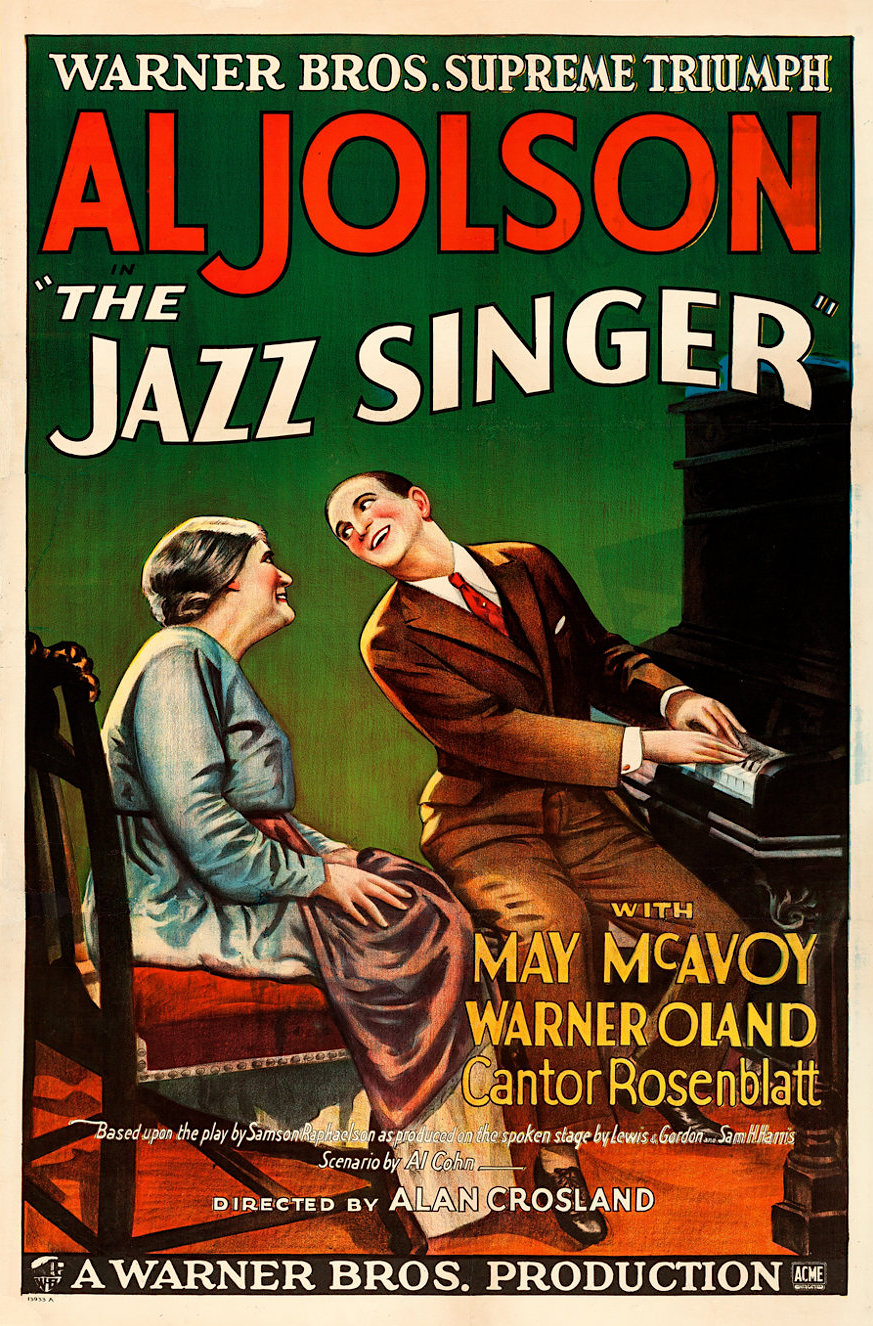
Behind the film
- Year
- 1927
- Director
- Alan Crosland
- Writers
- Alfred A. Cohn
- Genres
- Romance, Musical, Drama, Melodrama
- Production
- Warner Bros. Entertainment, The Vitaphone Corporation
- Country
- United States
- Cast
- Al Jolson, May McAvoy, Warner Oland, Eugenie Besserer, Robert Gordon, Otto Lederer, Richard Tucker, Yossele Rosenblatt
About the film
Contains story spoilers.
Jakie Rabinowitz wants to sing popular music rather than follow his father into the cantor’s role. After being punished, he leaves home and later performs as Jack Robin, building a career with dancer Mary Dale’s help. His return to his parents does not settle the conflict. When his father is gravely ill near Yom Kippur, Jack must choose between the Broadway opening and singing Kol Nidre in his father’s place. The story ends with a family reconciliation framed through music and religious duty.
The film’s historical importance is specific: it is a part-talkie with synchronized music and several spoken passages, not the first sound film in an absolute sense. Much of its storytelling still uses silent-era performance and intertitles, while the Vitaphone sequences interrupt that familiar grammar with a voice that seems to address the audience directly. The effect is less a clean replacement of one medium by another than a seam between them. The movie makes that seam visible, and its unevenness helps explain why it became a landmark in exhibition history. Its hybrid construction is clearest when an otherwise silent scene gives way to a song with recorded accompaniment.
Those moments of recorded speech change the scale of performance. A silent image lets a viewer watch faces and gestures while imagining the sound; a synchronized line fixes timing, accent and vocal texture. Jolson’s stage presence becomes the central bridge between screen and auditorium, especially because songs can move from theatrical display into something closer to direct address. The technology matters as part of the film’s form, but the scenes are not only demonstrations. They are also arranged as emotional punctuation within a family melodrama. Vocal timing becomes a new expressive tool because the audience can hear hesitation as well as see it.
The story’s conflict is built around inheritance. Jakie is not rejecting every part of his family; he resists the assumption that affection obliges him to repeat his father’s vocation. His parents give the dilemma its emotional weight, because the choice is presented inside a loving home rather than a simple battle between cruelty and freedom. The film’s old-fashioned melodramatic turns make that tension legible through declarations and staged decisions. The recurring question is whether a son can shape a public identity without treating his origins as a burden to discard. This is a family conflict about a particular calling, not a general test of whether tradition is valuable.
The work also carries a damaging representation that needs to be named plainly: Jack performs in blackface. This is a racist minstrel convention, built on caricature and the erasure of Black performers’ agency. The movie presents the act as part of his route into popular entertainment, but that narrative function does not make the convention harmless or endorse it as acceptable. A contemporary account has to hold both facts together: the film’s place in early synchronized cinema and the racism embedded in its stage imagery. Naming the racist convention directly is necessary to describe its place in the film’s popular stage world.
The film’s use of a Jewish family and a sacred musical tradition is also shaped by the perspective of its period and its star vehicle. Cantorial singing is not interchangeable with popular entertainment; the story turns on a particular religious responsibility and on a son’s relationship to his father. The Kol Nidre sequence draws force from that difference. It should not be read as a general explanation of Jewish belief, but as a dramatic moment in which vocation, family attachment and public performance meet. The religious material belongs to this fictional family and should not be treated as an account of every practice.
Adapted by Alfred A. Cohn from Samson Raphaelson’s earlier story and play, the movie carries a stage melodrama into a medium whose relationship to live performance is changing. The film also contains supporting performers and musical turns beyond the central romance, including the cantor portrayed by Warner Oland and Sara played by Eugenie Besserer. These roles make the conflict feel intergenerational rather than solely an individual career story, even when the camera returns to Jolson as its principal attraction. The drama’s emotional architecture depends on how those family members understand duty differently.
The Jazz Singer is most revealing when approached as a work in transition. Its silent stretches preserve a visual language built on gesture and framing; its sound sequences introduce a new kind of presence that the film is still learning to organize. The family plot gives that formal shift a human shape, while the blackface performance exposes the unequal cultural conditions that shaped mainstream entertainment. Neither dimension cancels the other. The film can be studied as a technical turning point and criticized for the racial imagery it stages at the same time. The film’s legacy remains mixed: formal influence and harmful representation belong in the same discussion.