
Behind the film
- Year
- 2003
- Director
- F. Gary Gray
- Writers
- Donna Powers, Wayne Powers
- Runtime
- 1h 51m
- Genres
- Heist, Action, Mystery, Crime
- Production
- Paramount Pictures, Donald De Line
- Country
- United States, France, United Kingdom
- Cast
- Mark Wahlberg, Charlize Theron, Edward Norton, Seth Green, Jason Statham, Mos Def, Donald Sutherland, Franky G
About the film
Contains story spoilers.
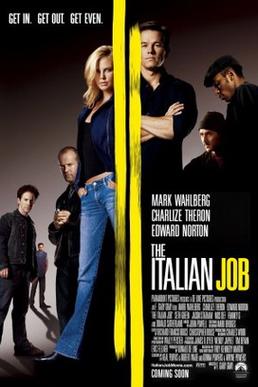
Charlie Croker's crew steals gold in Venice, but teammate Steve betrays them, kills veteran safecracker John Bridger and escapes with the bullion. The survivors later trace him to Los Angeles. Charlie recruits John's daughter Stella, whose safecracking skills and desire for justice give her reasons to join. Their first scheme to enter Steve's home fails, forcing a new plan around the transport of his gold. With hacked traffic signals, explosives and three modified Minis, the crew redirects an armoured truck and removes its cargo underground. Steve pursues them, but they reach a train and an arranged escape. A Ukrainian criminal takes custody of Steve, whose earlier violence has created another enemy. The crew divides the recovered fortune, while Charlie and Stella begin a life together.
That outline makes Charlie’s operation feel less like a one-man fantasy than a compact workplace, where people have specialties and the leader’s main skill is recognizing what each person can contribute. Rob is defined by the way he thinks while driving, Lyle by his confidence around connected systems, and Left Ear by a fondness for controlled explosions. Their distinct temperaments make the group legible before the plot asks them to improvise together. The reunion has an emotional condition as well as a practical one: these colleagues were nearly killed by someone they trusted, so the plan is also a way to restore a working bond. Charlie supplies direction, but the heist works because no one can do the whole job alone.
Stella changes the crew’s balance. Her father’s safecracking relied on touch and patience; she approaches the same craft through tools and technology, a contrast that gives their profession a generational dimension. She is not simply brought in to complete a missing technical slot. Her expertise is bound to grief and to a specific reckoning with Steve, while Charlie’s attraction to her must coexist with her independent reasons for joining. The film lets professional competence function as a form of characterization: the way Stella studies a lock tells us about her precision, just as Charlie’s ability to keep the group focused shows how he processes a personal loss without pretending it has disappeared.
The Los Angeles setting gives the second operation a different texture from Venice. The opening relies on waterways, close quarters, and a getaway that must fit through a historic city’s narrow routes; the later plan turns public infrastructure into its instrument. Traffic lights, tunnels, streets, and the underground rail system become parts of a temporary machine. This city-scale choreography is the film’s central visual pleasure: the crew’s work is not just to defeat guards but to understand how an urban environment can be made to carry a small, fast-moving vehicle. The Mini Coopers are practical tools and recognizable personalities, each one carrying a portion of the stolen weight through spaces too tight for conventional getaway vehicles.
Gray and cinematographer Wally Pfister give the action a mobile, polished look while keeping its geography readable. Cars turn, dive, and emerge through sharply differentiated spaces rather than dissolving into undirected speed. The view can glide with a vehicle, cut to the operator manipulating a system, then return to the larger route, making the audience follow cause and effect. The sequence in which the road gives way to the subway below is a particularly clear change in scale: an ordinary surface becomes a hidden level of the city, and the heist abruptly shifts from traffic control to a tunnel escape. The moving camera and brisk editing support the fantasy that planning can temporarily make the metropolis obey.
The comedy comes from friction around that competence. Lyle’s boasts, Rob’s easy charm, and Left Ear’s careful handling of explosives add distinct rhythms to a story that could otherwise become a technical diagram. Charlie is controlled, but the plan is exposed to chance: neighbors hold a party, Steve changes his transport, and the team must abandon the carefully prepared version and design another. These complications are not just pauses before the next stunt; they show that a successful crew needs judgment as much as preparation. The improvisation keeps the set pieces connected to character, because each surprise tests the person best equipped to respond.
The ending invites a distinction between defeating an enemy and repairing the relationship he damaged. Money can be divided precisely; confidence in another person cannot be restored through an equally simple transaction. What makes this caper hopeful is its belief that competence can serve friendship rather than only individual appetite. Charlie's group becomes a small counterexample to Steve's idea of success: cooperation creates possibilities that betrayal can seize but cannot sustain. That gives the expensive machinery and elaborate manoeuvres an emotional purpose. The fantasy extends beyond getting rich to finding people whose abilities complement yours, and being able to rely on them when the carefully drawn route stops working.