
Behind the film
- Year
- 2005
- Director
- Michael Bay
- Writers
- Caspian Tredwell-Owen, Alex Kurtzman, Roberto Orci
- Runtime
- 136 minutes
- Genres
- Action, Science fiction, Post-apocalyptic, Dystopian
- Production
- Warner Bros. Entertainment, DreamWorks
- Country
- United States
- Cast
- Ewan McGregor, Scarlett Johansson, Djimon Hounsou, Sean Bean, Michael Clarke Duncan, Steve Buscemi, Brian Stepanek, Kim Coates
About the film
Contains story spoilers.
The Island begins with a society in which comfort is inseparable from restricted knowledge. Its residents are encouraged to understand routine as protection and obedience as the condition of a better future. That makes the promised destination more than an attractive place. It supplies a reason to tolerate a life whose rules they did not choose. The film's central movement is from accepting that explanation to questioning who benefits from it. Escape requires a change in understanding before it can become a journey, because a person taught that the outside world is deadly has to recognise that remaining inside can be the greater danger.
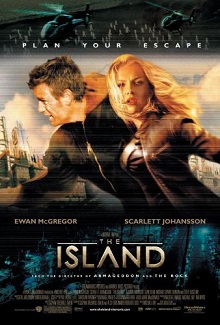
Michael Bay directs the 2005 science-fiction action film, starring Ewan McGregor as Lincoln Six Echo and Scarlett Johansson as Jordan Two Delta. Sean Bean plays Merrick, Steve Buscemi plays McCord and Djimon Hounsou plays Laurent. Caspian Tredwell-Owen, Alex Kurtzman and Roberto Orci wrote the screenplay. The premise combines a controlled community with a pursuit story, so the physical scale expands as the characters' knowledge grows. What initially appears to be a protected social order becomes a problem of ownership, consent and whose interests count. The adventure asks the protagonists to learn not merely where they are, but what their lives mean to the people running it.
Lincoln discovers that the compound's residents are clones maintained for wealthy sponsors, and that winning its lottery means being selected for medical exploitation. He escapes with Jordan and learns about their originals. His sponsor Tom betrays them, but Lincoln survives the confrontation and takes Tom's identity. Merrick orders further clones destroyed when he recognises their capacity to question their circumstances. Lincoln and Jordan return to free the residents, with Laurent eventually helping them. Merrick dies and the compound's illusion is broken. The clones emerge into the outside world, while Lincoln and Jordan finally leave towards an island of their own choosing.
The premise separates a body's origin from the question of whether its life belongs to somebody else. A commercial arrangement may explain why a person was created without establishing any moral right to their future. That gap is the story's core injustice. The institution treats awareness as a management problem, while the protagonists' emerging awareness reveals the inadequacy of its terms. Their capacity to feel fear, form attachments and make decisions is not an administrative defect. It is evidence of a life that cannot be honestly described as an available component. The film makes an abstract argument about personhood urgent by placing people inside its consequences.
Lincoln's questions also show how an explanation can become difficult to challenge when it controls the information available for judging it. A community does not have to understand the full purpose of a rule in order to follow it. Repetition and reassurance can make the rule seem like common sense, especially when the alternatives have been described as impossible. The story makes curiosity a practical form of resistance. Doubt begins as something uncomfortable rather than heroic, and understanding grows because discomfort is taken seriously. A promise about future happiness loses its authority when the present arrangement no longer supports the account given of it.
Meeting a person with the same appearance complicates identity in a different way. Resemblance can offer recognition without producing solidarity, and a shared biological origin does not guarantee a shared understanding of obligation. The double therefore creates a conflict more intimate than pursuit by an unfamiliar enemy. It asks whether someone will recognise an independent life when accepting that independence threatens their own interests. The film's identity puzzle is inseparable from the ownership question. Looking alike cannot tell two people what they owe each other, and it cannot turn the desires of one into a legitimate claim on the existence of the other.
The changing scale gives those concerns a physical form. Restricted surroundings concentrate attention on regulation and repeated behaviour; an outside world makes uncertainty spatial, introducing distance and choices the protagonists were not prepared to navigate. Action is therefore connected to the expansion of knowledge rather than operating solely as interruption. Freedom exposes them to danger while giving that danger a different meaning: it can involve decisions they make instead of an outcome silently selected for them. Their partnership helps bridge that uncertainty. Another person's presence becomes valuable because neither can rely on the institution's explanation and neither understands the wider world completely.
Returning for other residents extends the meaning of escape beyond individual survival. Understanding an injustice gives the protagonists a reason to consider people who remain unable to see it. The final release offers an opening rather than a complete description of the society that will follow. Those emerging from the compound will still need to learn, adapt and establish relationships outside the terms imposed upon them. The film stops at the change that makes such possibilities available. Its island becomes meaningful because reaching it can finally express a choice: a future approached by people whose lives are their own, rather than a prize used to conceal their disposal.