
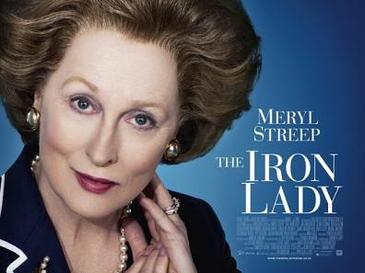
Behind the film
- Year
- 2011
- Director
- Phyllida Lloyd
- Writers
- Abi Morgan
- Genres
- Biographical, Drama
- Production
- Pathé, Film4 Productions, UK Film Council
- Country
- France, United Kingdom
- Cast
- Meryl Streep, Jim Broadbent, Alexandra Roach, Harry Lloyd, Olivia Colman, Anthony Head, Richard E. Grant, Iain Glen
About the film
Contains story spoilers.
The elderly Margaret Thatcher converses with an imagined Denis as memories interrupt her domestic life. Flashbacks follow her upbringing in a Grantham grocery shop, university education, marriage and struggle to enter a male-dominated Conservative establishment. She rises through Parliament and government, changes her public image and wins the party leadership. As prime minister, she confronts economic unrest, the Falklands conflict and political violence. Increasing certainty becomes isolation, and disagreements over the poll tax and Europe help fracture her support. Geoffrey Howe resigns, Michael Heseltine challenges her, and her cabinet's withdrawal of confidence leads to her departure from office. Back in the present, she packs Denis's belongings and asks his imagined presence to leave. The film closes with her alone, attending to an ordinary household task.
The structure makes a public life accessible through a decidedly private frame. A figure associated with command is encountered through uncertainty, with the scale of government placed beside the scale of a room. That arrangement changes the question a conventional rise-to-power story might ask. Instead of treating achievement as the final explanation of a person, the film considers what remains available to the person after the structures supporting that achievement have receded. Memory can preserve a feeling of authority without restoring the circumstances in which authority once operated. Phyllida Lloyd's direction and Abi Morgan's screenplay use that distance to organise the drama. The result is a portrait whose emotional centre concerns identity over time, even when its subject's political decisions reach far beyond the domestic world shown on screen.
Meryl Streep's role therefore involves more than presenting a recognisable public manner. The character moves between different relationships with certainty, attention and the people around her. Alexandra Roach's younger Margaret supplies another part of the contrast. An identity that later appears fixed once had to be asserted against a world that did not assume it belonged there. Bringing the younger and older figures into the same account lets determination look both formative and costly. A quality that helps somebody enter a closed institution can eventually make it harder for her to recognise when the institution, or the people inside it, has changed.
Denis gives the film a way of approaching that change through intimacy. Jim Broadbent's character occupies an emotional space that cannot be explained by political agreement alone. A long relationship can contain private habits and forms of recognition unavailable to the public persona. His imagined presence makes absence active rather than merely supplying a sad fact from the past. The conversations also complicate the apparent independence of the central figure. Someone can build an identity around self-reliance while still depending profoundly on a particular person's continuing place in the world. The film's grief belongs to that contradiction. Losing a companion means losing part of the audience for a life, including someone who knew the person outside the version circulated through speeches, photographs and political argument.
The earlier political world establishes how gender and class shape the character's sense of opposition. Entering an institution is one problem; being permitted to define oneself within it is another. The film gives ambition a social context by placing Margaret against expectations that would make her easier to categorise and easier to dismiss. That creates a source of dramatic sympathy without settling the question of what she does with power once she possesses it. The distinction is essential. Recognising an obstacle faced by a public figure does not require endorsing every later choice. The account of personal resolve can explain how a political identity is formed while leaving its consequences open to scrutiny. Otherwise the story of overcoming exclusion would become a shortcut around the larger responsibilities of government.
The political passages need to be understood within that selective frame. The film dramatises episodes and relationships rather than supplying a balanced history of Thatcher's policies, their effects or the people who opposed them. It also invents access to private thought and conversation as part of its biographical method. Those choices can make a character legible while narrowing the world through which she becomes legible. A viewer may understand the emotional logic of determination without having received a full explanation of an economic conflict. Keeping that difference visible makes the portrait more useful. Its intimate perspective is a particular route through a public life, with strengths and omissions that belong to the route, rather than a substitute for the broader historical record.
Authority becomes especially fragile when conviction begins to interfere with listening. The film's later movement allows a trait once presented as a means of survival to acquire a more isolating force. That gives the drama a continuity which a simple contrast between heroic youth and diminished age would lack. The person remains recognisable across the different stages, but the circumstances change what her habits accomplish. Institutions depend on relationships as well as leadership, and relationships can erode when certainty leaves no space for another person's judgment. The dramatic interest lies in that erosion. A loss of support can be experienced as betrayal by someone who sees herself as consistent, while appearing to others as the consequence of a consistency that has ceased to respond to the world.
The Iron Lady ultimately places the public name beside the person who has to live beyond it. Its domestic scale can feel striking precisely because the title carries such a forceful promise of permanence. A household object needs attention without acknowledging any past achievement; ordinary time continues without becoming another platform for command. That is where the film's account of loss becomes most specific. It imagines a life confronting the limits of the identity that once organised it. Understanding this portrait means allowing its emotional perspective to remain distinct from political agreement. The film offers a way to consider ambition, attachment and the uncertainty of memory, while leaving the larger argument over Thatcher's historical legacy far too extensive to be contained by one person's remembered world.