
Behind the film
- Year
- 1999
- Director
- Brad Bird
- Writers
- Tim McCanlies, Brad Bird
- Runtime
- 1h 26m
- Genres
- Action, Science fiction, Comedy drama, Fantasy
- Production
- Warner Bros. Entertainment, Warner Bros. Family Entertainment, Warner Bros. Animation
- Country
- United States
About the film
Contains story spoilers.
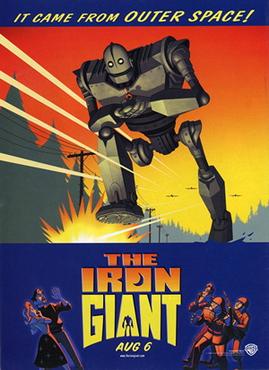
Brad Bird’s 1999 animated feature relocates Ted Hughes’s story to Rockwell, a small Maine town in October 1957. The Cold War setting makes the arrival of an enormous metal visitor feel like a national-security crisis before anyone knows what he is. Nine-year-old Hogarth Hughes hears about strange power failures, follows the reports into the woods and finds the Iron Giant near an electrical substation. The Giant is unfamiliar with the world and behaves with the impulsive curiosity of a child. When he becomes entangled in power lines, Hogarth risks himself to free him.
Hogarth and the Giant develop a quiet friendship in secret. The boy teaches him words, shows him comic books and explains the difference between a hero and a weapon through Superman. The Giant eats metal, including railroad track, without understanding the consequences; a collision with a train damages him, but his pieces return to the central body and let him repair himself. Hogarth has to keep him hidden while also finding food for a visitor who is difficult to conceal. What could be a simple fantasy of a boy and a giant becomes a story about teaching a powerful being how to interpret his own actions.
The town’s sightings draw federal agent Kent Mansley, who arrives convinced that an unknown machine could be a danger to the country. He has little patience for Hogarth’s attempts to explain the Giant as a person. Mansley questions the boy and his widowed mother Annie, then places himself close to the family so he can watch them. Hogarth gets help from Dean McCoppin, an outsider who runs a scrapyard and makes sculptures from discarded metal. Dean is wary at first, but he understands the Giant is not attacking anyone and agrees to hide him among the junk.
Hogarth’s lessons take a more serious turn after he and the Giant see hunters kill a deer. The Giant begins to understand that living things can die, a concept that makes his own destructive capabilities newly frightening. Later, while they are playing, Hogarth points a water pistol at him. The Giant’s body responds by unfolding hidden weapons and targeting the apparent threat. He regains control before harming Hogarth, but the discovery disturbs him. Rather than celebrate the spectacle of a robot transforming into a combat machine, the film shows the Giant recoiling from what his body can do.
Mansley finds evidence tying Hogarth to the Giant and brings General Rogard and soldiers to the scrapyard. Dean hides the visitor by arranging him to look like one of his sculptures, temporarily diverting the search. When the Giant later appears in Rockwell, he rescues two children from a fall and wins over some of the townspeople. Mansley still insists on force. During the confrontation Hogarth is knocked unconscious, and the Giant reads his stillness as death. His defensive systems take over, turning a frightened response into the very military threat that Mansley had predicted.
The Giant attacks the forces surrounding him, and conventional weapons fail to stop him. The military prepares a nuclear strike from the submarine USS Nautilus. Hogarth wakes and calms the Giant, and Dean convinces Rogard to stand down. Mansley nevertheless orders the launch. The order is meant for the Giant, but the missile is now on a course that will destroy Rockwell and its people. Hogarth has reminded the Giant that he can choose who he wants to be, but Mansley's refusal to stop now threatens everyone. Rogard realizes the missile is aimed at their own position, and the launch cannot be recalled in time.
The Giant chooses to save the town. He says goodbye to Hogarth, flies into the sky and intercepts the missile far above the ground, where it detonates away from Rockwell. The Giant appears to be destroyed. Months later, Dean’s memorial statue stands in the town park, and Hogarth receives a piece of metal recovered after the explosion. It begins to move. Remembering that the Giant’s body could reassemble itself, Hogarth lets it go, and the final image shows the Giant’s head on an Icelandic glacier as his scattered parts begin to gather around it.
The contrast between Hogarth and the Giant is built into the animation. The boy was drawn by hand while the metal figure was animated with computers, giving them different visual textures while keeping them together in the same scenes. Bird’s film version also fixes the story in a specific Cold War moment, where fear of invasion shapes adults’ reactions to an unknown visitor. Against that pressure, the Giant’s size and weapon systems do not determine his final act. His friendship with Hogarth becomes a practical example of choice: what he was made for and what he decides to do are not the same thing. The Giant’s movements help distinguish curiosity from threat: he crouches to look closely at small objects, follows Hogarth’s teaching, and reacts to danger before he can interpret it. His mechanical repair ability is also important to the ending, because earlier damage teaches Hogarth that apparently scattered pieces can find one another again. The final movement of the recovered metal therefore answers a physical detail established in the story, while leaving the Giant’s return open rather than showing a complete reunion.