
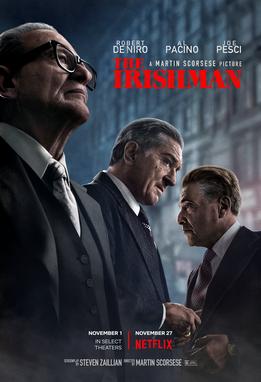
Behind the film
- Year
- 2019
- Director
- Martin Scorsese
- Writers
- Steven Zaillian
- Runtime
- 3h 29m
- Genres
- Crime, Drama, Epic, Gangster
- Country
- United States
- Cast
- Robert De Niro, Al Pacino, Joe Pesci, Harvey Keitel, Anna Paquin, Ray Romano, Stephen Graham, Bobby Cannavale
About the film
Contains story spoilers.
From a nursing home, elderly Frank Sheeran recalls how he moved from truck driving into work for Pennsylvania mob boss Russell Bufalino, then became close to Teamsters leader Jimmy Hoffa. Hoffa trusts Frank as a bodyguard and friend, but his return to union politics strains his relationship with mob figures including Russell and Tony Pro. In 1975, Russell tells Frank that the crime bosses have sanctioned Hoffa’s murder and insists Frank be the triggerman. Frank lures Hoffa to an empty house in Detroit and shoots him. Years later, Frank is old, isolated from his daughters and visited by a priest. He asks the priest to leave the door partly open, echoing Hoffa’s old habit. The film presents his confession as a memory, not a settled account of real history.
Martin Scorsese frames the story around recollection rather than a clean rise-and-fall arc. Frank’s voice leads the audience through decades, but the nursing-home frame keeps returning as a reminder of where the story ends. The camera glides through an empty corridor before settling near him, making time feel both expansive and already spent. Instead of treating the gangland world as a succession of thrilling operations, the film watches how a life becomes legible only after its choices have accumulated. Frank’s narration can explain what he did, but cannot restore the relationships that those actions consumed.
The film’s social world is built through overlapping institutions. Frank drives a truck, deals with union lawyers, meets local gangsters, and eventually becomes Hoffa’s trusted protector. These settings connect labour, political influence and organized crime without reducing them to one secret organization. Hoffa’s position at the Teamsters gives him access to power, but also makes him difficult for Russell’s allies to control. Al Pacino plays him as charismatic and restless, a man who can command a room and still misread the loyalties surrounding him. His force of personality is part of why Frank’s friendship matters and why it becomes dangerous.
Joe Pesci's Russell differs sharply from the explosive gangsters familiar from many crime films. His quiet authority turns conversation into a way of establishing what everyone is already expected to accept. Robert De Niro's Frank responds with a professional attentiveness that can resemble humility while also revealing a profound dependence on approval. Their pairing makes violence feel connected to habits of politeness and obligation. Menace does not need to announce itself as rage. It can arrive through the apparently reasonable assumption that a trusted subordinate will perform what loyalty requires, leaving refusal almost unimaginable before it has even been discussed.
Family supplies a measure of Frank that his professional circle cannot control. Anna Paquin's Peggy carries much of that measure through observation and silence, denying the narrator an easy answer to the person who knows him in a different way. The absence of an extended explanation matters. Frank's account can fill the film with the reasons and arrangements that made his working life intelligible, yet those explanations do not oblige another person to accept it. The contrast places a limit on narrative charm: being able to tell the story of one's conduct is not the same as repairing its effect on someone else.
The film’s digital de-aging keeps the same actors moving through different decades, but it does not make their bodies entirely ageless. Their faces shift in age while gestures and posture retain traces of later life. That tension suits a story in which memory cannot fully recreate youth. Rodrigo Prieto’s cinematography and Thelma Schoonmaker’s measured editing keep the chronology readable through changes in cars, rooms, clothes and public events. The effect is less a parade of period detail than a long recollection whose images gradually acquire the weight of an old man’s present.
The film dramatises Sheeran's disputed account of Hoffa's disappearance; its apparent access to private encounters is a storytelling choice, not proof that those encounters occurred. That distinction matters precisely because Scorsese makes the social world so persuasive. A coherent dramatic explanation can feel satisfying where the historical record remains unresolved. Within the fiction, the quietness of the crucial violence denies the usual action-movie release. The accumulated conversation and obligation make the event feel like the fulfilment of a terrible administrative expectation. The audience is left considering a relationship rather than admiring the successful execution of a criminal operation.
Old age changes what a gangster film can count as a consequence. Survival need not look like victory when the institutions that made a man important no longer surround him with attention. The late scenes give ordinary rooms and pauses the weight that earlier passages attached to alliances and negotiations. Spiritual conversation offers a listener without automatically supplying absolution. Frank can remain articulate while finding that articulation has less and less practical power. The closing image leaves the possibility of contact barely open, making loneliness a material condition rather than a grand speech about regret or a final flourish of criminal legend.