
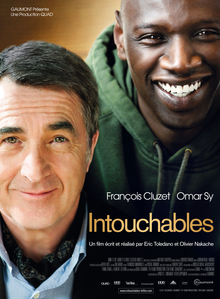
Behind the film
- Year
- 2011
- Director
- Éric Toledano, Olivier Nakache
- Writers
- Olivier Nakache, Éric Toledano
- Runtime
- 1h 52m
- Genres
- Comedy, Biographical, Drama
- Production
- Gaumont, TF1
- Country
- France
- Cast
- François Cluzet, Omar Sy, Anne Le Ny, Audrey Fleurot, Grégoire Oestermann, Clotilde Mollet, Alba Gaïa Bellugi, Cyril Mendy
About the film
Contains story spoilers.
The Intouchables begins at night in Paris with Driss driving Philippe’s Maserati at high speed while police pursue them. When the car is stopped, Driss claims Philippe needs urgent medical attention, and Philippe pretends to have a seizure; the officers escort them to the hospital, and Driss drives away. The film then rewinds to explain how they came to be friends. Philippe is wealthy and lives with quadriplegia after a paragliding accident. He and his assistant interview applicants for a live-in caregiver, while Driss arrives expecting only a signature to confirm he was rejected and preserve his benefits.
The next morning Driss returns for the signed form and is told he has the job on a trial basis. He is inexperienced and recently released from prison, but Philippe prefers his bluntness to applicants who treat him with pity. The work is practical and demanding: Driss learns to assist Philippe in daily life, and his unconventional approach changes the household’s routines. Their relationship does not begin as a sentimental rescue. Philippe gives Driss responsibility and expects him to do the job properly; Driss discovers that the person he cares for wants conversation, humor and ordinary respect as much as careful assistance.
Driss is also adjusting to the world Philippe inhabits. He encounters contemporary art, opera and classical music, and he begins painting, though he views much of the culture around him through comic skepticism. At Philippe’s birthday, a private concert fills the living room with classical pieces. Driss then plays Earth, Wind & Fire, changing the mood and drawing the guests into the music. That contrast captures the film’s central pairing: the men do not simply trade lessons, but make room for different tastes to coexist. Driss’s relationship with Philippe’s adopted daughter Elisa adds another responsibility, as he intervenes when she is upset over a boyfriend. The two men’s musical exchange also avoids a simple reversal in which Driss must become cultured to belong in the house. Philippe shares what he enjoys, while Driss responds honestly and sometimes irreverently; the concert changes because he brings his own music into the room. Their friendship is reciprocal in a less tidy way: Philippe offers a position and respect, and Driss offers presence without reducing him to an injury or a source of inspiration.
Philippe has been corresponding by letter with Eléonore, a woman in Dunkirk, but he fears meeting her because she may react to his disability. Driss encourages him to speak to her by phone and send a current photograph. Philippe hesitates and asks Yvonne to send a photo from before the accident, revealing how vulnerable he feels about being seen as he is. They arrange a date, but Philippe leaves with Yvonne before Eléonore arrives. Driss does not pretend that the fear is solved; instead, he continues to urge Philippe toward a connection that Philippe wants but cannot yet face.
The demands of Driss’s own life eventually pull him back home. His cousin Adama arrives at the mansion under the pretense of bringing mail, and Philippe overhears that Driss needs to support his family. Philippe releases him from the job, suggesting that he may not want to spend his life pushing a wheelchair. Driss returns to his community and helps his cousin, while Philippe tries new caregivers and loses his usual energy. The separation gives each man space, but the film shows that their companionship has become important to both of them: Philippe’s staff calls Driss back when his mood and self-care deteriorate.
Driss returns and takes Philippe for another fast drive in the Maserati, bringing the narrative around to the opening chase. After they evade the police, he drives Philippe to the seaside and helps him prepare for the lunch date. At the restaurant Driss leaves Philippe alone, and Eléonore arrives. Philippe looks through the window and sees Driss smiling outside before he walks away. The scene resolves the correspondence thread through a meeting Philippe chooses to attend, while Driss steps back instead of taking over the moment. The film closes with images of the real Philippe Pozzo di Borgo and Abdel Sellou together, marking the story’s inspiration without implying every event in the fictionalized account occurred exactly as shown.
The comedy comes from the men’s differences in taste and manner, but their relationship is also shaped by care work and trust. Philippe controls the household’s resources, while Driss brings a perspective not filtered through professional etiquette; both have to adapt if the arrangement is to last. The film is inspired by Philippe Pozzo di Borgo and his caregiver Abdel Sellou, but the characters’ names and events are dramatized. Its episodes—music, painting, family intervention and the missed date—build a portrait of friendship through everyday decisions rather than a single cure or grand transformation. Their paragliding trip gives that developing trust another setting. The activity associated with Philippe’s injury remains something he wants to experience, while Driss has to confront his own alarm in a place beyond the familiar household. Philippe’s willingness to return to the air complicates any assumption that care should consist only of preventing risk. François Cluzet and Omar Sy make the exchange work through reactions and timing, allowing Philippe’s quieter amusement and Driss’s expressive disbelief to become another conversation between equals with different kinds of confidence.