
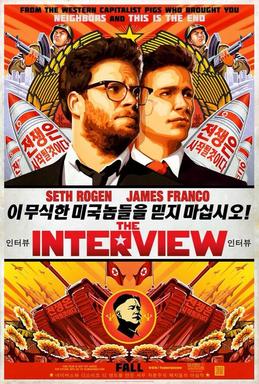
Behind the film
- Year
- 2014
- Director
- Seth Rogen, Evan Goldberg
- Writers
- Dan Sterling
- Runtime
- 1h 52m
- Genres
- Action, Adventure, Comedy
- Production
- Point Grey Pictures, Columbia Pictures
- Country
- United States
- Cast
- James Franco, Seth Rogen, Lizzy Caplan, Randall Park, Diana Bang, Timothy Simons, Anders Holm
About the film
Contains story spoilers.
Dave Skylark’s celebrity programme earns him access to North Korean leader Kim Jong-un, and producer Aaron Rapaport sees a chance to make the show more serious. Before they travel, the CIA recruits them to assassinate Kim during the interview. Their plan unravels in Pyongyang: a ricin strip is accidentally consumed by a bodyguard, and Dave grows close to Kim, who presents himself as a misunderstood friend. When Dave discovers the staged grocery store and sees Kim’s threats, he and Aaron join propagandist Sook to expose the leader on air rather than kill him. Dave’s broadcast humiliation enrages Kim, who shoots him before preparing a missile launch. Dave survives, destroys Kim’s helicopter before the launch and escapes with Aaron. Sook stays to maintain security, becoming interim leader of a democratic North Korea.
The movie begins with a mismatch: Dave is famous for asking celebrities intimate questions, while Aaron wants their programme to matter beyond its audience. Their disagreement gives the action a personal engine before the CIA arrives. Dave believes connection and performance can solve almost anything; Aaron sees the difference between being watched and doing journalism. The film keeps teasing that distinction. An interview can be conversation, publicity or a weapon, depending on who controls the room and what viewers are allowed to see. Their assignment magnifies the gap until neither can pretend that a camera automatically makes someone brave or truthful.
Dave’s friendship with Kim is the story’s most useful complication. Kim wins him over through flattery, shared entertainment and apparent vulnerability. Dave wants to believe the leader is simply lonely, because that confirms his own talent for making people open up. The comedy comes from watching that confidence exceed his judgement. Friendship, performance and manipulation can occupy the same encounter, particularly when one participant controls the setting and the other wants to be liked. Dave’s eventual recognition of Kim’s cruelty does not turn him into a seasoned reporter overnight. It forces him to decide whether personal warmth excuses the image he is helping create.
Aaron is not merely the cautious friend beside Dave’s recklessness. He wants professional respect, and the trip places that ambition next to real danger. He must improvise as the plan repeatedly collapses, but he also sees how their access can be used to stage a false picture for viewers. Seth Rogen gives Aaron a nervous practicality that keeps the friendship’s argument grounded. The film asks what responsibility a producer has when a broadcast can shape public understanding, and whether changing the format is enough if the powerful still control the feed. Aaron’s relationship with Sook extends the question beyond the American duo: she understands the local risks of turning spectacle into dissent.
The broad, crude jokes are part of the film’s method. It reduces state power to vanity, childish appetites and bodily comedy, using humiliation to puncture the image of an untouchable leader. Randall Park makes Kim funny without making him harmless; charm is one of the tools he uses to manage people. This balance matters because the farce involves a real political figure and country. Its comic premise offers an exaggerated fantasy of access and exposure, not a reliable portrait of North Korean life. Within that limit, the joke targets authoritarian image-making and outsiders who mistake a staged encounter for genuine insight.
The climax makes television a contested space. Dave’s interview can reproduce Kim’s script or interrupt it, and the choice endangers everyone around the broadcast. The film imagines a performance opening a crack in a manufactured persona, while showing how quickly spectacle becomes dangerous and personal. That fantasy is cleaner than real political change: one successful broadcast cannot explain or resolve a country’s history. The ending speeds towards an action-comedy escape and a hopeful new political order. Its more durable question is smaller: when the camera is running, are Dave and Aaron trying to understand what is happening, or just trying to become the most memorable people in the room?
The friendship gives the media satire a continuing emotional argument. Two people can care about one another while relying on incompatible accounts of what their shared work should achieve. One values the immediate response of an audience; the other wants recognition from a professional world that may not value the same response. Neither ambition automatically provides sound judgment. Their disagreements therefore need more than a compromise over format. They have to consider what another person risks when a public image is made persuasive. The film's outrageous scale keeps that question inside farce, yet the question remains specific to its television world. Being memorable can reward the person in front of the camera without benefiting the people described by the broadcast. The difference between attention and understanding gives the comedy a point of pressure that survives its deliberately implausible political fantasy. Friendship gives that pressure an immediate personal cost.