
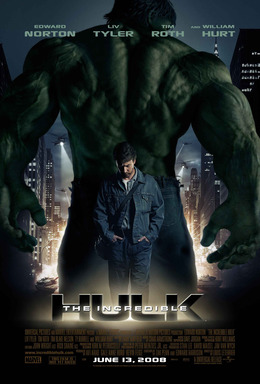
Behind the film
- Year
- 2008
- Director
- Louis Leterrier
- Writers
- Zak Penn
- Genres
- Action, Adventure, Science fiction, Superhero
- Country
- United States
- Cast
- Edward Norton, Liv Tyler, Tim Roth, William Hurt, Tim Blake Nelson, Ty Burrell, Peter Mensah, Robert Downey Jr.
About the film
Contains story spoilers.
The Incredible Hulk introduces Bruce Banner through the consequences of an experiment rather than a lengthy account of his life before it. Images of the laboratory disaster explain why he has disappeared, why Betty Ross was injured, and why her father considers him valuable military property. By the time the story settles in Brazil, Bruce is already organizing his existence around avoiding discovery. Edward Norton plays him as a man who measures danger before anyone else notices it. Work, accommodation and contact with strangers all involve calculations about whether his body will betray him, giving an enormous superhero a notably small everyday life.
His job in a bottling factory provides both cover and a reminder that concealment is fragile. A cut contaminates a bottle with his blood, and that trace eventually exposes his location. He has also been corresponding with an anonymous researcher called Mr. Blue, hoping that the condition might be treatable. Breathing exercises and a pulse monitor make emotional control visible without suggesting anger is a simple choice. When General Ross sends soldiers after him, a pursuit through the crowded neighbourhood becomes a factory confrontation. The transformation turns the narrow places where Bruce has been hiding into spaces that cannot contain what he becomes.
Emil Blonsky experiences the Hulk as an opponent he should be capable of defeating, and the gap between training and physical power begins to consume him. Tim Roth gives the soldier a competitive intensity that contrasts with Bruce's exhaustion. Ross offers enhancement through another experimental programme, extending the same military appetite that helped create Banner's condition. The distinction between the two men matters: Bruce wants to get rid of an ability that makes ordinary relationships dangerous, while Blonsky wants more of it. Their paths grow closer because the people pursuing a weapon repeatedly ignore the warnings carried by its original failure.
Returning to the United States brings Bruce back to Betty, who has continued her life during his absence. Their reunion makes the pursuit more complicated than a fugitive simply moving between safe places. She knows him as a person rather than a specimen, but loving him cannot make the physical danger disappear. The confrontation at the university illustrates both sides of the Hulk: military equipment provokes destructive force, while Betty's presence draws out recognition and protection. Their quieter time together has an awkward tenderness, especially when Bruce's effort to maintain control interrupts gestures that would otherwise be ordinary. His body has become a third presence in the relationship.
The search leads them to Samuel Sterns in New York, where a possible treatment briefly changes what the future might look like. Sterns is excited by the scientific possibilities and has multiplied the blood Bruce supplied, seeing opportunity where Bruce sees another route to exploitation. That difference exposes a problem no antidote alone can solve: knowledge about the Hulk can move into other hands. Bruce wants the material destroyed, but capture interrupts the decision. Blonsky's insistence on acquiring the same power turns the research room into the origin of the Abomination. His earlier enhancement and the new exposure produce a body whose scale makes his ambition impossible to disguise.
Harlem becomes the place where Banner's wish to remain human conflicts with his ability to protect other people. The Abomination is loose among civilians, and the armed pursuit has produced a threat it cannot readily control. Bruce persuades Ross to let him try to intervene, accepting a transformation without certainty that the attempted treatment has left it available. The leap from the helicopter makes that gamble physical before the monster fight begins. Once transformed, his conflict with Blonsky has the force of two incompatible relationships to power colliding: one man has pursued domination, while the other has been cornered into using what he fears.
Louis Leterrier gives the confrontation a heavy, street-level setting, using cars, walls and military debris to establish the bodies' impact. Betty remains important because the battle is not settled solely by proving the Hulk can hit harder. Her appeal helps stop him killing the defeated Abomination, preserving a distinction between strength and surrender to rage. Craig Armstrong's music and the scenes of Bruce alone give the film a mournful current beneath its pursuit structure. The pauses are not simply intervals between action scenes; they establish how much the protagonist wants a life in which he would not have to become the central spectacle.
The closing return to isolation leaves Bruce practicing control rather than declaring himself cured. His altered expression suggests that his relationship with the transformation may be changing, but the film does not demonstrate a permanent solution. Tony Stark's visit to Ross opens a wider possibility without making that unfinished personal question disappear. The story's most useful tension remains the one established in the Brazilian room: Bruce is both the person who needs protecting and the force other people fear. Following his attempts to separate those identities explains why the Hulk's victories cannot automatically provide the happy ending that an ordinary pursuit thriller might promise.