
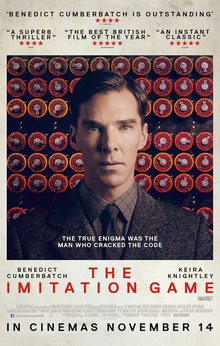
Behind the film
- Year
- 2014
- Director
- Morten Tyldum
- Writers
- Graham Moore
- Runtime
- 1h 54m
- Genres
- War, Biographical, Drama, Historical
- Production
- Black Bear Pictures
- Country
- United States
- Cast
- Benedict Cumberbatch, Keira Knightley, Matthew Goode, Rory Kinnear, Charles Dance, Mark Strong, Allen Leech, Matthew Beard
About the film
Contains story spoilers.
The Imitation Game tells Alan Turing’s story through several periods rather than following his life in a straight line. In 1951, a police investigation into a reported break-in at his Manchester home brings Detective Robert Nock to the door of a mathematics professor whose machines and guarded manner raise questions. Turing turns the interrogation into a contest: Nock must listen to his account and work out what lies beneath the answers. From there, the film moves back to Turing’s school years and forward to Bletchley Park during the Second World War, gradually connecting his habits of secrecy with both codebreaking and the criminal law used against him.
At school, young Turing is bullied and isolated until he befriends Christopher Morcom, another boy drawn to mathematics and codes. Christopher gives him a book about ciphers, and the two create a private coded language. Turing’s feelings for Christopher deepen, but Christopher dies before Turing can tell him. The loss leaves Turing with a lasting idea that a person might continue in some form through what they leave behind. The film uses these scenes to give an emotional origin to his later drive to build a machine that can discover patterns no single mind could track, while showing how early rejection makes ordinary social exchanges difficult for him. Cumberbatch often makes Turing’s literal answers sound like refusals to participate in a conversation, even when he believes he is answering it accurately. Clarke gradually helps translate between that manner and the team’s expectations. Their collaboration requires social understanding as well as mathematical ability, giving the relationships a practical importance beyond making an isolated protagonist more likable.
In 1939, Turing arrives at Bletchley Park, where a group of mathematicians and linguists works on German Enigma traffic. Commander Alastair Denniston oversees the operation, while Hugh Alexander and the others bring established methods and a sense of team discipline. Turing is impatient with convention and distrustful of colleagues, and he begins designing an electromechanical device that the film calls Christopher. When Denniston refuses to fund it, Turing appeals directly to Churchill and gains authority to lead the team. He then fires two members and recruits through a difficult newspaper crossword, which brings Joan Clarke into the operation. Her intelligence matches his, but her family’s restrictions and the male-dominated workplace put practical obstacles in her path.
The machine’s first version fails to find the daily Enigma settings quickly enough. Denniston orders it dismantled, and Turing faces dismissal just as Clarke considers leaving because her parents expect her to marry. Turing proposes, and she accepts, partly to keep her in the work she is good at. During the engagement period, he tells John Cairncross that he is gay; Cairncross warns him to keep it hidden. The breakthrough comes from listening to how German messages are phrased. Turing realizes that repeated words can provide a known starting point for the machine, giving it a way to test possible settings. The team confirms the method and finally begins reading messages in time to matter.
Success creates a new ethical problem. The decoded traffic reveals that a convoy is about to be attacked, but an immediate warning could tell Germany that the code has been broken and lead to a change in the system. The film stages Peter Hilton pleading for action because his brother is on the convoy. The team decides it cannot respond to every interception; Turing develops a statistical approach for choosing which intelligence to use while concealing the source. The choice gives the film its hardest wartime consequence: codebreaking is not simply a puzzle with a triumphant solution, because protecting the secrecy of the method means accepting losses. It also turns the group’s achievement into a continuing act of judgment rather than one decisive victory.
Turing later confronts Cairncross after discovering that he is passing information to the Soviets. Cairncross threatens to reveal Turing’s sexuality, but MI6 officer Stewart Menzies explains that he already knows and has been using the spy to send misinformation. Menzies also pressures Turing through Clarke, prompting Turing to urge her to leave and to confess the truth about himself. Clarke says she would have been happy with him anyway; Turing lies that he never cared for her, hoping to protect her, but she chooses to stay at Bletchley. After the war, the team destroys records and is ordered to remain silent, leaving their work hidden even from one another.
The framing story returns in 1951 as the investigation turns from espionage suspicion to Turing’s arrest for homosexuality. The film follows his conviction and the hormonal treatment imposed as an alternative to prison, then shows Clarke visiting him as his health and independence deteriorate. Its ending connects the public achievement of the codebreakers to the private punishment of a man whose government service could not protect him from discriminatory law. This is a dramatized biographical film, not a documentary record: it compresses events and invents or rearranges dramatic encounters. Its strongest through-line is the contrast between Turing’s ability to make hidden messages legible and the secrecy society demands of him. Clarke’s visit gives that contrast a human scale: someone who saw his ability at work now sees the effects of a punishment that reaches into ordinary movement and concentration. Their conversation returns to the value of the life he has lived, while the performance makes reassurance visibly difficult to receive. The wartime machine and the postwar room become opposite settings for the same question of who is allowed to contribute, and under what conditions.