
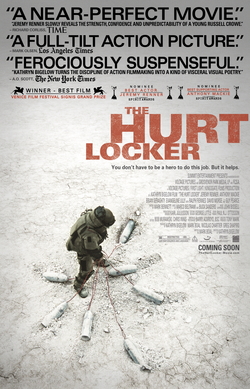
Behind the film
- Year
- 2008
- Director
- Kathryn Bigelow
- Writers
- Mark Boal
- Runtime
- 2h 11m (cinema version)
- Genres
- Action thriller, War, Independent, Drama
- Production
- Summit Entertainment, Grosvenor Park Productions
- Country
- United States
- Cast
- Jeremy Renner, Anthony Mackie, Brian Geraghty, Guy Pearce, Christian Camargo, Ralph Fiennes, David Morse, Evangeline Lilly
About the film
Contains story spoilers.
The Hurt Locker follows a small American explosives disposal team in Baghdad during the Iraq War. Its opening assignment establishes how quickly a procedure can become a catastrophe: a robot cannot complete the task, Sergeant Matthew Thompson approaches the device himself, and a man watching from nearby detonates it. Thompson dies, leaving Sergeant J. T. Sanborn and Specialist Owen Eldridge to absorb the failure and continue working. Eldridge believes he should have stopped the man with the phone. The film then introduces Sergeant First Class William James as the replacement leader and begins counting down the days left in the deployment. What should be a temporary arrangement becomes a test of whether three men can survive one another’s responses to danger.
James is skilled, but his way of working gives the others little reassurance. He moves toward devices without sharing enough of his intentions, blocks Sanborn’s view and refuses to abandon a complex car bomb when the risk grows. Taking off his protective suit and removing his headset make his concentration visible while cutting the connection to colleagues who are supposed to cover him. Sanborn needs a team with predictable roles; James appears most comfortable when he is alone with the object everyone else wants to escape. Eldridge, already carrying guilt, has to watch another leader make himself vulnerable. Their arguments are therefore about more than personality. One man’s confidence changes the amount of danger another man must stand beside without controlling it.
The film varies that pressure rather than building toward one decisive enemy. During an encounter with British contractors in the desert, sniper fire turns a roadside problem into a long wait under threat. James and Sanborn take over a rifle and watch a distant position while heat, thirst and fatigue make sustained attention difficult. Eldridge has to notice danger approaching from another direction. Here, the men briefly function as the coordinated unit that their bomb assignments have threatened to break apart. The long distance between shooter and target changes the action’s pace: small movements matter, uncertainty lasts, and providing water or keeping watch becomes as important to survival as making the next shot.
James also forms a casual connection with Beckham, an Iraqi boy who sells DVDs near the base. When a raid reveals a dead child whose body has been turned into a bomb, James believes he has found Beckham. He deals with the device but becomes emotionally fixed on that identification. Lieutenant Colonel Cambridge, who has been trying to help Eldridge handle his fear, is killed during the operation. James then leaves the base without permission and pressures a man to take him to the boy’s home, only to enter an unrelated household. His attempt to turn grief into an investigation exposes how little he knows about the people around him. When Beckham later appears alive, James cannot smoothly return to their earlier familiarity.
Another decision has consequences he cannot contain. After a tanker explosion, James chooses to search nearby streets for those responsible rather than keeping the team within its immediate assignment. Sanborn objects, but follows with Eldridge. The men split up, Eldridge is captured, and rescuing him leaves him badly injured. Before he is evacuated, he directly blames James. The film does not erase that accusation because the rescue succeeded. Near the deployment’s end, James tries to help a man forced into an explosive vest, but cannot remove it in time. He has to retreat and leave the man to die. Sanborn’s response is a desire for a different life, including a family, rather than another opportunity to demonstrate courage.
The return home changes the scale of the images without providing a simple release. James is back with Connie and their young son, doing household jobs and facing an overwhelming supermarket aisle full of cereal boxes. Choosing among ordinary products appears to give him less direction than examining a lethal device. His conversation with his son suggests that the things he once loved have narrowed until one remains dominant. The final sequence sends him back to Iraq for another year-long deployment, with a fresh countdown replacing the one just completed. Sanborn’s wish to leave and James’s decision to return offer different outcomes from the same period of service. Going home physically does not mean danger has stopped organising his attention.
Kathryn Bigelow directs from Mark Boal’s screenplay, with Jeremy Renner, Anthony Mackie and Brian Geraghty carrying the team’s conflicting needs. The camera watches rooftops, windows and faces around a device without always settling what the observers intend. That uncertainty keeps the soldiers’ view of a street provisional: a person can be a spectator, a threat or someone they have misread. The bomb suit makes James look isolated even when others are nearby, while conversations at the base reveal fear that military routines cannot neatly process. This is a fictional character drama within a war setting, not a reliable guide to explosives disposal. Its central tension is the growing gap between being effective at one dangerous job and being able to build a life beyond it.