
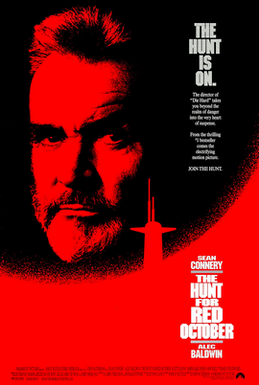
Behind the film
- Year
- 1990
- Director
- John McTiernan
- Writers
- Larry Ferguson, Donald E. Stewart
- Genres
- Action, Drama, Spy, War
- Production
- Paramount Pictures
- Country
- United States
- Cast
- Sean Connery, Alec Baldwin, Scott Glenn, Sam Neill, James Earl Jones, Fred Thompson, Joss Ackland, Richard Jordan
About the film
Contains story spoilers.
The Hunt for Red October makes the meaning of an approaching submarine more important than its destructive capacity alone. A weapon can be detected, tracked and classified while the purpose of the person commanding it remains uncertain. John McTiernan directs Sean Connery as Captain Marko Ramius and Alec Baldwin as Jack Ryan in this adaptation of Tom Clancy’s novel. The fictional Cold War situation brings military procedure into conflict with a hypothesis about human intention. Ryan’s task is not simply to discover where the submarine is. He has to persuade people that the story they are telling themselves about its destination may be dangerously wrong.
In 1984, Ramius takes the advanced Red October towards American waters, intending to defect with his officers. Ryan interprets the Soviet effort to destroy it as evidence supporting that plan. He joins the American submarine Dallas and helps establish contact. Ramius stages an emergency to evacuate his unsuspecting crew, allowing Americans aboard. A pursuing Soviet submarine and an onboard saboteur threaten the arrangement; Ryan kills the saboteur, while the pursuer is destroyed by its own torpedo. The evacuated crew believes Red October has sunk. Ramius and Ryan instead take it into concealment, completing a transfer that depends on maintaining that false appearance.
The opposing interpretations make the thriller’s bureaucracy part of its action. Officials do not have to be foolish to see a threat in a powerful enemy vessel approaching their coast. Ryan has to work with that understandable fear rather than merely dismiss it. His insight gains value only if it survives questioning and reaches people able to act on it. The film places persuasion alongside technical knowledge: an analysis left in a room has limited power, while a convincing argument can change orders at sea. That gives conversations a practical urgency. The danger advances while people decide which explanation is credible enough to guide them.
Connery’s Ramius supplies the other half of the uncertainty. His authority aboard the vessel allows him to direct its course, but his intentions cannot be known equally by everyone serving under him. Command therefore depends on controlled information, and the plan exposes distinctions between the captain, participating officers and the wider crew. The submarine becomes a social structure as well as a machine. It contains people sharing the same physical risk while working with different understandings of why that risk exists. Ramius’s composure is important because disclosure at the wrong moment could collapse the arrangement on which his attempted defection depends.
The submarine setting gives those questions of information an unusually concentrated form. A crew cannot step away from a disagreement, and the enclosed environment makes trust a practical condition of survival. Systems must be operated by people whose knowledge and discipline complement one another. At the same time, the vessel’s concealment outside leaves everyone trying to read fragments: a sound, a movement or a pattern that may suggest another boat’s presence. The thriller lets expertise feel specific without making the ocean transparent. Finding a signal does not necessarily establish an intention, and technological advantage does not remove the need for someone to interpret what technology detects.
Ryan’s movement into that environment changes the kind of credibility he needs. Being able to formulate an argument in an office is different from defending it among people who must live with the operational consequences. Baldwin’s character enters a world with established procedures and experienced officers, so his theory cannot substitute for their skills. The film’s tension depends on joining those forms of knowledge. He offers an account of motive; they can turn contact into action if the account proves persuasive. Neither contribution is sufficient alone. That relationship keeps the analyst’s role distinctive without requiring the military professionals around him to become incompetent for his benefit.
The larger political situation also complicates the idea of rescue. Helping Ramius means acquiring a strategically valuable vessel, and avoiding an obvious confrontation matters to both the immediate escape and its aftermath. The plan must manage what observers believe happened, not merely ensure that the protagonists remain alive. This makes deception a tool operating at several levels. Ramius conceals his purpose from his crew, while the final arrangement depends on concealment from the wider world. The film’s resolution is therefore an achievement of timing, performance and interpretation as much as firepower. A successful encounter has to leave an explanation that others can accept without exposing what occurred.
By the ending, two men who began on different sides of an immense military divide have acted on a shared understanding. That cooperation does not abolish the Cold War setting or make distrust irrational. It shows how a particular crisis can change when someone is willing to investigate an alternative to the most alarming explanation. The Hunt for Red October builds its momentum from that narrow opening between certainty and doubt. Its machines make the stakes enormous, but its decisive resource is the ability to read another person’s purpose accurately enough to take a risk on it. The ocean hides the vessel; competing assumptions almost hide the opportunity.