
Behind the film
- Year
- 2002
- Director
- Stephen Daldry
- Writers
- David Hare
- Runtime
- 1h 55m
- Genres
- Drama, Lgbtq-related
- Production
- Miramax, Paramount Pictures, Scott Rudin Productions
- Country
- United Kingdom, United States
- Cast
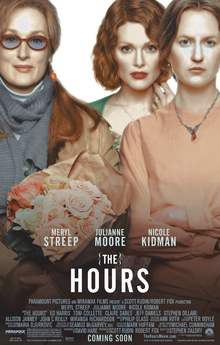
- Meryl Streep, Julianne Moore, Nicole Kidman, Ed Harris, Toni Collette, Claire Danes, Jeff Daniels, Stephen Dillane
About the film
Contains story spoilers.
The Hours moves among three women whose lives are separated by decades but drawn together by Virginia Woolf’s novel Mrs Dalloway. In early 1920s England, Woolf begins writing it while living with her husband Leonard in Richmond. In 1951 Los Angeles, Laura Brown reads the novel while trying to perform the duties expected of a wife and mother. In 2001 New York, Clarissa Vaughan, a book editor, prepares a party for her friend Richard Brown, a poet living with AIDS. Each story unfolds largely within one day, and the film’s crosscutting makes that shared shape visible without suggesting the women occupy the same moment.
Virginia’s thread begins with the film’s prologue: she walks into a river with stones in her pockets, then the story turns back to the years when she was trying to write and stay well. Leonard hopes their life in Richmond will protect her from illness, yet she longs for London and resents the limits placed around her. A visit from her sister Vanessa and the children lifts the household into brief liveliness, but a dead bird gives their time together an encounter with mortality. Her determination to return to London is bound up with creative work and the desire to have some say over her own life.
Laura’s day appears quieter, which makes the strain in it easy to underestimate. She is pregnant with a second child, married to Dan, and mother to young Richie. She bakes a birthday cake for Dan while reading Mrs Dalloway and struggling with the gap between the domestic performance she is expected to offer and her private despair. Her friend Kitty visits and tells her about a medical problem; their conversation leads to a moment of closeness that complicates Laura’s feelings rather than solving them. She later checks into a hotel and considers suicide, then returns home, leaving open what her choice will be.
Clarissa’s routine is organized around Richard. Richard calls her “Mrs Dalloway” as she handles errands for the party, and tends to him in his apartment with a closeness that has lasted since their youth. Richard, once an ambitious poet and now seriously ill, jokes and lashes out as his body and energy fail. Clarissa’s partner Sally and Clarissa’s daughter Julia are present in her life, but the day makes clear how much of her emotional identity has narrowed around Richard’s needs. Louis, Richard’s former lover, arrives too, and the reunion turns old attachments into an uncomfortable part of the planned celebration.
The film’s structure links these separate hours through repeated gestures rather than explanatory narration. A woman arranges flowers, looks at a face in a mirror, or pauses over a sentence; the cut moves to another era where a related image returns in a different context. Mrs Dalloway travels between the stories as a material object and an idea: Virginia writes it, Laura reads it, and Clarissa lives with a name and pattern that echo its heroine. Philip Glass’s score gives the intercut sequences a persistent forward pulse, so the characters’ days feel simultaneous to the viewer even as their circumstances remain distinct.
The relationships become clearer as the day advances. Laura’s son Richie will grow up to be Richard, though the film initially asks the viewer to experience them as separate people. Richard’s party is meant to honour a literary career, but he refuses its consolations and jumps from his apartment window while Clarissa is with him. His death converts preparation into grief. At the same time, Virginia decides that the central character of her novel should be allowed to live, a decision made while she continues to confront her own suicidal thoughts. The story does not turn these choices into simple opposites; survival carries consequences for everyone around it.
Laura’s later arrival in Clarissa’s apartment brings the strands together. She is Richard’s mother, and her decision to leave her family becomes part of the history he has carried. Laura explains that she chose to live, though that meant abandoning her husband and children, and she does not present the choice as painless or easily defended. Clarissa must meet her not only as the mother of the dead man but as a person with a life of her own. The final movement returns to Virginia and the river, completing the frame opened at the beginning. The Hours leaves the women’s decisions connected through love and loss, while refusing to claim that one life can serve as a tidy answer for another.
The performances also help distinguish repetition from simple parallel. Kidman’s Virginia is alert to how her writing may affect the people around her, while Moore’s Laura makes ordinary domestic tasks feel like acts that require preparation and concealment. Streep’s Clarissa moves quickly through the city, carrying flowers and food, but her briskness softens whenever Richard refuses help. Their different rhythms give each timeline its own weight. The film often cuts on a look or movement, inviting comparison without turning the women into interchangeable examples. Even when their circumstances echo one another, each must make a decision within relationships and obligations that belong specifically to her day.