
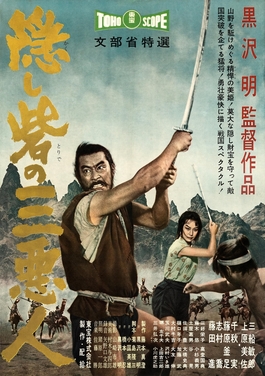
Behind the film
- Year
- 1958
- Director
- Akira Kurosawa
- Writers
- Akira Kurosawa, Ryuzo Kikushima, Hideo Oguni, Shinobu Hashimoto
- Runtime
- 139 minutes
- Genres
- Adventure, Drama
- Production
- Toho
- Country
- Japan
- Cast
- Toshirō Mifune, Misa Uehara, Minoru Chiaki, Kamatari Fujiwara, Takashi Shimura, Susumu Fujita, Toshiko Higuchi, Yū Fujiki
About the film
Contains story spoilers, including the ending.
The Hidden Fortress follows two peasants who hope a civil war will make them rich, then find themselves helping a defeated clan survive. Akira Kurosawa's 1958 adventure puts Tahei and Matashichi beside General Rokurota Makabe and Princess Yuki without letting them understand the company they are keeping. The general needs their labour and their route through enemy territory. They want the gold he promises them. Yuki's safety and the recovery of her throne depend on men whose interest in the mission begins with their own reward.
Tahei and Matashichi have little protection in this world. Armed men can seize them, force them to work or threaten their lives, regardless of what they hoped to gain from the war. Their arguments and attempts to take the treasure make them unreliable companions, but their suffering also gives their greed a setting. They are trying to profit within a system that keeps treating them as expendable. Rokurota uses that appetite to move the clan's gold, concealed inside firewood. The peasants' presence helps the royal party pass as ordinary travellers, while their ignorance protects the secret. Toshiro Mifune plays the general and Misa Uehara plays Yuki, whose survival carries its own cost: Rokurota's sister dies in her place. The princess is appalled by that sacrifice. Protecting the royal line can demand the life of someone who has no comparable power, and Yuki's reaction prevents the general's loyalty from making that loss seem simple. The journey brings her into contact with the people who pay for such decisions.
The peasants' proposed escape takes the party towards Yamana territory before turning into friendly Hayakawa, avoiding the more obvious guarded crossing. Yuki pretends she cannot speak, concealing the manners and speech that might betray her. At an inn she insists that Rokurota free a captive woman from the defeated Akizuki clan; the woman then stays with them. When the travellers mingle with a Fire Festival procession, soldiers are watching and their load of firewood must go onto the bonfire. They join the dance rather than expose the gold. Afterwards they recover treasure from the ashes and continue towards the border. The festival's song about life's brevity stays with Yuki. Captured later, she tells Rokurota that travelling has let her see both the ugliness and beauty of human life. At the eventual reunion in safety, the peasants finally learn who their companions are. The gold will help restore Yuki's clan. Their reward is one coin to share, leaving their appetite for treasure subject to a very different division from the fortune they had imagined.
Rokurota's treatment of an enemy also becomes part of the escape. After a pursuit on horseback takes him into an enemy stronghold, he faces his old rival Hyoe Tadokoro in a duel. Rokurota defeats him but leaves him alive. Tadokoro subsequently suffers punishment from his own side for that failure, and the defeated opponent becomes the man able to save Yuki and her companions when their journey seems over. He turns against his former allegiance and helps them escape. Mercy therefore has a practical consequence within a story otherwise crowded with pursuit and capture. Rokurota cannot simply fight his way beyond every obstacle; the fate of the people with him also depends on what he has done when he held the advantage. Yuki's rejection of unquestioning sacrifice and Tadokoro's change of loyalty complicate the war's divisions. The people carrying out a lord's commands can decide that those commands no longer deserve obedience, even after years of service and rivalry have placed them on opposite sides.
The movement through hostile country fills Kurosawa's first widescreen feature. The opening follows the farmers towards the horizon, keeping the rough ground ahead of them in view. Later, Rokurota's horse pursuit moves along a narrow road before carrying him through the enemy's gate. The wider frame makes room for the distance he must cover and the danger waiting at the end of the ride. Deep focus, diagonal arrangements of people and movement across the image keep the landscape active around the travellers. The princess's disguise also has a visual dimension: her determined expression draws on a Noh mask, while music accompanying her first appearance and the final presentation of the heroes recalls Noh drama. Her eventual appearance as a princess changes what the peasants can see and understand. The figure who has travelled beside them becomes visibly royal, bringing their restricted knowledge of the mission to an end after the dangers of the road have passed.
Donald Richie recalled visiting the production near Mount Fuji in late summer 1958. After a difficult day, he shared a bath with Mifune, who still wore General Makabe's makeup above the neck. A scene had been repeated many times. Richie had also watched Kurosawa persist with a ballpoint pen that would not write, trying it again between takes rather than discarding it. Mifune recognised the comparison with his own working day, but pointed out that the director had eventually made the pen work. Richie's memory gives a small, specific glimpse of the effort behind the general's seemingly unstoppable progress across the screen.