
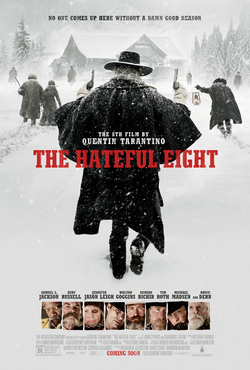
Behind the film
- Year
- 2015
- Director
- Quentin Tarantino
- Writers
- Quentin Tarantino
- Runtime
- 2h 48m (theatrical release)
- Genres
- Western, Mystery, Thriller, Action
- Production
- The Weinstein Company
- Country
- United States
- Cast
- Samuel L. Jackson, Kurt Russell, Jennifer Jason Leigh, Walton Goggins, Demián Bichir, Tim Roth, Michael Madsen, Bruce Dern
About the film
Contains story spoilers.
In the Wyoming Territory after the Civil War, bounty hunter John Ruth rides through a blizzard with Daisy Domergue, whom he intends to deliver alive to Red Rock for hanging. Ruth keeps her shackled to him because he wants the reward and insists on seeing his prisoners reach the gallows. Major Marquis Warren, a former Union cavalry officer and bounty hunter carrying three dead fugitives, hitches a ride when his horse fails. Chris Mannix joins them and claims he is the new sheriff of Red Rock, a title Ruth does not readily accept.
The storm drives them to Minnie’s Haberdashery, where a small group of strangers is already sheltering. Bob says he is minding the place for Minnie and Sweet Dave; the others include hangman Oswaldo Mobray, cowboy Joe Gage and Confederate general Sanford Smithers. Ruth disarms most of them, leaving Warren armed, and watches their behavior for signs that the shelter is a trap. Mannix admires Smithers as a war hero, while Warren tells him that Smithers ordered Black prisoners of war executed at Baton Rouge. Their argument turns the room into a compressed version of the war’s unresolved divisions.
Ruth and Warren share a story about Warren’s letter from Abraham Lincoln, which Ruth has treated as a personal token of respect. Warren admits the letter is a forgery and says it gives him room to be treated more civilly by white people. Later, he provokes Smithers with a graphic account of what he claims happened to Smithers’s son. When the old general reaches for a gun, Warren shoots him. This act, along with the false letter, makes it clear that people in the room use performance and violence to manage power.
While attention is focused on the confrontation, Daisy witnesses someone poison the coffee. Ruth and the stagecoach driver O.B. drink it; both become violently ill, and O.B. dies. Ruth realizes Daisy knew the drink was poisoned and attacks her, but she shoots him with his own gun. Warren takes control and leaves Daisy shackled to Ruth’s corpse. The incident changes the room from uneasy shelter to an active crime scene, and Warren begins testing the occupants’ stories against what he can observe.
Warren finds that Bob’s claim about watching the haberdashery does not fit the evidence and kills him. Gage eventually admits to poisoning the coffee, while a hidden man beneath the floorboards shoots Warren. Mobray and Mannix wound one another in the confusion. A flashback reveals that Bob, Mobray, Gage and Daisy’s brother Jody arrived earlier, murdered Minnie, Sweet Dave and the employees, and staged the inn so Daisy could be rescued. Jody had been hiding in the cellar while the travelers arrived, waiting for the plan to unfold.
Warren and Mannix, both badly wounded, hold Daisy and the surviving gang members at gunpoint. Jody surrenders and Warren kills him. Daisy and the others offer Mannix a deal: if he kills Warren, they will let him collect the bounty on the dying Mobray and deceased Bob. Warren kills Mobray, and the two men shoot Gage when he reaches for a hidden pistol. Mannix rejects Daisy’s bargain, judging her claim of further waiting gunmen unreliable. When he later faints from blood loss, Daisy chops through the arm shackling her to Ruth and tries for a weapon; Mannix wakes and shoots her. Warren and Mannix hang her from the rafters in keeping with Ruth’s insistence on seeing her hanged, and lie dying beneath her.
Quentin Tarantino’s chapter structure withholds information and then returns to the earlier arrival at the haberdashery from a new angle. That shift turns the coffee, hidden weapons and occupants’ rehearsed behaviour into details the audience can reconsider. The wide frame keeps a speaker and the people watching him within the same field of attention, making a glance towards another part of the room potentially important. Robert Richardson’s photography gives the snowy journey an expansive landscape before the characters are confined together. Once inside, the size of the image remains useful for showing how close an unnoticed action can be to an apparently central conversation.
Samuel L. Jackson’s Warren repeatedly uses a story as a weapon, inviting somebody to respond before revealing how the response serves him. The forged Lincoln letter creates a temporary advantage of another kind, giving him access to courtesy he cannot safely assume. Walton Goggins’s Mannix begins with the manner of a talkative opportunist but must eventually judge whom he believes while badly wounded. Kurt Russell’s Ruth mistakes the firmness of his own rules for protection against deception, and Jennifer Jason Leigh’s Daisy watches for openings beneath the violence he directs towards her. Her knowledge of the poison makes even an apparently powerless listener consequential. Tim Roth’s polished Mobray and Michael Madsen’s taciturn Gage offer contrasting performances of harmless company before their identities are exposed. Ennio Morricone’s score adds unease to the journey, while the dialogue inside allows silences, interruptions and waiting to carry threats of their own. At the end, Mannix reads the Lincoln letter knowing it is false. The gesture creates a brief connection without repairing the deaths around them or turning their final violence into a clean moral victory. The room remains a place where people have used truth, invention and force to survive at one another’s expense.