
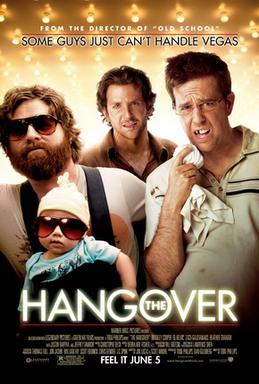
Behind the film
- Year
- 2009
- Director
- Todd Phillips
- Writers
- Jon Lucas, Scott Moore
- Genres
- Comedy
- Production
- Legendary Pictures
- Country
- United States
- Cast
- Bradley Cooper, Ed Helms, Zach Galifianakis, Justin Bartha, Heather Graham, Sasha Barrese, Ken Jeong, Jeffrey Tambor
About the film
Contains story spoilers.
Doug travels to Las Vegas for his bachelor party with Phil, Stu and his future brother-in-law Alan. The next morning, the other three wake in a wrecked suite without Doug or any memory of the night. A baby, a tiger and Stu's missing tooth begin a bewildering investigation. They discover Stu married Jade, whose baby they are carrying, and that the tiger belongs to Mike Tyson. Alan admits he drugged their drinks with what he thought was Ecstasy. Mr. Chow claims they stole his money and offers to return Doug for it, but the man he holds is a different Doug, the drug dealer. A remark about the drugs' name helps Stu realize their friend could be on the hotel roof. They find the sunburned groom there and rush him home for the wedding. Recovered photographs finally reveal scenes from the missing night.
The central device is absence. The audience wakes with the friends, learning the night through the wreckage of a hotel suite and clues that seem to have arrived without causes. Each object produces a question: the missing tooth, a baby, a tiger, a police cruiser. The film delays explanation so discovery becomes its comic rhythm. Confusion is shared with the viewer; we are not watching a known disaster unfold but reconstructing it from fragments. That structure makes exposition active, turning the search into deductions, wrong assumptions, and sudden changes in scale.
Phil, Stu, and Alan have distinct comic functions. Phil is the confident schoolteacher who turns panic into a plan. Stu, a dentist accustomed to avoiding conflict, notices details that do not fit and carries the most visible personal consequence in his missing tooth. Alan is socially awkward and hard to read, making his observations sound strange and potentially useful. Phil keeps them moving, Stu gives the search a skeptical counterweight, and Alan’s unusual thinking sometimes exposes a connection the others miss. The group is funny because none can fully compensate for the others.
Las Vegas is more than a glamorous playground. Hotels, chapels, hospitals, casinos, and rooftops turn excess into a landscape of clues. The city appears built to make decisions feel temporary, yet morning insists every action leaves a trace. A room key, photograph, borrowed car, or unexpected person becomes evidence. The bright surfaces sharpen disorientation: the setting remains open and visible while the characters cannot reconstruct their own night. The environment becomes a comic machine for multiplying the consequences of a choice before anyone knows what the choice was.
Stu's anxiety gives the mystery a personal cost beyond getting the groom home. He is accustomed to managing disagreement through avoidance, and the discovery that his life can contain something he did not authorize makes that habit harder to maintain. Ed Helms gives the panic a precise comic form: Stu tries to restore a sensible order while each new fact makes the previous explanation less useful. His relationship with Melissa adds pressure without making every scene about romance. The important contrast is between the person he wants to appear to be and the awkward evidence in front of him. Comedy emerges from that distance, but it also gives him an opportunity to reconsider the compromises he treats as normal.
Alan’s inclusion adds unease beneath the comic oddity. He is Doug’s future brother-in-law and wants to belong, but his social instincts are unreliable. Zach Galifianakis plays him with calm literalness, making implausible events feel matter-of-fact. His lack of self-awareness can create problems, yet he is genuinely attached to the group. The film gradually changes how the friends read him: the question is not only what Alan did, but whether they can accept him after confronting the evidence of his behaviour. The character makes awkwardness both a source of conflict and a route into the group.
The comedy also depends on how confidently the friends misread their evidence. A familiar object can suggest a plausible story, and the next person they meet overturns it. This makes the investigation comic without making the characters foolish in exactly the same way: each has a different theory and a different blind spot. The city’s maze of commercial spaces becomes a sequence of social encounters, with strangers sometimes knowing more about the men than the men know about themselves. The form keeps their embarrassment public and their memories private.
Phillips gives the investigation enough forward purpose to stop the strange encounters becoming a disconnected collection of jokes. Finding Doug is the recurring practical need, however far the evidence carries his friends away from a reasonable plan. That structure lets embarrassment accumulate: each encounter requires them to explain themselves using information they do not trust. The comedy is social as much as physical. Other people can hold a version of the men that the men cannot recognize, and confidence offers little protection from being corrected in public. At the same time, the group's cooperation keeps the absurdity from becoming entirely hostile. Their differing reactions give them ways to keep moving when any one of them would be stuck. The film's friendship is built through that messy dependence rather than through declarations of affection. Its mystery makes shared memory an unreliable foundation, then tests what else can hold a group together. Responsibility remains awkward, even when the morning becomes a story they can finally tell.